Product Overview
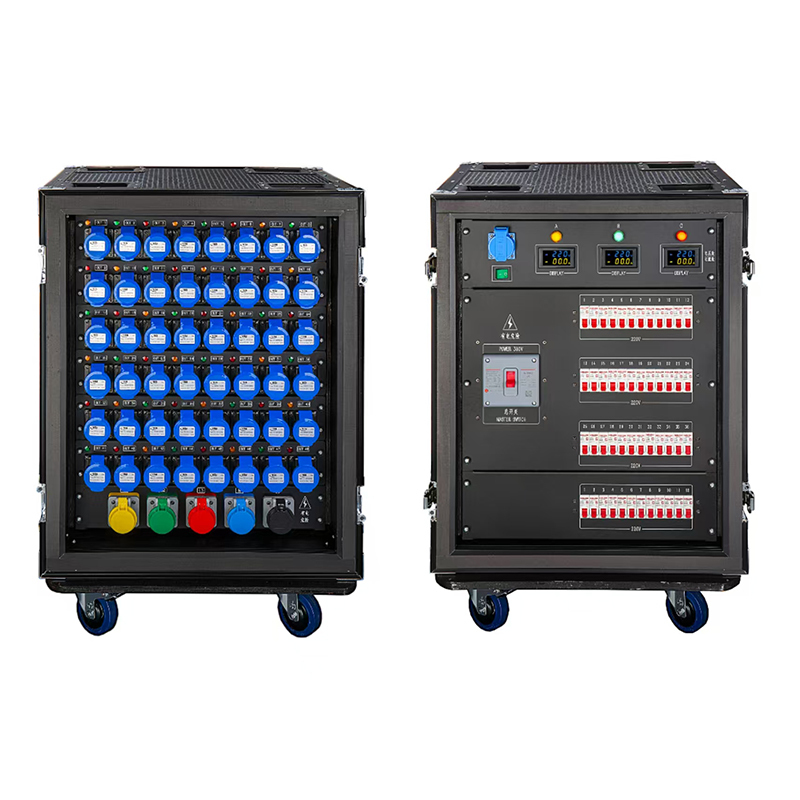
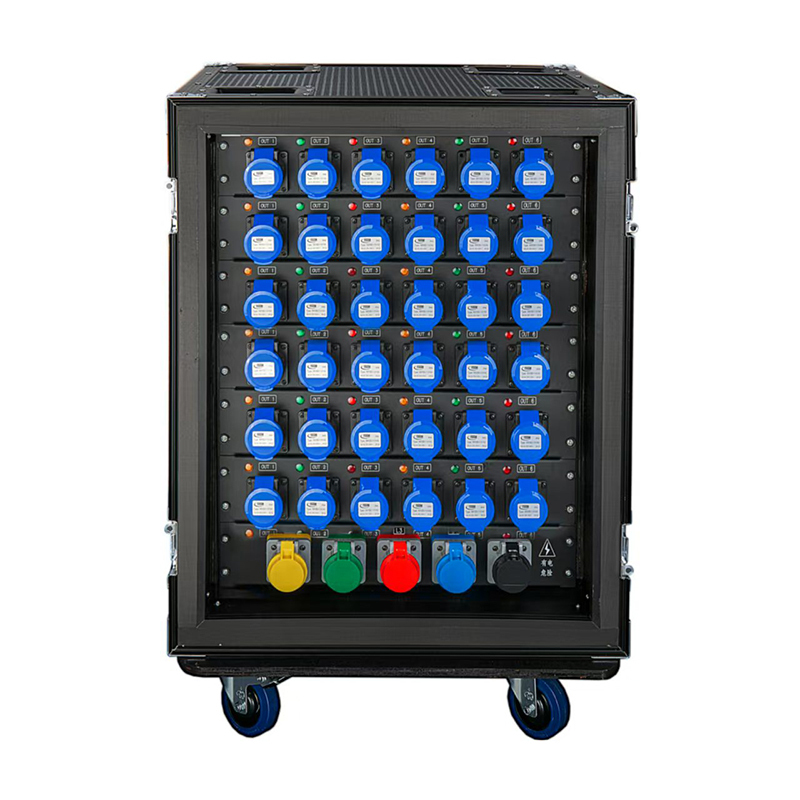
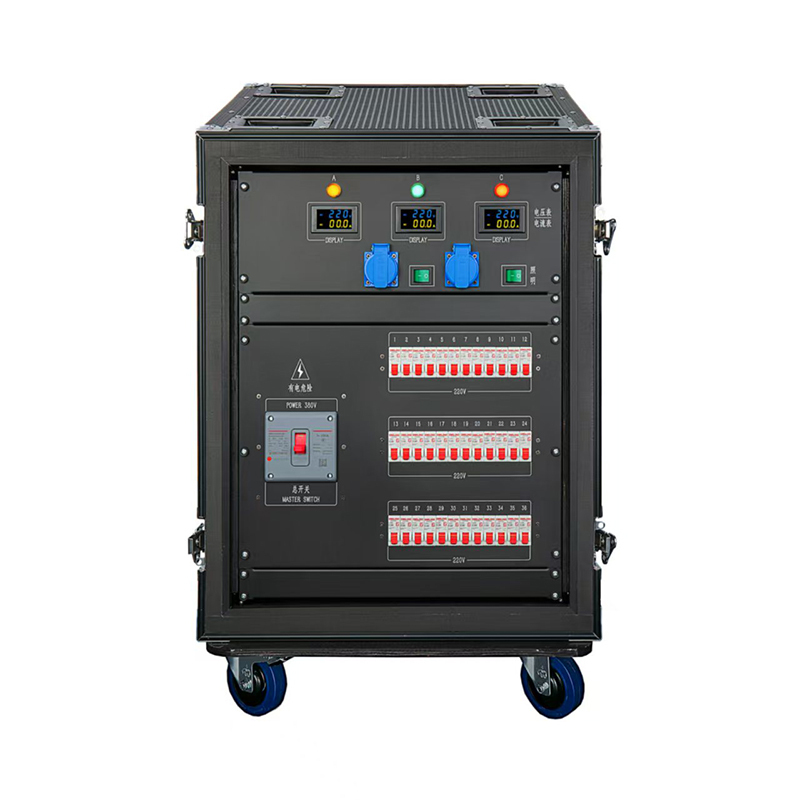
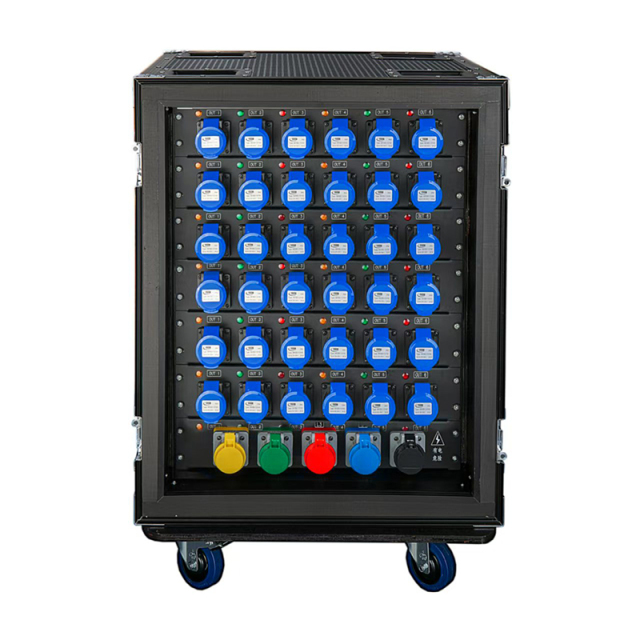
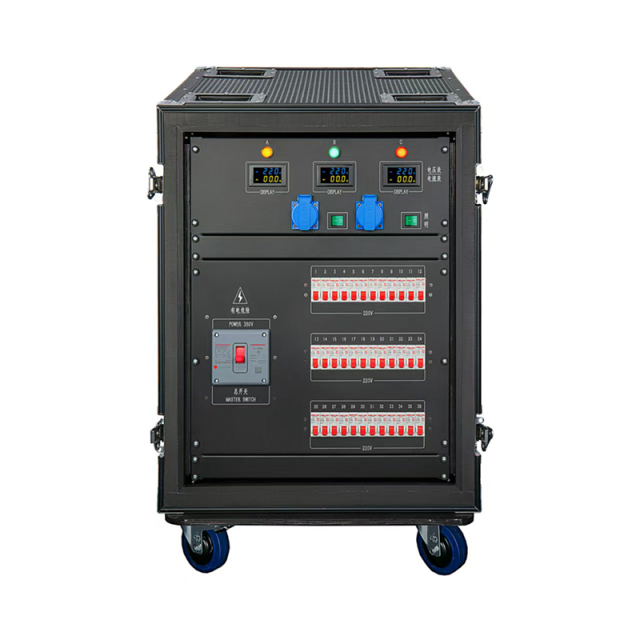
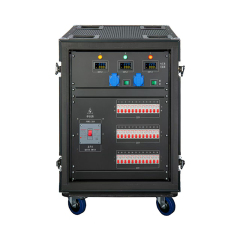
For electrical crews organizing stage lighting circuits, the 14U DB Power Box brings a three-phase five-wire supply, a 250A main air breaker and 48-way 16A waterproof outputs into a 14U standard cabinet. Independent C20A branch air breakers provide overload and short-circuit protection, while separate A.B.C LCD current and voltage displays let operators compare phase readings without switching display modes. Individual output indicators help technicians trace circuits against outlet labels and the circuit schedule, and a blue LED work light provides local task illumination at the cabinet. Load planning must account for the complete assembly, upstream supply and installation conditions, with each outgoing connection kept within the lowest applicable rating of its outlet, plug, cable and connected equipment.
Power Distribution
An expanding stage lighting system needs a coordinated load plan from the incoming feeder to the outgoing circuits. This cabinet brings those connections together so the electrical crew can organize the rig around a documented circuit schedule.
The input connector, main breaker, branch breakers and outlets each have a different job. A connector marking describes that connection; the main protective device governs a different part of the electrical path. Usable loading depends on the complete assembly, upstream supply and installation conditions.
professional stage lighting equipment can draw changing loads as fixtures start, move and run different programs. Build the electrical schedule around manufacturers’ input-current and inrush information, including equipment that may operate simultaneously. Lamp or LED-source wattage alone does not describe the full electrical demand.
At each outgoing connection, loading must respect the lowest applicable limit of the outlet, plug, cable and connected equipment. A branch-breaker marking does not increase the permissible current of a lower-rated component. Adding together the outlet ratings does not establish an allowable total load for the cabinet.
For stage lighting suppliers supporting a larger rig, the phase schedule is as useful as the fixture list. Allocate circuits against the actual phase assignments and anticipated operating loads; equal fixture counts do not necessarily produce balanced phase currents.
Your stage lighting equipment supplier needs the complete electrical schedule when discussing a cabinet for an installation. Include ancillary loads sharing the feed, the upstream protective arrangement and the expected operating pattern so the electrical designer can establish the permissible configuration.
Specifications
| Property | Value |
|---|
| Supply topology | Three-phase five-wire |
| Power supply | AC380±10% |
| Frequency | 50Hz/60Hz±5% |
| Input connector | Self-locking staggered zero-fire 400A rhino plug |
| Outputs | 48-way 16A waterproof output |
| Cabinet | 14U standard cabinet |
| Body construction | Double-layer shockproof hexagonal pattern plate |
| Main protection | 250A main air breaker |
| Independent branch protection | C20A air breakers |
| Protection functions | Overload and short circuit dual protection |
| Product size (mm) | L670×W600×H880 |
| Ambient temperature | 0-±45C |
| Relative humidity | 40%-80% |
Monitoring & Controls
Monitoring & Controls
Independent A.B.C LCD current and voltage displays provide direct readings for the individual phases, giving the operator a clear view of the incoming electrical conditions. Real-time readings remain visible without switching between display modes. During operation of a lighting system on stage, this makes it easier to compare phase behavior as different groups of equipment are brought into use. Each output has its own indicator light, helping technicians trace the circuit serving particular lighting fixtures on stage against the outlet labels and circuit schedule. A blue LED work light provides local task illumination at the cabinet during lighting work on a concert stage. Keep the panel area accessible so labels and operating controls remain easy to inspect. Red breaker switches and green rocker switches make the control groups visually distinct. Use the marked function of each control when operating the cabinet; color alone does not establish its electrical function. For theatrical lighting, recording voltage and current at repeatable points in rehearsal can help the crew investigate a change in operating behavior. Record the active cue or equipment group with the readings so comparisons have a useful context.
Installation & Wiring
- A venue supply assessment comes before connection. Have a qualified electrician check the site supply, earthing arrangement, upstream protection and feeder suitability; resolve assembly-specific questions with your stage lighting equipment supplier before energizing the cabinet.
- For portable stage lighting work, position the cabinet on a firm, level surface and secure it against unintended movement. Leave room for connected plugs, cable bends and access to the main controls. Obtain an approved mounting method and load rating before considering any suspended installation.
- Identify every connection from the wiring diagram and terminal markings with the supply isolated. The color-coded bottom connectors provide visual identification, but phase, neutral and protective-earth assignments must follow verified documentation. Check the exact mating connector and locking arrangement rather than relying on the connector name alone.
- In theatrical stage lighting installations, route feeders and outgoing cables away from scenery movement, access routes and areas where cables may be crushed or pulled. Support cable weight so it does not strain sockets or terminals, and retain access for emergency isolation.
- For damp, hot or cold locations, obtain a clear operating-temperature range and any condensation restrictions before deployment. The waterproof-output description does not establish a whole-cabinet ingress rating; exposed use requires an enclosure rating and installation method appropriate to the location.
- Before connecting the complete stage lighting system, have the electrician complete the required protective-earth, insulation, polarity and protection checks using suitable test equipment. Verify the outgoing-circuit assignments against the electrical schedule.
- Bring circuits into service progressively under the electrician’s commissioning procedure. Compare the resulting behavior with the planned loading, investigate unexpected readings or trips, and leave a verified circuit schedule with the cabinet for the operating crew.
Applications & Compatibility
Lighting for concert stages often places equipment across trusses, floor positions and separate performance areas. Organizing the circuit schedule by physical location helps the electrical crew associate each outgoing feed with the equipment it serves during setup and production changes. Mixed lighting fixtures used on stage require individual electrical checks. Moving heads, PAR lights, blinders and other luminaires may differ in operating voltage, input connector, current demand and permitted power-linking arrangements. Match each connected model to the actual output wiring and its own manufacturer’s instructions; a shared lighting category does not establish compatibility. Lighting installations for theatrical stages may divide equipment between overhead positions, side lighting and practical lights within scenery. A location-based schedule keeps these groups identifiable while allowing the venue electrician to account for the particular demands of each connected device. TV studios and fixed entertainment venues may combine professional lighting equipment for stages with other electrical services. Keep the lighting distribution requirements documented alongside the venue’s broader electrical design, including equipment that needs separate circuits or a different supply arrangement. Rental operators and suppliers of lighting equipment for stages can use a consistent circuit-naming convention across recurring productions. Retain the fixture list, approved connection arrangement and venue-specific changes with each job record so a previous configuration is not assumed to suit a different installation.
Inspection & Care
- Caster-mounted cabinets used for portable stage lighting need a mechanical check after movement. Inspect wheels, fasteners, handles and enclosure fittings, and remove the cabinet from service if damage affects stability or access to electrical parts.
- Covered outlets need intact covers and clean mating surfaces. With the supply isolated, inspect sockets and plugs for cracks, loose parts, damaged contacts or contamination; keep cleaning liquids away from electrical openings.
- Feeder and branch cables need inspection along their full accessible length. Look for cuts, crushed sections, damaged strain relief and pulled terminations, especially where cables pass through doors or around equipment cases.
- Connections serving professional stage lighting equipment need attention if there is unusual heat, discoloration or an electrical smell. Stop using the affected circuit and have a qualified electrician investigate the connection and connected load before returning it to service.
- After concert stage lighting operation, investigate any protective-device trip before resetting. Repeated resetting can conceal a persistent overload, damaged cable or faulty appliance; record which circuit and equipment were involved.
- Internal maintenance belongs to qualified electrical personnel working under an isolation procedure. Use replacement components with ratings and characteristics approved for the assembly, and repeat the appropriate electrical checks after a repair or modification.
Technical Data & Downloads
Technical Data & Downloads
The cabinet identification and drawing revision should accompany any technical-document request to your equipment supplier. Ask about the current availability of the specification sheet, operating manual and dimension drawing before planning around a particular file. For portable installations of this product, review the assembly drawing for its stated handling, role and connection requirements. Use the applicable document revision when preparing the site instructions. Review the circuit diagram and output schedule for terminal assignments, phase allocation and the installed protective devices. Keep an approved copy accessible to the electrician responsible for the installation. Check the operating manual for switching procedures, inspection requirements and fault isolation. Obtain the DMX channel tables and photometric files for the connected fixtures separately, using the exact fixture models and control versions involved. Suppliers of this product supporting an overseas installation should establish the destination market’s requirements with the responsible electrical professional. Request applicable declarations and test documentation covering the assembled cabinet and its installed configuration; acceptance depends on the requirements of the particular project.
Fixture Control & Dimming
- Plan power distribution and show control separately. The 14U DB supplies mains power; connecting a light does not add remote control, dimming or programmable effects to that fixture.
- Electrical outputs and control channels serve different purposes. An outlet feeds connected equipment, while a control channel carries an instruction for a fixture function. Assigning lights to separate power circuits does not give them separate console control.
- Build the control connections around the lights’ supported inputs. For a DMX installation, connect the console and fixtures through the appropriate data connections; the cabinet’s mains outlets do not replace that signal path.
- Choose any data splitter, network interface or protocol converter to suit the console, fixtures and control layout. Include these devices separately in your stage lighting system plan rather than assuming power distribution provides their functions.
- Check how each fixture selects its operating mode. Console control, automatic programs, sound activation and master-slave operation depend on the individual light; supplying power does not select or synchronize those modes.
- Keep cue groups distinct from power-circuit groups. Lights sharing an electrical circuit can perform different cues when their control configuration supports it, so prepare the control patch alongside the electrical schedule.
Technical Support & Model Matching
LITEVISION brings together more than 30 engineers who have worked in the industry for an average of 15+ years. Share your purchasing requirements and the models you are considering to discuss the available options with our team. We provide product maintenance and technical support, with customer service staff available to answer your questions and help address issues. Whether you are comparing options before ordering or need assistance after purchase, contact us with your technical questions and maintenance concerns.
FAQ
Does the cabinet make connected lights dimmable?
No. The cabinet does not make connected lights dimmable; brightness adjustment depends on the fixture and its control electronics. For an LED fixture, check whether the manufacturer specifies an electronic dimming function and which control methods it accepts.
For console operation, a fixture that supports DMX dimming needs the appropriate control connection, address and channel mode. The console’s fixture profile must match that mode so its intensity control operates the intended function.
A conventional lamp fixture may require a separate, compatible dimmer. Check the lamp type and manufacturer’s instructions before selecting one, and do not assume that an LED fixture can accept a dimmed mains supply.
Switching electrical power off produces a shutdown, not a programmed fade. For cues that need a gradual transition, use the fixture’s supported intensity control; some fixtures also need time to restart after power is restored.
For theatrical stage lighting, assess how the chosen fixture behaves near blackout. Smooth fades, the lowest usable brightness and any visible stepping depend on the fixture’s dimming performance, so test representative cues before committing to a production setup.
For filmed performances, check the fixture’s available dimming settings with the intended camera settings. Flicker performance can vary with brightness and recording conditions; connecting the light to this cabinet does not change that behavior.
Does the 400A input connector mean the cabinet can supply a 400A total load?
The cabinet has a 400A input connector and a 250A main air breaker; these ratings describe different parts of the electrical path. Usable loading depends on the complete assembly, upstream supply and installation conditions. Adding together the outlet ratings does not establish an allowable cabinet load. Plan around manufacturers’ input-current and inrush information, including equipment expected to operate simultaneously.
What output connections and branch protection does this cabinet provide?
The cabinet provides 48-way 16A waterproof outputs with independent C20A branch air breakers for overload and short-circuit protection. The branch-breaker marking does not increase the permissible current of a lower-rated component. Each outgoing connection must remain within the lowest applicable rating of its outlet, plug, cable and connected equipment, so check the complete connection path when planning fixture circuits.
Can operators view all three phase readings without changing display modes?
Independent A.B.C LCD current and voltage displays show individual phase readings without switching display modes. This lets operators compare phase behavior as different equipment groups are brought into use. Each output also has its own indicator light to help technicians trace circuits against outlet labels and the circuit schedule, while a blue LED work light provides local task illumination at the cabinet.
What cabinet size and construction should we allow for in our installation plan?
The unit uses a 14U standard cabinet measuring L670 × W600 × H880 mm, with double-layer shockproof hexagonal pattern plate construction. These are the stated cabinet format, dimensions and body construction for installation planning. The panel area should remain accessible for reading labels and operating the cabinet, and the blue LED work light provides local task illumination during lighting work.