One Ethernet Feed, Eight Isolated DMX Runs
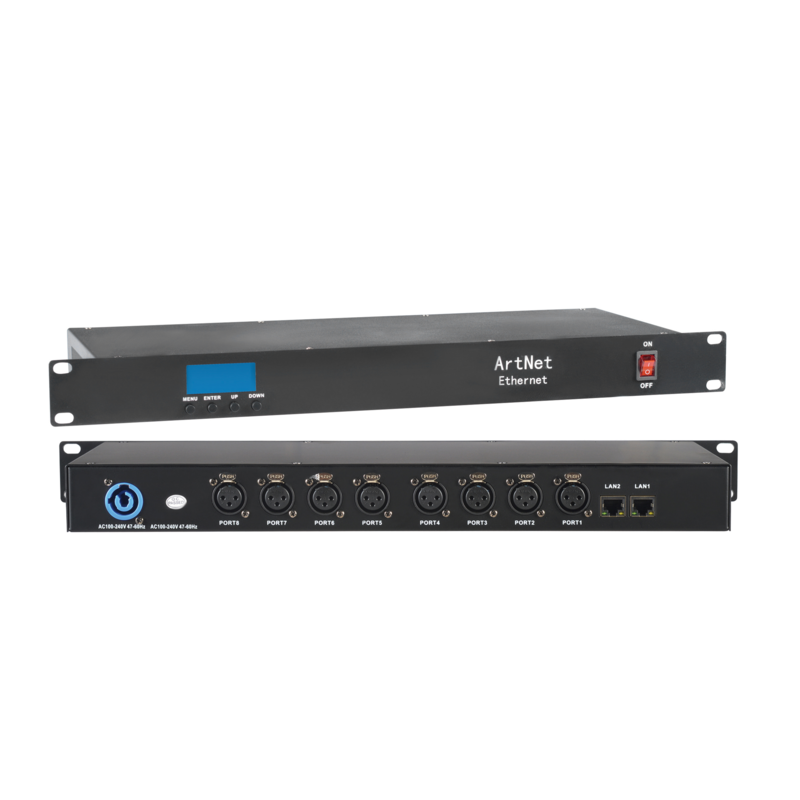
The ArtNet-8 8 ways DMX & 2 ways ArtNet splitter signal splitter sits where a show's Ethernet backbone turns into DMX cable. ArtNet over TCP/IP arrives on the network side and leaves again as eight DMX512 ports, each one a line of its own, so a single network run can reach fixtures across a venue instead of dragging one long chain back to the desk. Conversion runs both ways. A conventional DMX512 stream can be wrapped back onto the network, which is how a desk with only DMX outputs joins a rig that has already moved to Ethernet — and how one DMX lighting control system serves the whole room instead of eight unrelated lines.
Isolation, Grounding and Mains Handling
- Every output stands on its own. Each of the eight channels is independently photoelectrically isolated, so a shorted cable, a wet connector or a failed fixture stays on its own line. That is the figure to quote when a consultant asks how the branches are separated from one another and from the incoming signal.
- Ground loops lose their route. Trusses, racks and the stage floor are often fed from different points, so earth potential drifts between them; an isolated output breaks that path before it turns into hum, flicker or a fixture dropping out mid-show.
- One supply for the tour. The wide mains range means the same rack unit runs on 120V and on 230V without a tap change or a step-down transformer.
- Signal leaves through NEUTRIK sockets.
- Settings stay reachable. Parameters are set on the LCD keys or over the network, so a change during a fit-up does not need a laptop balanced on a dimmer rack.
Rack Position, Cabling and Commissioning
- Choose the position first.
- Check the supply before it is energised.
- Bring the network in.
- ArtNet arrives on the network side of the unit; where the DMX 512 controller feeds a whole building, the long haul stays Ethernet and the split happens at the far end.
- Patch the eight DMX ports against your universe plan and write the group on each cable end — truss position, fixture type or both.
- Set the mapping from the front panel or over the network: which ArtNet way feeds which DMX output, plus any address options the rig needs.
- Commission one branch at a time. RDM lets the desk confirm which fixture answered on which line, so a wrong address shows up before doors rather than during the first cue. Update the firmware last, over the network, so the unit is on the current version before the show file is locked.
- Keep it indoors. This is a rack unit for protected positions; on an outdoor stage or in a damp plant room it needs an enclosure that keeps rain and condensation off it, so talk to us before the rack is built.
Stages, Studios and Fixed Installs
- Touring and festival racks. The node travels with the dimmers and takes the network down to eight separate branches; when the stage is re-shaped, the port assignment is re-drawn with it.
- Theatre, school halls and auditoria. The truss goes up once, and addresses are changed from the desk over RDM for years afterwards rather than on a ladder.
- Television studios and broadcast floors. Fewer cables across the floor and nobody crawling behind a rack in the middle of a record day.
- Clubs, bars and live rooms. A DMX controller for moving heads, a few LED bars and an effects unit can sit on separate branches, so the room keeps its light when one line goes down.
- Rigs built around DMX LED stage lighting. Splitting by truss position rather than by fixture type keeps every cable route short and every line well inside its load.
- Where there is no rack. A floor package or a one-day event is better served by the portable MINI ArtNet-8, which carries the same eight DMX ports in a 1.25 kg body with PowerCON input; this unit is the rack version of that job.
ArtNet-8 Technical Data
| Specification | ArtNet-8 |
|---|
| Model | ArtNet-8 |
| Network signal | ArtNet over TCP/IP |
| ArtNet ways | 2 |
| DMX channels | 8-way DMX512, output and input |
| Port isolation | Independent photoelectric isolation on every output; isolated supply 2000V DC |
| RDM | Supported |
| Processor | ARM Cortex-M4F |
| DMX connectors | NEUTRIK three-core XLR (five-core optional) |
| Working voltage | AC 100V~240V, 47/60Hz |
| Front panel | LCD display with MENU / ENTER / UP / DOWN keys and power switch |
| Parameter setting | Front panel keys or over the network |
| Firmware upgrade | Over the network |
| Mounting | 19-inch rack |
| Net weight | 3 kg |
Ordering, Warranty and Delivery
- Quantity, minimum order quantity and the volume breaks for your order are confirmed in writing with the quote, together with the payment and trade terms that apply in your market. Production and delivery are scheduled against your order date. As a DMX lighting controller supplier we confirm the slot in writing, and it moves with configuration and season — ask early when an opening night is already fixed.
- Warranty length and scope are set per order.
- Ask for the current policy with the quote and check it against your own contract before the units ship, then record the serial number and firmware version in the rack file.
- Returns and quality claims are handled against the port number, the symptom and the firmware version; we work through the fault with you and agree whether the unit is repaired or replaced.
- Compliance paperwork is issued for the destination market.
- As a DMX lighting controller manufacturer we confirm which declarations and test reports can be supplied once we know where the unit will be installed.
- Packing and freight are agreed per shipment, so settle the carton or crate arrangement with your forwarder before the units leave.
| Document | What it covers |
|---|
| Specification sheet | Electrical and mechanical data for tender and submittal packages |
| User manual | Front-panel menus, network settings and port mapping |
| Port and universe chart | Which ArtNet way feeds which DMX output in a given configuration |
| Firmware release notes | Current version and what each release changes |
| Rack and panel drawing | Front-panel layout, connector positions and rack dimensions |
| Compliance documents | The declarations and test reports your destination market requires — tell us where the unit will be installed and we confirm what can be issued |
| Submittal set | The documents above, assembled for specifiers and project files |
Technical Support & Model Matching
More than 30 engineers with an average of 15+ years in professional lighting stand behind every order — the same people who answer your technical questions. Tell us your venue, rigging height, throw distance and existing control setup; we help match models, check protocol and channel fit, and build a package that works as one system. If a fixture misbehaves on site, we work through the fault with you and sort out spares. Installation and commissioning guidance come with the order. Founded in 2016, exporting since 2022, LITEVISION serves buyers in more than 80 countries from offices in the USA, Taiwan, Mexico and China.
FAQ
Does it convert in both directions?
Yes. The ArtNet-8 8 ways DMX & 2 ways ArtNet splitter signal splitter takes ArtNet over TCP/IP down to eight DMX512 outputs, and it also converts a conventional DMX512 signal back into an ArtNet network signal. That second direction is what lets an older DMX 512 controller work inside an Ethernet-based rig without being replaced.
How many DMX lines does one unit give me?
Eight DMX512 ports, each a separate line, with two ArtNet ways on the network side. That is enough to keep a DMX controller for moving heads on one branch and wash or effect fixtures on another instead of sharing a single chain. If your network layout is unusual, send the plan and we will check it before the racks are wired.
What does the 2000V DC figure refer to?
It is the rating of the isolated power supply behind the output isolation. Every one of the eight outputs is independently photoelectrically isolated, so a damaged cable or a failed fixture on one line does not pull the others down, and ground loops between racks, trusses and the stage floor are broken before they reach the fixtures.
What can RDM do for the crew?
RDM is supported, so an RDM-capable desk can read and change fixture addresses over the network instead of at the fixture — on a rig hung above the stage, that is the difference between a five-minute change and a ladder call. The console has to support RDM as well; tell us the model and software version you run and we will go through the setup with you.
Which consoles is it built around?
Consoles that output ArtNet over TCP/IP, including Pearl Expert, Tiger Touch, MA and Hog. Send the console model and software version with your enquiry and we will check the ArtNet side before the racks are wired.
Are the DMX sockets three-pin or five-pin?
The standard build uses the original Swiss NEUTRIK three-core XLR socket, and a five-core socket is available as an option. The socket is fixed at build, so state the choice when the order is placed.
Can settings and firmware be updated while it is in the rack?
Yes. System parameters are set from the front-panel LCD keys or over the network, and the firmware is upgraded over the network as well, so a unit already installed does not have to come out of the rack to reach a new version.
Can it sit on an outdoor stage or in a damp plant room?
It is a rack unit, built for protected positions such as dimmer rooms, control racks and indoor stages. For an outdoor stage or a damp room it needs an enclosure that keeps rain and condensation off it; tell us where it will be installed and we will confirm what the position needs.