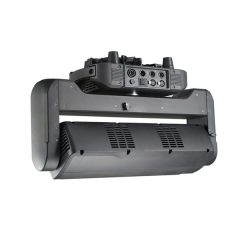
Product Overview
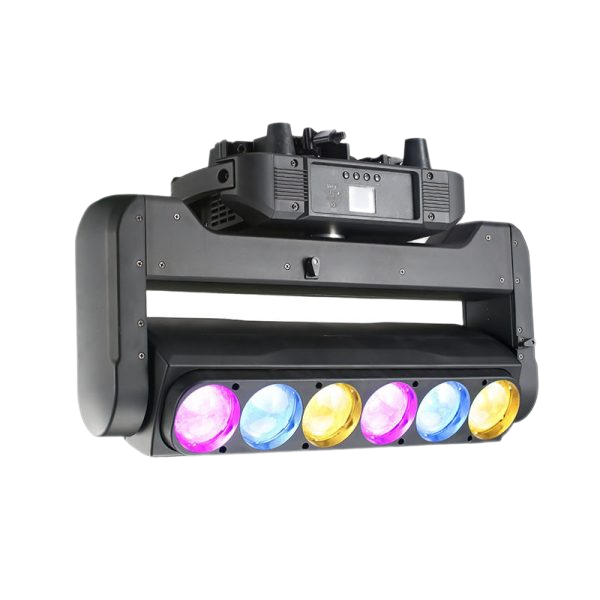
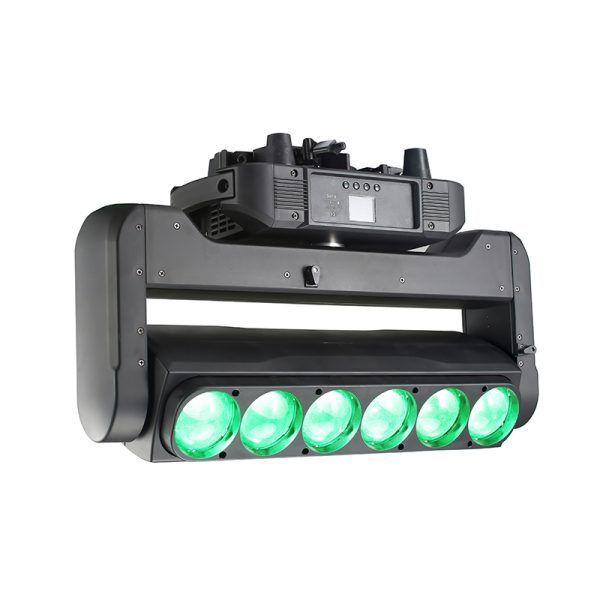
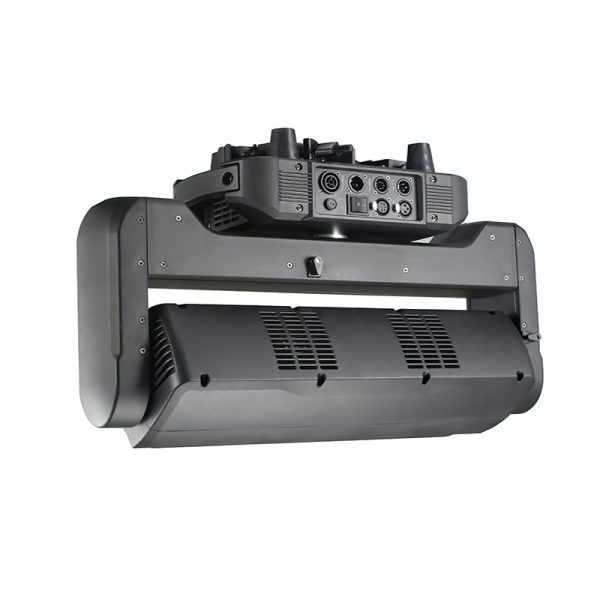
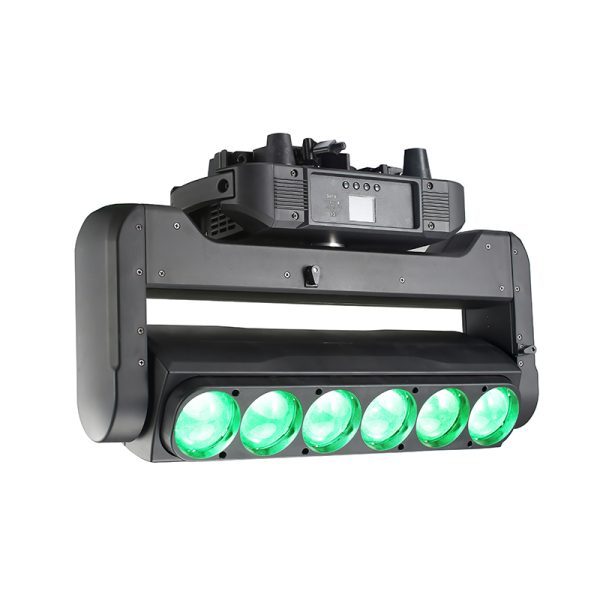
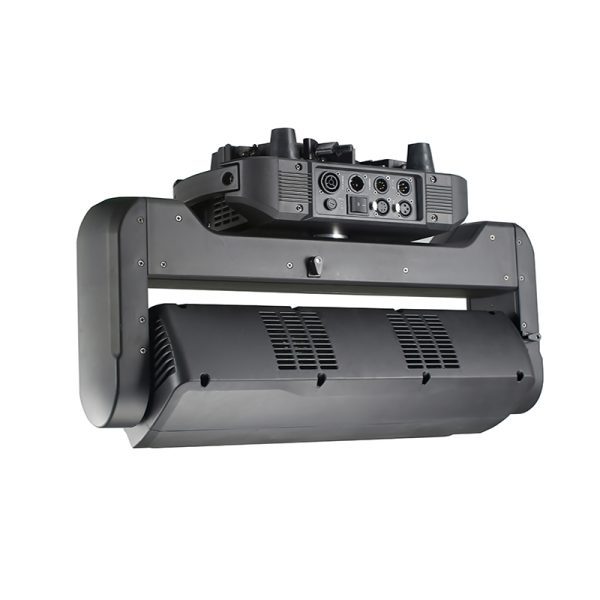
The Bar M0660Z is a bar-shaped LED moving head light built around six 60 W RGBW 4-in-1 lenses. Each lens is a complete colour engine with its own red, green, blue and white emitters, so the row can fire six separate beams, blend into one broad wash, or run a colour chase from one end to the other. It is meant for rooms where a moving head wash light has to do more than colour a wall: clubs and live houses flying a wide look from a short trim height, band stages, booth positions and rental stock that has to cover several kinds of show. One unit takes the place of a pair of narrow single-lens spots and still leaves you the option of working lens by lens. Because each lens answers to its own channels, patterns are built along the bar rather than thrown from a single point — in practice it behaves like a DMX moving head light with six lenses and one yoke. The housing is matte black, with a rotating yoke and a recessed lens bar at the front; the connector panel and the ventilation sit at the rear, so units can hang shoulder to shoulder without blocking each other.
Beam, Wash and Zoom Optics
- Zoom from 3° to 45°. At the tight end the six lenses throw narrow, parallel columns that read as aerial beams through haze; opened fully, the same fixture spreads across a backdrop, a set wall or a band.
- Six independent colour engines. Each 60 W lens mixes its own red, green, blue and white, so the bar can hold one blended colour, six different ones, or a gradient that walks from lens to lens.
- Pixel effects along the row. Because every lens is addressed separately on the DMX moving head light, chases, sweeps and stepped patterns travel down the bar instead of across the room — the effect rental clients ask for first.
- A moving head beam light for the aerial numbers, and a wash for everything else. Rather than hanging a beam fixture plus a separate colour bar, one moving head stage light covers both looks, which is how it earns its place on a small stage.
- Long throws without a bigger fixture. Closed down, the six lenses still carry a narrow column to the back of a deep room, so a club with a long floor does not have to move up a class of fixture to fill it.
- Used as an led bar light for a set wall, it is happiest hung close and opened wide, where the row gives an even, unbroken field of colour instead of six separate pools of light.
Pan, Tilt and Thermal Control
Pan and tilt both run a full 360° with infinite rotation on this DMX moving head light, so the head keeps turning the same way instead of stopping at a limit and swinging back. On a bar fixture that is the difference between a sweep that dies at the edge of the room and one that keeps travelling across it.
That continuous travel is what makes the fixture useful as a moving head stage light rather than a static bar: the whole row can be re-aimed at a new part of the stage in a single cue, and it can rotate right through a build or a breakdown without a visible reset.
High-precision three-phase stepper motors drive the head — quick to accelerate, smooth at slow speeds, and quiet enough to sit above an acoustic number or a spoken-word cue without drawing attention.
LED temperature protection on the moving head wash light watches the head and brings the fan up only as the temperature climbs, so the unit stays quiet during the parts of a show that need silence and works the fan harder only when the rig is genuinely hot.
Control, Channel Modes and Setup
- Set the start address on the 1.8-inch TFT display. It swivels through 180°, so you can read and change it from the floor whether the fixture is flown upright or upside down. Pick the channel mode. The fixture runs 25 or 45 channels — the compact layout keeps a long fixture list manageable on a small desk, the extended one hands more control of individual lenses and movement to the console. Load the matching profile before you patch. Run the data. Decide what happens without a console. Auto run and music modes are there for installs and one-off positions where no data line reaches; the fixture works on its own until it is patched into the rig. Record the show. With each lens on its own channels, the led bar light's chases and sweeps can be stored as cues and recalled for the next date, which is where the fixture earns its keep on a touring rig.
Applications and Venue Fit
- Nightclubs and bars — flown low over a dancefloor, the row works as a moving head wash light across the floor and as six separate beams into the room, so one bar covers a whole ceiling without a second truss.
- Live bands and touring packages — a moving head beam light on the back truss carries the aerial looks for the loud numbers, and the same unit opens to a wide wash for the quiet ones.
- Booth positions and small stages — one unit overhead gives six moving beams, colour chases and a wash for the crowd, which means less to carry in and less to rig.
- Rental stock — an LED moving head light that covers two jobs is easier to substitute when a client's brief changes between beams and wash.
- Rental fleets and dry hire — keeping the inventory on one model from a single moving head light factory means one channel layout, one profile and one spares list across the fleet.
- Theatre, school halls and multipurpose rooms — as a moving head stage light for a small rep plot, it covers a stage wash and a special from one hanging position.
- Backdrops and set washing — used as an led bar light, the row colours a set wall or backdrop evenly from a short distance instead of spotting it with six separate circles.
Specifications
| Model | Bar M0660Z |
|---|
| Light source | 6 × 60 W RGBW 4-in-1 LED |
| Power consumption | 450 W |
| Input voltage | AC 100-240 V, 50/60 Hz |
| Zoom range | 3°-45° |
| Dimming | 0-100% smooth dimming |
| Colour system | RGBW 4-in-1 with LED pixel effects |
| Pan / tilt | 360° infinite rotation |
| DMX channels | 25 / 45 channels |
| Control modes | DMX512, auto run, music |
| Data in / out | 3-pin and 5-pin XLR sockets |
| Protection rating | IP20 |
| Dimensions | 640 × 210 × 400 mm |
| Net weight | 17.5 kg |
Ordering and Delivery
- Start with the layout: how many positions you need to fill, the trim height, and whether the rig is flown or standing on the floor. That decides the unit count and whether flight cases are worth adding.
- Confirm the packing. Two units travel in a flight case measuring 70 × 62.5 × 59.5 cm at 64.5 kg gross, and a single fixture ships at 19.5 kg gross. Tell your sales contact which configuration suits your freight.
- Confirm the terms for your order — current lead time, the minimum quantity that applies, batch pricing, and the payment and trade terms for your destination. As a moving head light supplier we quote these per order rather than publishing fixed figures.
- Ask which warranty cover comes with your order and what it includes, and how a quality claim should be raised if a unit arrives with a problem.
- Tell us the destination market so we can confirm which compliance documents can travel with the shipment.
- Ask for the channel chart, photometric file and manual in the version that matches your build, so the console is patched before the cases open.
- Place the order against a written specification — model, channel mode, quantity, packing and documents — so what arrives matches what was quoted.
- Every unit is built and tested in our moving head light factory before it is packed, and quoted against its destination; we would rather confirm a detail twice than ship a fixture that does not fit the rig.
- Specification sheet | Light source, power, zoom, control and weight for this fixture DMX channel chart | Channel assignment tables for the 25 and 45 channel modes User manual | Addressing, display menu, control modes and operating notes Photometric data | Beam angle and throw information for planning positions Flight case layout | Case dimensions and the two-unit packing arrangement Rigging notes | Yoke mounting and secondary attachment points Quick-start guide | Power, addressing and a first run in auto mode
Technical Support & Model Matching
More than 30 engineers with an average of 15+ years in professional lighting stand behind every order — the same people who answer your technical questions. Tell us your venue, rigging height, throw distance and existing control setup; we help match models, check protocol and channel fit, and build a package that works as one system. If a fixture misbehaves on site, we work through the fault with you and sort out spares. Installation and commissioning guidance come with the order. Founded in 2016, exporting since 2022, LITEVISION serves buyers in more than 80 countries from offices in the USA, Taiwan, Mexico and China.
FAQ
Can this fixture be used outdoors or in a damp room?
No — it is rated IP20, which means indoor, dry use. Rain, hose-down and heavy condensation sit outside what the housing is built for. If a show moves outside or into a humid space, ask us about the IP-rated models in the range instead of putting this one at risk.
When should I run it in 16-bit rather than 8-bit?
8-bit is enough for fast cues, colour changes and anything the audience sees in motion. Switch to 16-bit when the fixture has to move slowly — a long travel across a stage, a slow tilt on camera — because the extra resolution stops those moves from stepping. Both are available, so the choice is made per cue rather than per fixture.
How many units fit on one DMX line?
A universe carries 512 channels. At the extended 45-channel setting that works out at eleven fixtures per universe; at the compact 25-channel setting, twenty. Keep each physical line within the usual 32-device limit and split the run when the rig grows, so one faulty cable cannot take the whole chain down.
How much clearance does it need around the head?
The fan draws air through the rear panel, so leave the vents clear of truss, cable bundles and the fixture directly behind. Above and below, the bar needs room to swing through its full travel without striking a boom arm or a neighbouring yoke. Check the position at both extremes before you finalise the rig.
What happens if one unit is set to a different channel mode from the rest?
Its cues land on the wrong channels, so that one fixture misbehaves while the rest of the rig looks correct — the classic symptom is a unit that answers colour commands with movement. Keep every fixture on the same mode and the same address spacing, and write the mode into the show file so a spare can be brought into line quickly.