Product Overview
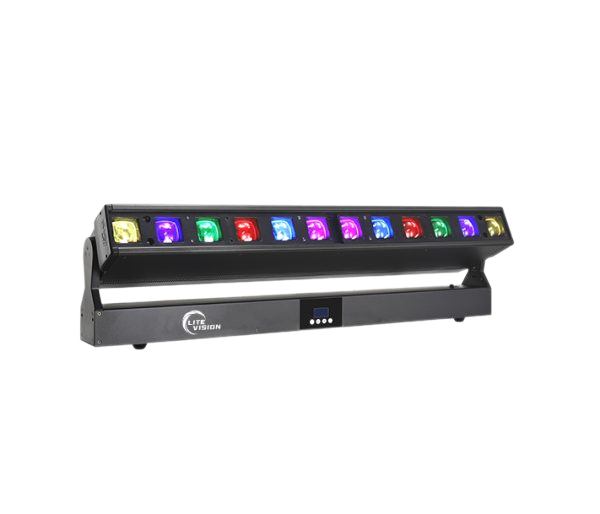
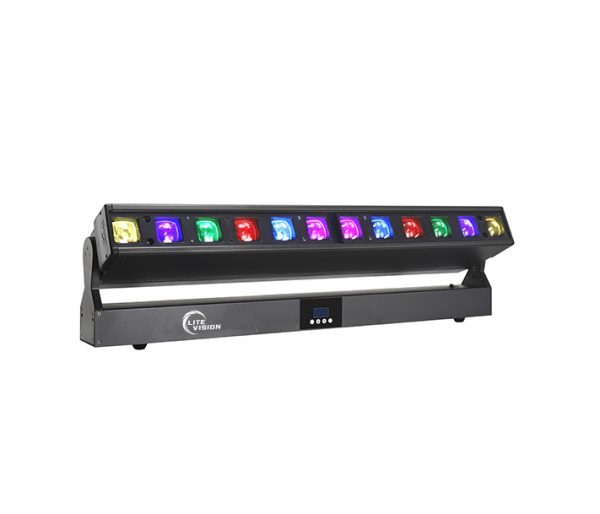
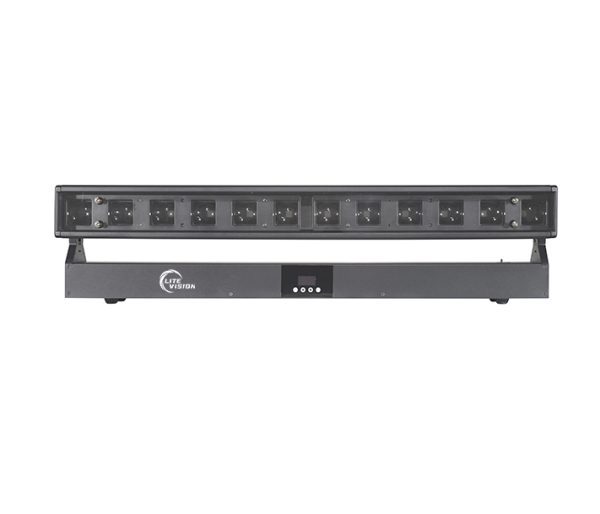
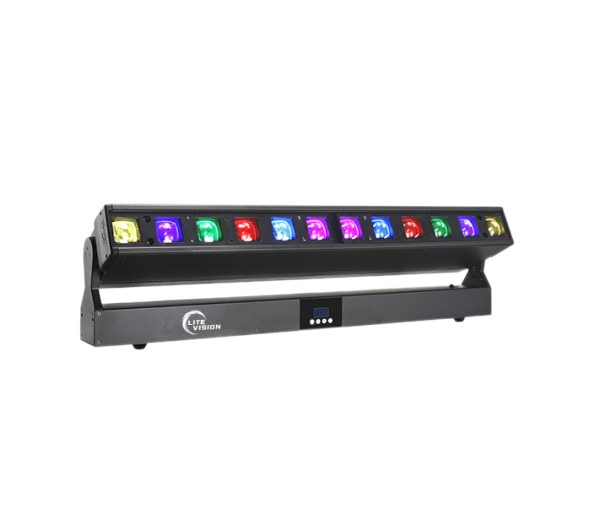
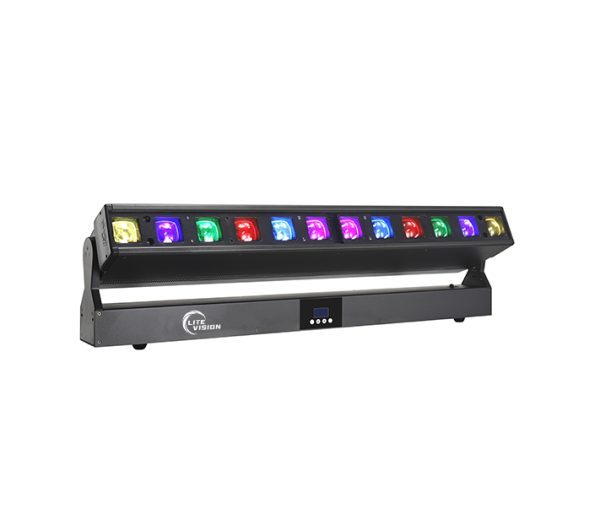
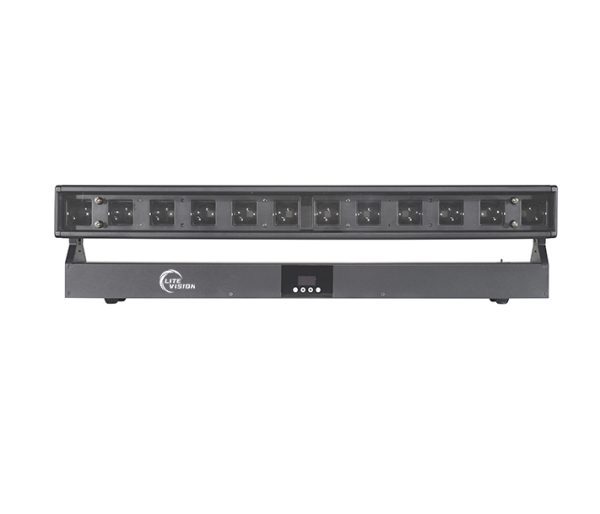
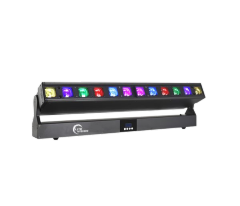
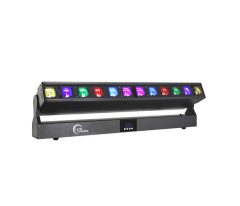
The Bar M1240Z is a linear LED wash light for the positions where a moving head will not go. Twelve 40 W RGBW four-in-one OSRAM emitters run along the body, each one addressed separately, so the fixture can hold a flat wash across a cyclorama and then break that wash into blocks, chases and shapes without a second unit joining in. There is no pan motor. The bar works on a single tilt axis, which keeps the housing shallow enough to sit on a riser, slide into a shelf behind a set piece, or hang tight beneath a low truss where a full moving head would foul the scenery.
Used that way it is a moving wash light that paints surfaces rather than a head that throws a circle across them, and that is the whole point of the shape. Twelve emitters in one housing also mean fewer hanging points, fewer power drops and less cable in the air than the same wall coverage built from individual wash heads. Rental companies like it because it trims as one piece and focuses quickly; designers like it because a wall lit by one bar changes as a single surface rather than twelve overlapping circles.
We build and supply the fixture as a moving head wash light supplier to distributors, rental fleets and venue integrators, and it leaves us with the channel and control information a crew needs on the first day rather than the second week.
Key Features
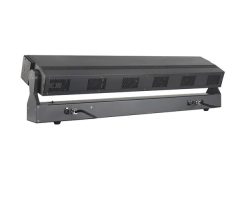
- A tilt-only body — with no pan axis the RGBW LED bar's housing stays flat, so it slips into low gaps above a set, under a truss or along the back edge of a stage, and still sweeps a full wall from a shallow angle.
- Zoom that covers beam and wash — the same bar throws a narrow shaft for mid-air work and opens into a wide, even surface wash, so a small stage does not need separate beam and wash bars to cover both jobs.
- Colour temperature on the console — dial from warm tungsten to cool daylight so the bar sits inside a theatre plot one night and a daylight studio look the next, without gels or a second fixture type.
- Built-in macros for fast looks — ready-made colour and movement sequences straight from the menu, which is what keeps a DMX bar light useful in clubs, bars and event rooms where nobody is programming a desk.
- Bars that lock into one line — two or more led bar lights combine into a continuous strip and the spacing between emitters stays even across the joint, so a chase reads as one surface instead of a row of separate boxes.
- A body one person can handle — the bar lifts and hangs without a second pair of hands, and the dedicated road case groups several moving head wash lights so a fleet moves as packs rather than loose fixtures.
Light Engine & Pixel Mapping
Red, green, blue and white live in the same package, so the colour mixes inside the chip and the bar holds one clean tone along its length instead of drifting from emitter to emitter. Every emitter can be addressed on its own. One section can sit at full white while the next runs deep blue, which is what makes gradient washes, block chases and simple logo or text shapes possible from a single LED pixel bar with no media server in the chain. In the expanded channel mode, colours and shapes can be edited and combined at will, then stored as looks to recall during a show. What remains is electronics, firmware and cleaning, which a venue technician can handle. The emitter choice is also the part of a fixture an LED moving head light supplier cannot fake. A cheaper chip shows up under camera as uneven colour across the strip, and it shows up on a wall as a wash that never quite matches the next bar along.
Control & Documentation
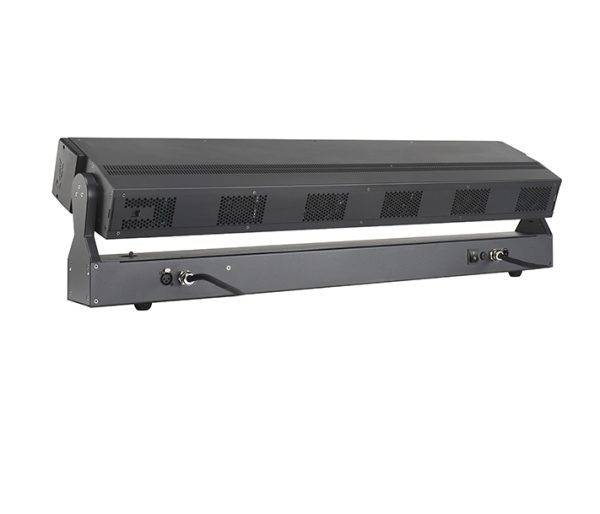
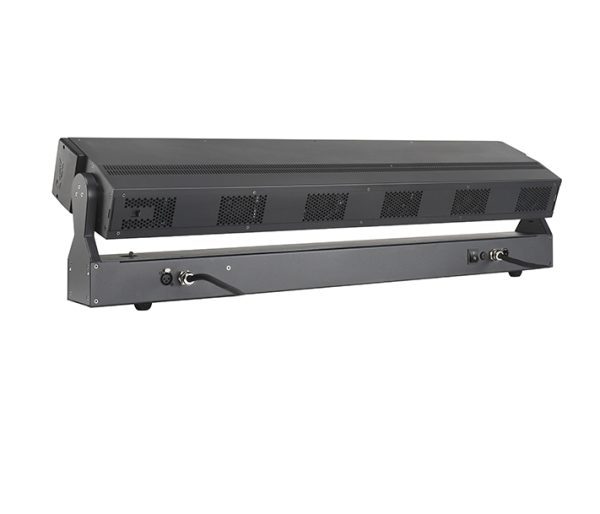
The DMX bar light runs in two channel modes. The standard mode groups it into practical zones for straightforward wall washes, while the expanded mode hands each emitter its own channels for full pixel mapping. DMX512 and RDM are built in, so the fixture reports back to the desk over the same line it takes its data from, and Art-Net, sACN and wireless control are available as options when the rig is networked rather than cabled. Ports follow the same logic: XLR-3 as standard, RJ45 when the network option is fitted. Tell us which combination you need and it is built to that specification.
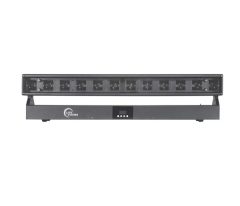
The 1.77 inch colour LCD menu is readable in English or Chinese and flips through 180° when the bar hangs upside down, which matters more than it sounds when you are addressing twelve bars on a vertical wall. Behind the menu, electronic sensors check the fixture on power-up, fan speed is monitored and regulated rather than fixed, and eco mode parks the bar when it is not in use. Tilt role runs on a non-contact magnetic encoder, so there is no wiper or optical disc to drift out of alignment as the fixture ages.
Ask your sales contact for the documentation package before you plot: the manual, the DMX channel table, the specification sheet, photometric data, CAD drawings and a fixture-library profile for your console. This is the material an LED moving head light supplier should hand over as a matter of course, and it is also the material a distributor forwards to an end customer who is signing off the design.
Applications
- Nightclubs and bar rooms — low trim heights leave no room for a moving head wash light, so the bar fixes to the wall behind the booth or above the bar back and washes the surface in colour, with the built-in macros carrying the look when nobody is on a desk.
- Theatre and school stages — specified as a low, close wash on a cyclorama or as colour along the set edge, exactly where a tall moving head would be visible from the auditorium. This is the led bar light a stage technician hangs once and leaves alone for the run.
- TV studios and broadcast sets — set backing and floor colour under camera; the flat strip keeps spill off the talent, and even emitter spacing keeps banding out of the shot when the camera pans across the wall.
- Touring and rental fleets — a bar that trims as one piece and travels in its own case, rebuilt and re-rigged night after night with the same result, which is what makes a moving wash light worth standardising on across a fleet.
- Themed venues, restaurants and attractions — colour on walls, ceilings and scenery in spaces with no dedicated operator, where the menu and preset macros do the work and the fixture is set once per season.
- Corporate and event spaces — an alternative to static uplighters when a wall has to change colour between sessions; a wash moving head light of this shape sits closer to the surface than a head on a stand and stays out of sightlines.
Specifications
| Light source | 12 x 40 W OSRAM RGBW 4-in-1 LED, individually controllable |
| LED expected lifespan | 50,000 hours |
| Zoom range | 3.5°–40° |
| Colour temperature | 2800–8000K, linear control |
| Preset effects | 33 macro effects |
| Tilt | 209°, 16-bit resolution |
| DMX channels | 17Ch standard / 57Ch expanded |
| Control protocols | DMX512, RDM; Art-Net, sACN and wireless optional |
| Control ports | XLR-3; RJ45 optional |
| Input voltage and power | 100–240V, 50–60Hz, 600W, PF ≥ 0.98 |
| Maximum input current | 6 A |
| Fixture size and net weight | 1020 x 318 x 106 mm / 20.5 kg |
| Road case | 1078 x 835 x 583 mm, three positions, 30.2 kg |
| Working temperature and protection | -20 °C to 40 °C / IP20 |
Rigging & Commissioning
- Check the position before anything is flown. The bar is an indoor fixture, so keep it out of weather and away from direct splash, and check the working temperature range in the specification table against the space it will live in — plant rooms and unheated loading areas are the usual surprises.
- Fit the adjustable mounting bracket and set the height. Because this moving wash light only tilts, you are choosing a height and an angle rather than a full hanging position; get the height right and the coverage follows without re-rigging.
- Power the unit. The supply is auto-ranging, so the same bar works on the venue's supply wherever the tour lands. Plan the circuit from the input power and maximum current in the specification table and leave headroom, since a body with twelve emitters draws its full load from the moment it is on.
- Run the data chain. As a DMX bar light, it takes DMX in and out on XLR-3 unless RJ45 ports were specified, daisy-chained bar to bar, with the last unit terminated. Address each fixture before you stack the next one on the line.
- Patch and choose the mode. Set standard or expanded in the menu, patch the matching profile in the console, then confirm each emitter responds in the order you expect — a wrong mode is the most common reason a mapped look comes up scrambled.
- Tilt, focus and check. Sweep the tilt travel, set the zoom for the throw you have, and where two bars abut look along the joint to confirm the emitter spacing lines up. Call one macro and one manual look, then leave the bar in eco mode if it will sit idle for long stretches.
Ordering & Delivery
- Configuration — Art-Net, sACN, wireless and RJ45 ports are fitted per order. Confirm the exact combination before the build is scheduled, because these cannot be added to a finished bar.
- Quantities and pricing — minimum order quantity and volume steps are quoted per order. As a moving head wash light supplier we price bars, cases and data accessories together when they ship as one package, which is usually cheaper than sourcing the case separately.
- Lead time — production and shipping schedules move with the season and with the options chosen. Confirm the current schedule with your sales contact before you publish a load-in date to your own customer.
- Payment and trade terms — payment method, currency and Incoterms are agreed at quotation and stated on the order confirmation.
- Packing and shipping — bars travel in the dedicated road case or in export cartons. Confirm which packing suits your freight, and whether cases ship with every bar or are ordered as a separate line.
- Warranty — the period and what it covers are set per order. Ask for the current terms in writing before you commit, and check whether your market's terms differ from the standard ones.
- Returns and quality claims — report transit damage at delivery and raise any functional fault with your sales contact, who will confirm the return or repair route and what is needed with it.
- Compliance documents — requirements differ by country. Ask which test reports and declarations can be supplied for your market rather than assuming a single certificate covers every destination.
- Spares — confirm the parts your fleet should hold for this led wash light, and how quickly they can be dispatched, before the first unit goes into service.
- Support before and after the order — questions about modes, cases or accessories go to the same LED moving head light supplier team that built the quote, so the answer on a channel table and the answer on a shipping date come from people who can see both.
Technical Support & Model Matching
More than 30 engineers with an average of 15+ years in professional lighting stand behind every order — the same people who answer your technical questions. Tell us your venue, rigging height, throw distance and existing control setup for the LED pixel bar; we help match models, check protocol and channel fit, and build a package that works as one system. If a fixture misbehaves on site, we work through the fault with you and sort out spares. Installation and commissioning guidance come with the order. Founded in 2016, exporting since 2022, LITEVISION serves buyers in more than 80 countries from offices in the USA, Taiwan, Mexico and China.
FAQ
Can each emitter in the bar be controlled separately?
Yes. Every one of the twelve emitters can be addressed on its own in the expanded channel mode, so colours and shapes can be edited and combined at will across the LED pixel bar. The standard mode groups emitters into practical zones for straightforward wall washes and uses far fewer channels. Most shows run standard mode for background colour and switch to expanded when the design calls for mapped looks.
What do the two ends of the zoom range actually give me?
At the tight end the bar throws a narrow shaft for mid-air and longer throw work; at the wide end it opens into an even surface wash for walls, cycloramas and set backing. Because the beam stays parallel across the range, the wide end does not fall apart into separate circles. One bar can therefore cover both jobs on a small stage where separate beam and wash fixtures would not fit.
How do I join several bars into one continuous line?
The housings lock and combine, and the distance between emitters stays equal across the joint, so a chase or gradient travels along the line without a visible gap or a doubled emitter in the middle. Plan the joint at the rigging stage: set both bars to the same height and angle first, then confirm the spacing by eye along the seam before you address them on the desk.
Can this bar be used outdoors?
No. It carries an IP20 protection rating, so it belongs on covered stages, in studios and in indoor venues. The working temperature range of -20 °C to 40 °C covers cold loading areas and hot plant rooms, but rain, splash and dust exposure are outside what this fixture is built for. Exposed outdoor work needs a weather-rated model from the outdoor range.
What do I need to run the bar from my console?
DMX512 and RDM over XLR-3 as standard, with Art-Net, sACN, wireless control and RJ45 ports available as options specified at order. Choose the mode first because it decides your channel budget: the standard mode is light on channels, the expanded mode is heavy but gives you full emitter control. We send the channel table and a fixture-library profile so the patch matches the fixture.
Is there a lamp to replace, and what does servicing involve?
There is no lamp. The twelve OSRAM emitters are rated for 50,000 hours of expected life and are not a consumable, so servicing is about electronics, firmware, fans and keeping the lenses clean rather than stocking and swapping lamps. That also means the colour stays where it was set from one season to the next, with no shift as a lamp ages.