Product Overview
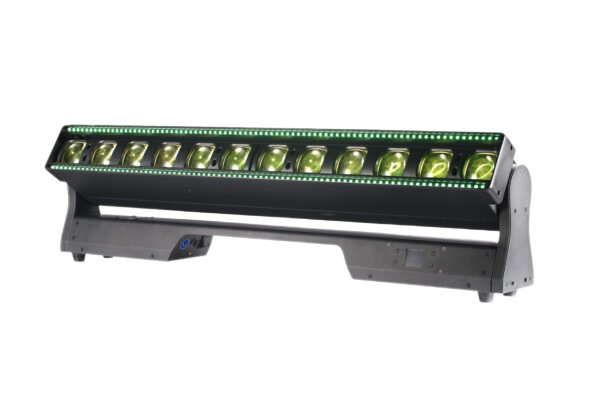
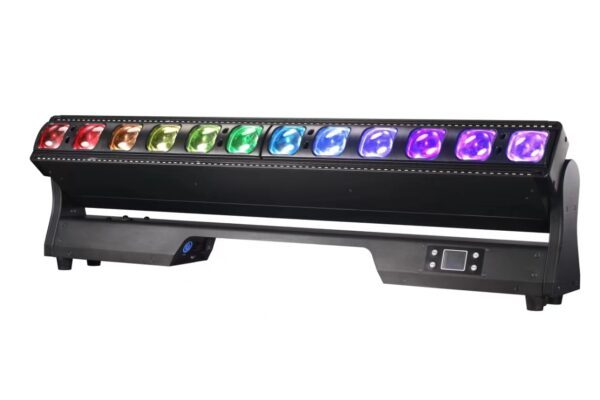
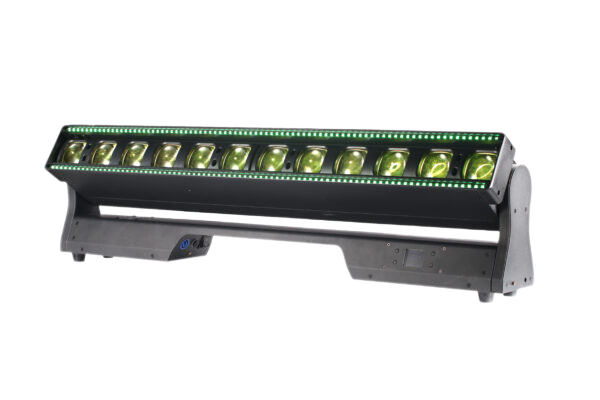
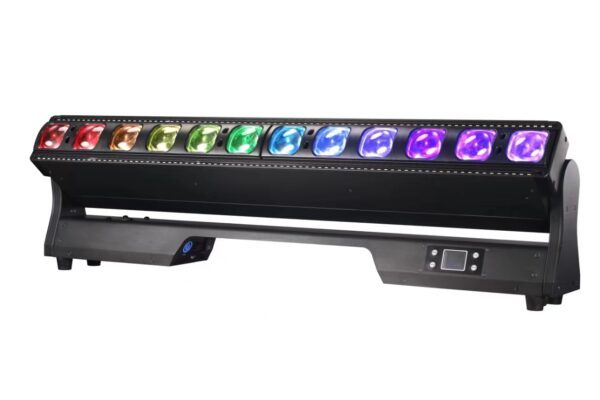
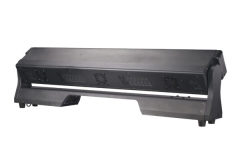
The Bar MZ1240D is a linear moving head built for shows that want the beam line and the backdrop hanging from one point. Twelve 40 W RGBW four-in-one lenses run along the front of a slim bar, and 82 RGB SMD LEDs form a second, independent layer across the back. Front and rear are addressed separately, so the face of the bar can throw beams into the room while its rear paints the wall behind it. Zoom carries the fixture from a tight pencil-beam array to a broad wash without swapping anything. At the narrow end the front lenses fire parallel beams that cut through haze and hold their shape over a long throw; opened up, the same bar covers a stage edge, a set piece or a plain backdrop as a moving head wash light. Every front lens is controllable on its own, colours and shapes included, which turns the bar into a pixel surface for sweeps, chases and shape effects instead of a single block of light. Rental houses tend to hang it as the beam moving head light over a stage lip or a runway, then switch to the backlight layer for the ambient wash behind a band or a speaker stack. Because both layers sit in one fixture, a design that used to need a beam bar plus a separate wash bar now takes one rigging point, one data run and one address block. It fits mid-sized stages, television floors, club installs and brand events where the background is part of the picture. In a dj moving head light rig the bar tilts through a wide arc, dropping beams onto the floor or lifting them to rake a backdrop without touching the clamp. Where a fixed led bar light washes a wall and does nothing else, this model adds movement, zoom and a second pixel layer. If the bars in your rig are static today, this is the fixture that keeps the same wall covered and puts the aerial look above it.
Electronic Control & Protocols
| DMX channels — standard | 28 |
| DMX channels — expanded | 67 |
| Control protocols | DMX512 and RDM |
| Network protocols | Art-Net and sACN (optional) |
| Wireless control | Optional |
| Data sockets | XLR-3 in and out |
| Network socket | RJ45 (optional) |
| Addressing | Rear control panel with display |
| Mode selection | Standard for a compact patch, expanded for full lens-level work |
| RDM function | Remote addressing and fixture identification from the console |
| Cable runs | XLR-3 in and out so units can be linked along one chain |
Fixture Movement & Rigging
- Check the hanging position and the structure first. A bar this long spans differently from a single-aperture moving head stage light, so give it two clear truss points or a solid floor position before anything is lifted.
- Bolt the yoke bracket to the bar, then hang it on clamps or stand it on the yoke for floor work. Keep those bracket bolts tight — the whole movement of the bar happens at that joint.
- Set the tilt inside its 196° range. Pointing down gives a curtain of beams across the floor; angled back, the same beams rake across a backdrop. The bar tilts as one piece with no pan axis, so framing comes from tilt, zoom and per-lens control rather than from swinging a head.
- Sweep the tilt through its full travel by hand before powering up, and check clearance against truss, drapes and set pieces — especially when the bar is flown close to a wall.
- Aim the array at the surface you want to fill, then use the zoom to tighten or spread it. A beam moving head light gives its look from one aperture; this LED moving head light places a row of them at once, so aim the bar before you trim individual lenses.
- Power up, address the fixture and run the tilt through its full travel under control before the first cue. On tour, repeat the clearance check after every load-in.
Optics & Photometric Data
| Zoom range | 3°–32° |
| Beam layout | Twelve parallel beams from the front lenses |
| Colour system | RGBW 4-in-1 at every front lens |
| Colour temperature | 2800 K–8000 K, linear |
| Per-lens control | Individual colour and shape editing |
| Built-in effects | 33 preset macros |
| Zoom drive | Motorised, set from the console or the rear panel |
| Colour mixing | Additive RGBW; no gels or colour wheel to change |
| Narrow end | Parallel pencils that keep their shape through haze |
| Wide end | Stage edge, set piece or backdrop coverage from the same bar |
| Macro handling | Presets recall ready to use, then rework lens by lens |
Power & Electrical
- Universal mains input. The bar runs on AC 100–240 V at 50/60 Hz, so a single stock item serves both 110 V and 230 V markets without a voltage change or a separate order code.
- 450 W at full output. Put that figure into the power schedule for the truss or floor package before you decide how many units can share a circuit with the rest of the moving head stage light package.
- What drives the draw. Most of the load comes from the front light engine, with the rear backlight layer on top of it. Running the backlight low or dark leaves headroom on the circuit for the front beams.
- LED life expectancy of 30,000 hours. That is long enough for the diodes to outlast several seasons of rigging and de-rigging before replacement becomes a conversation.
- One supply design across markets. As a LED moving head light manufacturer we fit the same wide-range supply to every unit, which keeps spare stock and cross-hired bars behaving the same in any territory.
- Connector check. Confirm which mains connector is fitted to your batch before you cut cable or build power tails, and match it against your distro.
Size, Weight & Packing
The fixture measures 1000 × 120 × 290 mm. That metre of length is what gives the bar its line of parallel beams, so plan the truss bay or the floor position around the full span rather than the lens row alone.
The slim 120 × 290 mm section keeps the housing narrow enough to sit between truss pipes and close to a backdrop, which matters when the bar is flown behind a set as a moving head wash light. It fits into gaps where a deeper led bar light housing would not.
Net weight is 16 kg and gross weight 18 kg. Two people on a lift is the comfortable way to handle it, and the figure belongs in the truss load calculation next to clamps, cable and safety bonds.
Cartons measure 1180 × 210 × 420 mm — longer and deeper than the fixture itself to leave room for transit protection. Use the carton size, not the light size, when you quote van or container space.
Between shows, keep the bar in its carton or a case with the lenses facing away from anything that can knock them, and store it indoors. As a LED moving head light manufacturer, we ship each bar in a single carton, and your sales contact can confirm how the current batch is packed before you finalise freight.
Working Conditions
- Ambient range. The working range is set at the factory to -20 °C to 40 °C, which covers cold load-ins, hot summer stages and the swing between a truck and a venue.
- Indoor only. Protection rating is IP20, so this is a fixture for dry stages, studios, clubs and covered event spaces. Rain, sea air and permanent outdoor mounting are outside what the housing is built for.
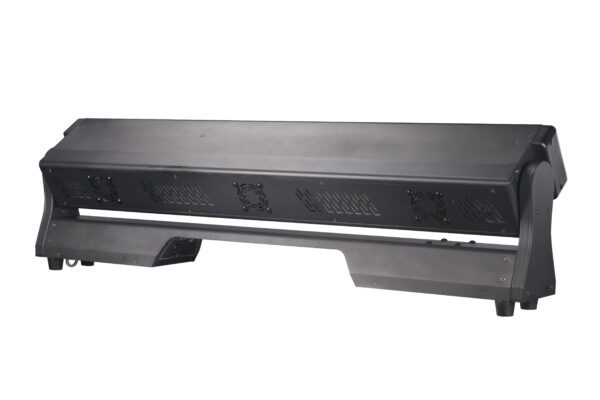
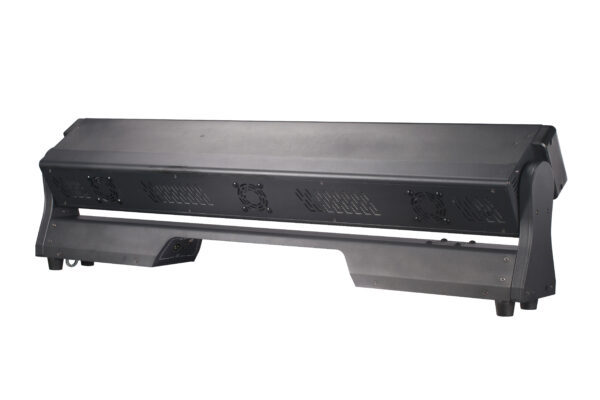
- Air behind the bar. The rear panel is vented and it needs air. Leave clear space behind the fixture and never press it tight against a backdrop or a drape.
- Packed rigs. Heat builds when bars are stacked close together or flown under a low roof. Check that air moves behind them and that the tilt position does not sit across the vents.
- Cold transport. If the bar has travelled overnight in an unheated truck, let it reach room temperature before powering up — condensation on cold lenses is the usual cause of a hazy first focus.
- Haze and dust. A smoky room leaves a film on lenses and grilles over a season. Book wipe-downs into the maintenance plan rather than leaving them until output visibly drops.
Ordering & Delivery
- Tell us where the bar is going: the venue type, the throw to the surface you want to light, and whether the job leans on it mainly as a moving head wash light or as a beam line.
- Confirm the control platform and the channel mode you plan to run, then ask for the channel chart and fixture library file that match the batch you will receive.
- Confirm quantities and how the order leaves the factory — which cartons, how they are packed for freight, and whether units need to be split across drops.
- List the documents your install team needs: spec sheet, manual, DMX channel table and photometric file. Nothing should be missing at commissioning.
- Agree the commercial terms with your sales contact before the order is released: warranty coverage and period, production lead time, minimum order quantity and volume pricing, payment terms and Incoterms, and the process for returns or quality claims. We put those terms in writing against your purchase order.
Technical Support & Model Matching
More than 30 engineers with an average of 15+ years in professional lighting stand behind every order — the same people who answer your technical questions. Tell us your venue, rigging height, throw distance and existing control setup; as a moving head light factory we help match models, check protocol and channel fit, and build a package that works as one system. If a fixture misbehaves on site, we work through the fault with you and sort out spares. Installation and commissioning guidance come with the order. Founded in 2016, exporting since 2022, LITEVISION serves buyers in more than 80 countries from offices in the USA, Taiwan, Mexico and China.
FAQ
Can this bar play as both a beam and a wash in one cue stack?
Yes, and that is how most shows use it. Programme the tight end for the aerial moments and the wide end for stage and floor coverage. Because zoom is one continuous range, a single cue can travel from one to the other instead of swapping fixtures, and the rear layer can hold its own static look underneath the whole thing. In a dj moving head light set the tight setting usually carries the drop while the wide setting carries the vocal.
How does this differ from a single-aperture beam moving head light?
A single-aperture fixture gives you one beam from one point. This bar gives you a row of parallel beams from a long housing, plus a separate backlight layer on the rear, so one unit covers both the aerial pattern and the wall behind it. It also takes the place of a static led bar light in the same position, which is usually the fixture it removes from a rig.
Will it drop into my existing console and show files?
It runs DMX512 with RDM in two channel modes, standard and expanded, with Art-Net, sACN and wireless available as options. Ask for the channel chart and the fixture library file for the mode you plan to use, and check them against the batch that arrives. If the file you are porting was written for a moving head stage light with a pan axis, remember this bar only tilts, so those pan moves need rethinking rather than re-patching. Any led moving head light on the same data line can share the run.
Can the front lenses and the rear backlight run different effects at once?
Yes. The two layers are addressed separately, so one can hold a slow colour wash while the other runs a chase, and each front lens still takes its own colour and shape. That is what makes the bar useful in a small room: a dj moving head light position gets an aerial look and a background from one fixture and one data run. The macros give you a starting point, and editing individual lenses takes it further.
Will a later batch match the show file I build now?
The standard and expanded modes use the same channel layout on every bar, so a file built for one patches the same way on the next. Before a new batch ships, ask us to confirm the firmware version against the one you are running and keep the channel chart with the show file. We would rather send the chart with the order than have a change discovered on site.
How should I clean the lenses and the rear vents?
Switch off, let the fixture cool, then wipe the front lenses with a soft dry cloth or a lens tissue — no solvents, and no water sprayed at the housing. Brush dust out of the rear vents rather than blowing it further in, and do it between runs of dates rather than during one. Lenses that stay clean keep their colour and output consistent across the row, which is what makes a row of beams look like one effect.