Product Overview
The DMX-6 takes one feed from your DMX 512 controller and turns it into six separate DMX512 outputs, each one re-amplified to full strength before it leaves the housing. One input, six outputs — no more running six fixture groups end to end down a single line. Wherever a run has to cross a stage, climb a truss or pass a rack of dimmers, this is the point where it gets divided and cleaned up.
Inside a DMX lighting control system this unit is the node between the desk and the fixtures. Instead of one long chain you get six short branches, each with its own driver, so a fault on one branch stays on that branch and a long cable no longer has to carry the whole show.
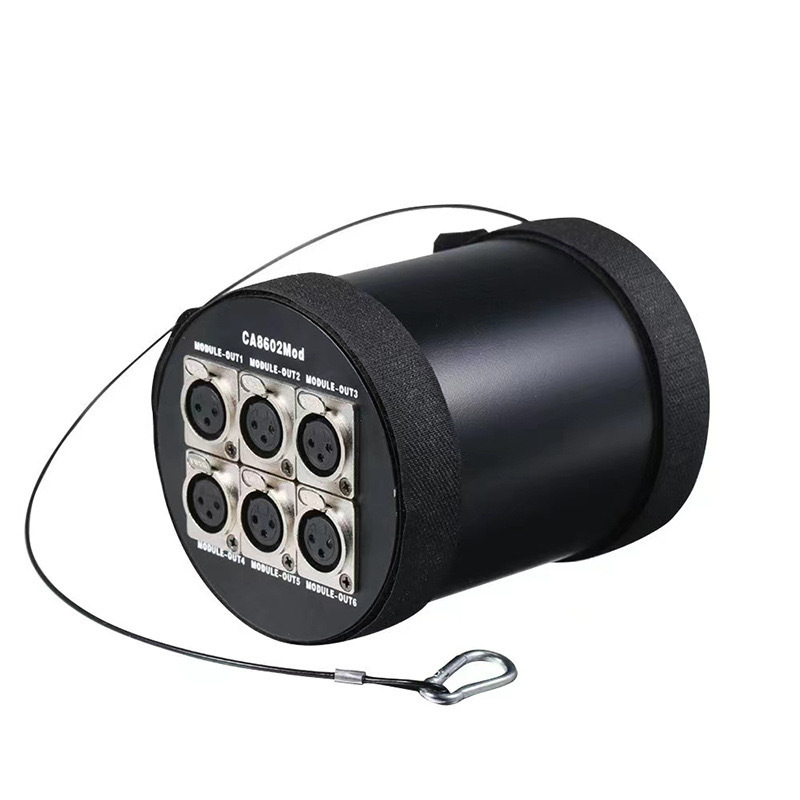
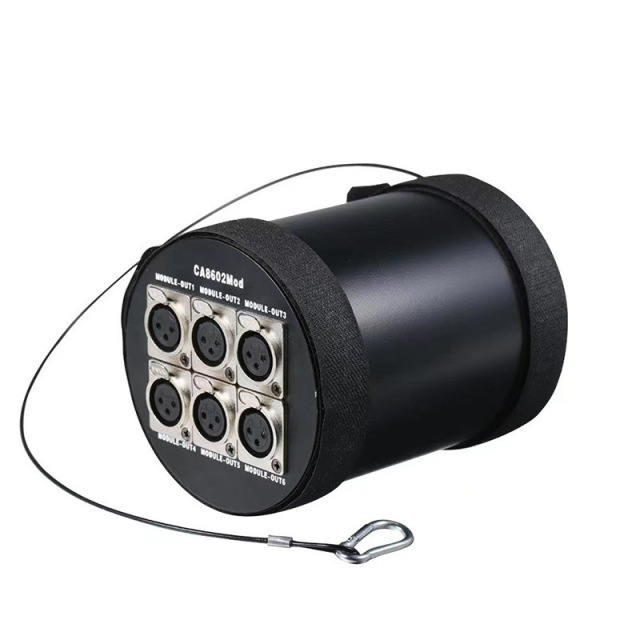
The housing is compact and black, with the output sockets set into the connector face and every port marked from MODULE-OUT1 to MODULE-OUT6. Strapping it to a truss takes seconds, and that numbering on the panel is what makes a mid-show cable swap quick.
Signal distribution, not remote addressing — this version carries standard DMX512 only. If your crew needs to read or change fixture addresses from the desk without climbing the truss, take the RDM version of the same six-way unit instead. As a DMX lighting controller manufacturer we build both, so the decision comes down to whether remote addressing earns its place on your shows.
Signal Path & Wiring
- Run a DMX cable from the DMX 512 controller output to the input on the splitter, and keep that first length as short as the layout allows — it is the one segment that still carries the whole universe before the split.
- Set the desk to output standard DMX512. The input side of this unit runs from its own supply inside the housing, separate from the output drivers, so the incoming signal is not sharing a rail with the amplification that pushes it back out.
- Take each of the six outputs to its own group of fixtures: house left, house right, floor package, dimmer rack, a cluster of DMX moving head light.
- Every output is re-amplified to full level rather than passed through at whatever strength arrived.
- Address and test one branch at a time.
- Because the outputs are electrically separate, you can unplug a branch to check it without the rest of the rig going dark, which turns most fault-finding into a two-minute job up the truss.
- Patch the whole rig as one universe on the DMX controller. From the desk's point of view the six branches are still one chain of addresses; the division happens physically, not in the patch sheet.
- Label the cable ends as you go, matching each one to the MODULE-OUT number it came from.
- The next person on the truss will not have to guess, and neither will you at the interval.
Isolation & Interference Control
- Every output sits behind its own optoelectronic isolation, so no two branches share a ground.
- That single detail removes most of the flicker and drop-out that appears once a DMX lighting system grows past a couple of trusses.
- Each interface carries an independent protection circuit as well.
- A crushed cable or a fixture with a damaged socket takes out its own branch and leaves the other five running.
- The in/out signal circuit has its own power supply inside the unit, which keeps switching noise on the power side away from the data.
- Dimmer racks and LED drivers are the usual suspects in a DMX LED stage lighting rig, and this is the part that stops them reaching the rest of the chain.
- A split also resets the electrical load.
- A single DMX512 segment is normally limited to 32 unit loads, and every output here starts a fresh segment, so fixture count stops being the constraint on how the rig is laid out.
- Ground loops between distant parts of a venue — stage-left truss against the dimmer room, for example — no longer have a path back through your DMX controller's output stage. Protecting the desk is a side effect of protecting the branches.
- What isolation will not do is repair a bad cable.
- It stops a fault spreading, so if a branch is still dead after swapping the cable at the splitter, the problem is almost always further down that run rather than inside this unit.
Truss Mounting & Connector Modules
- Pick the point on the truss closest to the first group of fixtures.
- Short output runs keep a DMX lighting system tidy and put the splitter within reach during a changeover.
- Wrap the strap around the tube and close it.
- The unit is built to hang from the truss rather than sit on a shelf, and the tether and carabiner give you a second point of contact while you are working at height.
- Bring the input in first, then work up from MODULE-OUT1 so the order you plug in matches the order printed on the panel.
- Keep the input cable away from mains feeds and dimmer looms where the layout allows.
- Isolation handles a great deal, but a data cable laid along a power run is still the most common cause of trouble in a rig.
- If a socket ever takes a hit, the connector is a module: release it and fit a replacement on the truss instead of pulling the whole unit out of the show and sending it away.
Applications & Setups
- Club and bar rigs — six outputs usually matches the number of runs a small venue actually has: a few heads over the floor, a wash bar, a set of battens, and room for whatever gets added next season.
- It keeps a compact DMX lighting control system compact, with no rack required.
- Theatre and school halls — fixed installs where the splitter lives on the truss above the stage and never moves.
- Set the branches once, label them, and the same six runs serve every production.
- Rental and tour packages — a node that travels in the data case and goes up with the first truss.
- One per truss keeps each DMX moving head light group independent, so a dead cable stage left does not take out the floor package.
- Dealers and trade stock — small, needs no configuration and is easy to explain to an end user: one input, six outputs, isolation on every branch.
- It is the kind of item a counter keeps two of.
- Exhibitions and one-day events — stands go up in a morning and the data layout changes every time.
- Six labelled outputs mean the next build can reuse the same patch without re-thinking it.
- Studios and broadcast floors — modest fixture counts, but a clean isolated feed to each bank of DMX LED stage lighting matters more than raw capacity, and short branches are easier to keep quiet.
- Package builds — when the desk, the split and the fixtures come from one DMX lighting controller supplier, connector types and signal standards are already matched before anything ships.
Specifications
| Property | Detail |
|---|
| Signal standard | DMX512 |
| Inputs | 1 DMX512 input |
| Outputs | 6 DMX512 outputs, each re-amplified |
| Isolation | Optoelectronic isolation on every output |
| Protection | Independent protection circuit per interface |
| Internal supply | Separate power supply for the in/out signal circuit |
| Operating voltage | AC 90-240 V, 50/60 Hz |
| Output connectors | Panel-mounted XLR sockets, individually replaceable modules |
| Mounting | Strap fixing for truss |
| Remote addressing | Not included on this model |
Ordering & Delivery
Tell us the rig: how many outputs you need per truss, the mix of fixtures — DMX LED stage lighting, moving heads, dimmers — and the console you run. That is usually enough for us to confirm a six-way split is the right size rather than a guess.
Quantity, price, minimum order and lead time are quoted against your order; as a DMX lighting controller supplier we confirm the production slot and delivery terms in writing before anything is scheduled.
Payment terms, trade terms and shipping method are agreed per order and shown on the invoice. Ask for the current terms for your market when you request the quote.
Packing follows normal export practice for this class of equipment — inner protection, an outer carton, and pallet or crate options for larger quantities. Confirm what your forwarder and your warehouse need before the order is booked.
Warranty length and scope, and the process for reporting a fault or transit damage, are set by the terms agreed for your order. Ask for the current policy with your quote so it can be checked against your own contract.
Because we build these units ourselves as a DMX lighting controller manufacturer, connector modules can be added to the original order as spares — worth doing if the splitters go out on tour.
| Document | What it covers |
|---|
| Datasheet | Signal standard, input and output counts, isolation and supply voltage |
| Port map | Output numbering from MODULE-OUT1 to MODULE-OUT6 as printed on the panel |
| Wiring diagram | Input and output connections for installation drawings |
| User manual | Mounting on truss, cabling practice and day-to-day operation |
| Conformity documents | The declarations and test reports your market requires |
| Spare parts reference | Connector module identification for field replacement |
| Submittal pack | The set above, prepared for specifiers and project files |
| Current issue | Request the latest version of any document before printing or publishing |
Technical Support & Model Matching
More than 30 engineers with an average of 15+ years in professional lighting stand behind every order — the same people who answer your technical questions. Tell us your venue, rigging height, throw distance and existing control setup; we help match models, check protocol and channel fit, and build a package that works as one system. If a fixture misbehaves on site, we work through the fault with you and sort out spares. Installation and commissioning guidance come with the order. Founded in 2016, exporting since 2022, LITEVISION serves buyers in more than 80 countries from offices in the USA, Taiwan, Mexico and China.
FAQ
Will this splitter work with moving head lights?
Yes. The six outputs are standard DMX512, so any fixture that takes a normal DMX feed will run from them, including every DMX moving head light in your inventory. The split changes nothing about addressing or channel count — it divides the signal into six separately driven branches.
Our console already has several DMX outputs. Do we still need a splitter?
Sometimes not, and it is worth checking first. A second output on the desk solves the problem when you simply need another run from the control position; a splitter earns its place when the runs are long, when fixtures are spread across several trusses, or when you want each part of a DMX lighting control system isolated from the others. Short runs and a low fixture count may only need one cable.
Does it work with any DMX 512 controller?
Any desk that outputs standard DMX512 will drive it — the input is a straight DMX512 input, not a proprietary format. Send us the console model with your enquiry and we will check it against the units we have already supplied.
What is the difference between this unit and the RDM version?
The protocol. The RDM version adds two-way communication so the desk can read and change fixture addresses remotely; this model distributes DMX512 without that return path. Mounting, isolation and output count are the same, so the choice comes down to whether your crew needs remote addressing.
Can a damaged output connector be replaced on site?
Yes. The connectors are modules, so a damaged one is released and swapped rather than sent away for repair. Keep one or two modules in the spares case and a DMX lighting system can be back in service during a changeover instead of after it.
Where should the splitter sit in the chain?
Close to the first group of fixtures, with the shortest practical cable back to the DMX controller. That keeps the un-split section short, puts the six isolated branches where the fixtures actually are, and leaves the unit within reach when you need to trace a cable.