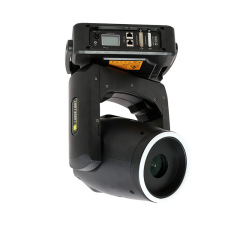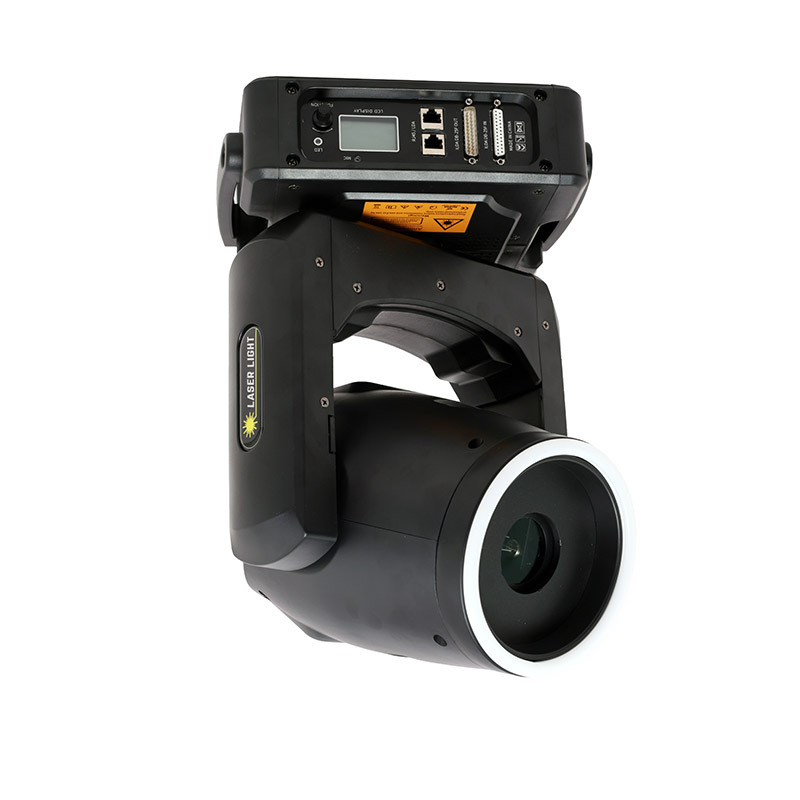
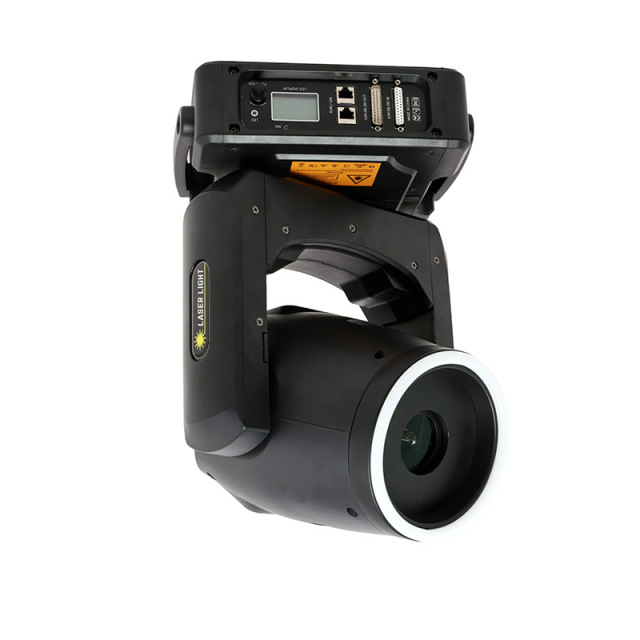
Ten watts of RGB laser light — 3 W red at 638 nm, 3 W green at 525 nm and 4 W blue at 450 nm — sits inside a moving-head housing with a DT20 galvanometer scanner and a ring of LEDs around the front aperture. With 540° pan and 270° tilt, the head can carry the graphics drawn by the scanner across a room rather than keeping them fixed on one wall, which is the practical difference between this fixture and a static projector bolted to a truss. DMX512 control with 29- and 46-channel modes puts the unit on the same network as the rest of the rig. Its effects include full-colour lines, three-dimensional line effects, computer animation and text drawn by the scanner over the ambient glow of the LED ring. This fixture is built for indoor use in large bars, live stages, water-curtain shows and indoor scenic installations. LITEVISION manufactures this fixture and supplies distributors, rental fleets and installers, alongside the moving heads, wash lights, hybrid beam/spot units and controllers that can be specified into the same rig.
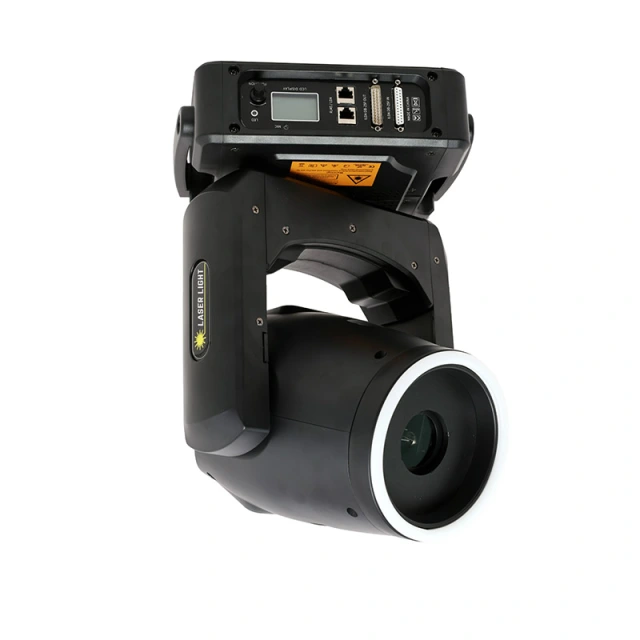

Product name: 10 W full-colour fixture; Rated voltage: AC100V–230V, 50/60 Hz ±10%; Laser source: Semiconductor pump laser; Laser power: 10 W total (red 3 W, green 3 W, blue 4 W); Laser wavelength: 638 nm red, 525 nm green, 450 nm blue; Laser modulation: TTL or analog; Laser system: DT20 high-speed galvanometer scanning system; Laser colour: Full colour; Pan and tilt: X axis 540°, Y axis 270°; Control: DMX512, master-slave; DMX channels: 29 / 46; Working temperature: -20 °C to 45 °C; Use environment: Indoor; Laser range: About 40 m.
Choose an indoor hanging position with room for a full 540°/270° swing, where the head clears drapes, balconies and walkways and the scanned graphics land above the audience rather than in it. Set the channel mode on the rear control panel and address this fixture, then patch it into the console — 29 channels keep the footprint small on a club desk, while 46 channels give the programmer more parameters to work with. Check the functions against the current channel table for your production batch before building the show file; as the manufacturer of this fixture, we keep that table matched to the units we ship, so request the version that corresponds to your delivery. Check power and DMX connections at the truss end, then test pan and tilt travel and run through the stage lighting effects at the actual trim height to confirm that movement clears the rigging hardware. For a rig without a console, set one unit as master and the rest as slaves, and make sure every follower uses the same mode and address plan before doors open. Repeat the movement test after any re-rig — a head that was clear on the bench can still clip a truss arm once flown.
Large bars and nightclubs: hung over the dance floor as the focal effect, with the ring providing a base glow and the scanner drawing lines and text across the room; this fixture can be re-aimed from the console between tracks without touching the truss. Live performances and touring stages: movement and graphics cued to the set list, with the head repositioning as quickly as the music changes. Water-curtain laser shows: the graphics read on a water screen, with the fixture itself kept indoors, dry and clear of mist and splash. Light shows and themed events: a compact unit that fits into an existing laser stage lighting rig and can move from a wall graphic to an aerial look within a single cue. Indoor scenic and themed installations: useful where a graphic needs to land on different surfaces throughout the evening rather than on one fixed wall. Rehearsal rooms and smaller stages: the same effect at low trim height, because the head handles the aiming instead of requiring a ladder.
Pre-show checks
Wipe the laser aperture window and the LED ring diffuser with a dry, lint-free cloth before each date. Dust and fingerprints on the window scatter the beam and leave the drawn lines looking soft, while a film on the ring shows up as uneven colour. Clear the fan grilles and side vents at the same time — a blocked vent raises the internal temperature, the cooling ramps harder and the fixture gets noticeably noisier long before anything fails. Run the head through its full 540°/270° travel and fire one test graphic and one ring colour before doors open; that single pass catches a marked window, a lazy fan or a loose connector while there is still time to act on it. Check the power and DMX connectors for bent pins and tired cable latches, and keep a spare data cable in the case, because a flickering moving head laser light is more often a connector than a scanner.
Storage and spares
Park the head, fit the aperture cover and store the unit dry and indoors, inside the published -20 °C to 45 °C working range rather than in a cold van overnight. Clean the outside only, with the fixture powered down, and never spray cleaner onto the window or open the laser housing. Keep a short log per serial number — hours run, any change in brightness, any new fan noise — so a stage laser light that starts to fade can be pulled and serviced before it drops out mid-show. For a rental fleet, one spare unit plus a spare data cable and a spare power cable covers the usual failures without tying up the cost of a full second inventory.
Blue carries the largest share of the 10 W output at 4 W, alongside 3 W of red and 3 W of green, giving you the deep blues, magentas and cold whites that club and concert looks depend on. Because the scanner draws rather than masks, your cue list can move from a logo to a fan of lines to a text drop without swapping fixtures or re-rigging the head.
Changeovers stay short: the head swings to its next angle as part of a cue, so a set change does not need a ladder and a focus session. The ring keeps the fixture visible during the quiet bars, when the scanned graphics are parked or dimmed, and gives you a warm or cool ambient base depending on the colour you set.
Add it to your laser stage lighting rig alongside LED wash and beam fixtures to create the graphics layer while leaving coverage to the washes, helping keep your console programming clean. You can control it from a small desk, and the effect reads strongly in a room with haze, where the drawn lines stand out clearly above the ambient layer.
LITEVISION builds stage and architectural lighting in Guangzhou, with more than 30 engineers who have worked in the industry for an average of over 15 years and a production line that ships more than 50,000 units a year to customers in over 80 countries. Offices in China, the USA, Taiwan and Mexico put a technical team in the same working day as most of our distributors, rental houses and integrators.
Quality control is a sequence rather than a claim: every product goes through thermal, electrical and longevity testing, an independent QC team inspects each machine, and a qualification report is issued before anything is released to the warehouse. Our products are CE, RoHS, UL, and ISO 9001 certified, ensuring compliance with international safety and quality standards.
The catalogue runs from moving heads, wash lights and hybrid beam/spot fixtures to profile and framing units, lasers, effects, battery lights, controllers and architectural luminaires, so a complete rig can be sourced from one place. Custom product design, OEM and ODM work, installation consultation and after-sales support are part of the service, and the sustainability work covers energy-efficient components, recyclable packaging and long-life design.
What that means when you choose a source: this moving head laser light manufacturer can match the fixture to the controller and the rest of the rig, keep the channel table and settings aligned with the batch you received, and support the unit through regional offices once it is in service.
Every unit goes through thermal, electrical and longevity testing before it is packed, so the checks cover how the fixture behaves once it is hot, how it behaves on a fluctuating supply and how it holds up over running hours rather than only on the bench. LITEVISION holds CE, RoHS, UL and ISO 9001 certification, and engineers monitor the production lines for consistency across a whole run rather than judging a single sample.
For a fleet buyer the practical result is uniformity: units from the same run should respond alike on the same cue, which is what keeps a laser stage lighting rig looking consistent from the first fixture to the last. Annual capacity of more than 50,000 units means an order can be scheduled as a production run instead of being pieced together from whatever happens to be on the shelf.
If a fault does appear, quote the serial number and describe the symptom precisely — one colour weak, a ring segment dark, a fan noise that was not there before — so the unit can be traced back against its batch. Keep the original foam and carton if the fixture is going into storage or travelling between venues, since a moving head laser light needs the packing it was designed around.
LITEVISION brings together more than 30 engineers who have worked in the industry for an average of 15+ years. Share your purchasing requirements and the models you are considering to discuss the available options with our team. We provide product maintenance and technical support, with customer service staff available to answer your questions and help address issues. Whether you are comparing options before ordering or need assistance after purchase, contact us with your technical questions and maintenance concerns.