Product Overview
The LTSPF-750W is a cold spark fountain built by stage lighting manufacturers for indoor stages. Heater, control panel and connectors all live inside one compact housing that lifts out of its carton and is ready to place, so the time between a van door and a working cue is short.
On cue it sends up a bright, dense fountain of sparks that reads clearly against a dark stage or a lit backdrop, and it stops the moment the cue is released. Height is set in steps, which means the same machine can throw a low, tight burst for a first dance and a taller plume for a chorus, an entrance or a trophy lift.
Because the effect is generated electrically rather than by burning a pyrotechnic charge, cold spark units are the usual answer for venues that do not allow open flame, for shows that need the same effect several times in one night, and for productions that want the look of pyro without the storage and transport rules that come with it. Check the approval requirements of your venue and local authority before the show.
It is a floor unit. You place it downstage of the action, at the edge of a runway, or either side of a ceremony arch, and it needs nothing above it. In theatrical stage lighting the same look is usually flown from a bar; putting it on the floor is what makes it practical in low rooms, listed buildings and marquees where rigging points are limited.
Rental houses, wedding and event producers, clubs and venue technical teams buy it from a stage lighting equipment supplier for that pairing of a strong visual moment and a case one person can carry. Distributors and stage and lighting companies that serve several venues a week take it by the pair and list it next to the smoke, haze and laser units already in the catalogue.
Key Features
- Console or handset, both live. The machine takes DMX512 and drops into an existing DMX lighting rig without an adapter, and it also ships with a multi-function wireless remote, so a programmed cue on the desk and a button press from the side of the stage are both available in the same show.
- Electromagnetic heating. The element is brought up to working temperature by electromagnetic induction rather than by an open flame or a burning charge, which is what keeps the effect repeatable from the first cue of the night to the last.
- Floor-standing and sightline friendly. The housing sits in front of a ceremony arch, a DJ booth or a drum riser without cutting into the audience's view, and it needs no bar, clamp or safety bond above it.
- Aluminium body. A rigid aluminium housing holds its shape through load-in and load-out and helps the unit shed heat between cues, which matters on a night with a long cue list.
- Handles on both sides. Two metal handles let one crew member lift, position and re-position the unit without a second pair of hands, so a two-machine effect can be reset during a changeover.
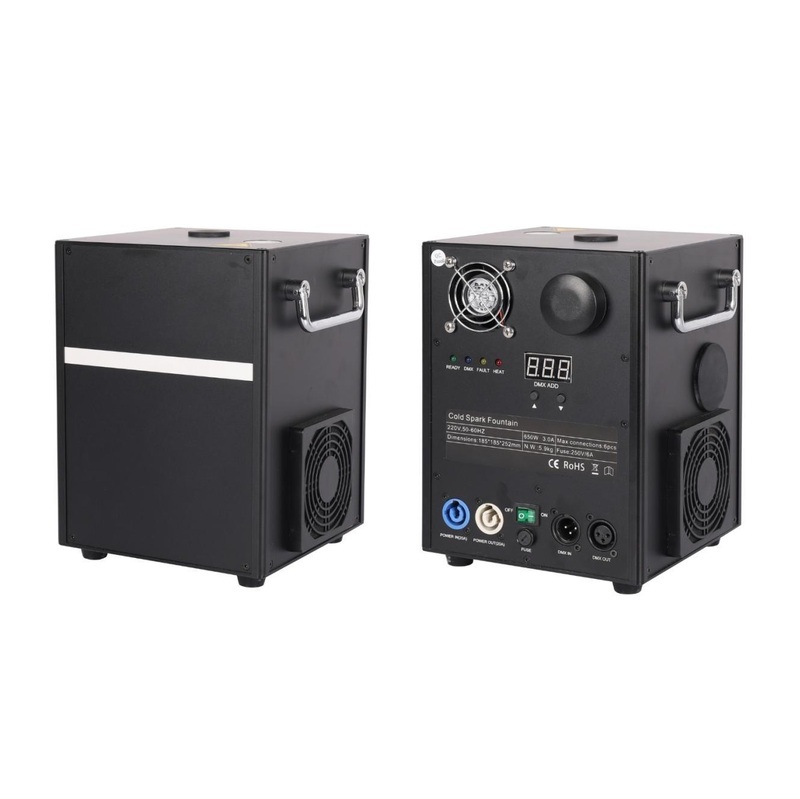
- Rear panel connections. POWER IN and OUT and DMX IN and OUT sit on the rear panel, so a line of units shares one supply and one data run and the whole line is addressed from a single DMX light controller at the desk.
- Digital display and address buttons. Set the DMX address and read the unit's state from the rear display, with no laptop on stage and no need to open the housing — a rear-panel layout stage lighting manufacturers use to keep addressing quick.
Setup & Connection
- Choose the position. Stand the unit on the floor downstage of the performer, in a spot the audience can see, and keep the path of the fountain clear of drapes, screens and loose fabric.
- Level it and mark the spot. Set it on a flat, rigid part of the stage rather than on a drum riser or a raked section, then tape the position so the same spot is used at every show and in every venue plan.
- Feed it power.
- Use the supplied power cord. Where you are running several units, POWER IN and POWER OUT on the rear panel let you link them along one supply line instead of running a cable to each machine.
- Run the data. Take DMX IN from the console or from the previous unit in the chain, send DMX OUT to the next, and terminate the last unit in the line as you would on any DMX lighting run.
- Address it. Set the DMX address on the rear panel display and patch it on the DMX light controller exactly like any other fixture in the rig.
- Pair the handset. Pair the wireless remote before doors and label both unit and remote, so a handset does not end up firing the wrong machine in a two- or four-unit arrangement.
- Test the cue at the level you will use. Fire each step once during the technical run, check the height against the room and the sightlines, then reset the units before the audience comes in.
Applications
- Weddings and civil ceremonies. Two units either side of the dance floor carry the first dance or the entrance, and the handset lets a celebrant, DJ or venue technician fire the cue without a desk — which is what most venues ask for.
- Product launches and press events. Placed behind a reveal screen or at the edge of a low stage, the column photographs well and stops cleanly on the cut, so the reveal is not smudged by a lingering effect.
- Clubs, bars and live music rooms. Used as a drop cue on a beat or as a transition between sets, it gives a small room the kind of moment that theatrical stage lighting normally needs a flown fixture to deliver.
- Theatre, school and college productions. A short run with a repeated cue is where a clean start and stop matters more than size, and where the machine has to be safe to reposition between scenes by a student crew.
- Corporate conferences, award nights and hotel ballrooms. Rooms that refuse open flame still want a visible moment on stage, and the crew is often a house technician rather than a touring lighting designer.
- Rental and dry-hire fleets. Event producers and professional stage lighting companies that serve several venues a week need an effect that packs into one carton, hands over with a remote and does not require a technician on site.
Specifications
| Specification | Detail |
|---|
| Power | 750 W |
| Spray height | 1–5 m |
| Height steps | 5 on a DMX console, 3 on the wireless remote |
| Spray diameter | 22 mm |
| Heating method | Electromagnetic heating |
| Control | DMX512 and wireless remote |
| Housing material | Aluminium |
| Product size | 205 × 205 × 265 mm |
| Net weight | 5.9 kg |
| Single carton | 290 × 29 × 355 mm |
| Supplied accessories | 3 m power cord, signal cable, multi-function remote control |
Care, Consumables & Spare Parts
The effect comes from a consumable granule fed into the heating chamber, so the two things that decide how the unit performs are the granule and the condition of the chamber. Ask us which granule specification we recommend for this machine and stay with it — mixing grades between suppliers is the most common reason a spark machine starts producing short, uneven bursts.
After each show, let the unit cool, empty the chamber of spent granule and residue, and brush out the fan grilles on the sides of the housing. A soft brush and a dry cloth are enough; do not wash the housing and do not blow compressed air into the grilles, which drives residue further into the heater.
Wipe the aluminium housing, check the handles and the rubber feet, coil the power and signal cables, and put the unit back in its carton. For professional stage lighting companies moving gear between venues every week, that carton is the cheapest road case the machine will ever have, and it stacks with the rest of a small effects package.
Keep a spare remote, a spare power cord and a spare signal cable per fleet. The handset is the part that stops a show when it fails on site and the cheapest thing to hold in stock; a house running five units should carry two.
If output drops, clean the chamber and try a known-good granule before anything else. If a unit stops heating or a fan turns noisy, take it out of service and send it back to us — as a stage lighting equipment supplier we would rather see it once in the workshop than have you find the fault on a show night, and the heater and fans are not parts to open on site.
Ordering & Delivery
- Start with the show. Rental houses, venues, stage and lighting companies and distributors all begin the same way: tell us how many units you need, the ceiling height, who will fire the cue and whether there is a console.
- Confirm the supply for your destination. Tell us the country the units will be used in so the power cord, plug and voltage are correct before packing; professional stage lighting companies ordering for several markets often need different plugs inside the same shipment.
- Fix the consumable at the same time. Ask which granule we recommend and how much to start with, so the first show is not held up waiting for a separate delivery.
- Ask for the current commercial terms against your date. Price, minimum order quantity, quantity breaks and production lead time move with the season, so confirm them in writing rather than working from an older quotation.
- Agree payment, trade terms and freight. Payment method, Incoterms, departure port or door delivery and the shipping method are settled with your sales contact before production starts. Agree warranty, returns and quality claims before dispatch.
- Ask what the warranty covers, how long it runs, who pays freight on a return and how a quality claim is handled, and keep the answer with the order paperwork.
- Confirm packing and the document set. Single carton or a touring case, and which commercial and compliance documents travel with the shipment — as stage lighting manufacturers we send the set your customs broker will ask for.
| Document | What it covers |
|---|
| Specification sheet | Power, spray height and diameter, control, dimensions, net weight and carton size, laid out for tender documents and dealer catalogues |
| User manual | Placement, control, addressing, cleaning and safety instructions for the machine |
| DMX channel table | Channel assignment and level mapping, ready to program on any DMX controller |
| Rear panel diagram | Power in and out, DMX in and out, and the display and address buttons, for planning a DMX lighting run |
| Compliance file | The safety and environmental documents required in your destination market |
| Packing list | What ships in the single carton, including the power cord, signal cable and remote control |
Technical Support & Model Matching
More than 30 engineers with an average of 15+ years in professional lighting stand behind every order — the same people who answer your technical questions. Tell us your venue, rigging height, throw distance and existing control setup; we help match models, check protocol and channel fit, and build a package that works as one system. If a fixture misbehaves on site, we work through the fault with you and sort out spares. Installation and commissioning guidance come with the order. Founded in 2016, exporting since 2022, LITEVISION serves buyers in more than 80 countries from offices in the USA, Taiwan, Mexico and China.
FAQ
How does a cold spark machine make its effect?
A consumable granule is fed into a heating chamber that is brought up to temperature electromagnetically; what leaves the machine is a fountain of sparks, not a flame and not a smoke effect. There is no burning compound and no haze left hanging in the room, which is why the effect can be repeated closely through a night and why it suits venues that refuse smoke.
Can I hang this unit from a truss?
No — this is the floor model, built to stand on a stage, a riser or a ballroom floor. Where the effect has to come down from above, we make a separate hanger version with a hook and a safety rope in the box, and in theatrical stage lighting that is usually the one written into the plot. Send us the mounting height and we will tell you which version you need.
Do I need a lighting console to run it?
No. The machine ships with a multi-function wireless remote, which covers a single cue or a short ceremony. A DMX controller gives programmed cues, timed sequences, recall of different looks and control of several units from one place — which is why rental and club work usually runs from the desk and keeps the handset as a backup, or hands it to the client for their own moment.
Can the effect be faded in and out?
Not as a smooth fade. Height moves in steps rather than through a continuous dimmer, so build the cue as a step change on the DMX light controller or on the handset rather than as a slow rise. Planned against the music, a step reads as a deliberate accent; treated as a dimmer it will feel abrupt.
How many machines does a stage usually need?
For a wedding or a club stage the answer is normally a pair, one each side of the performance area, because a single fountain tends to read as an accident while two read as a design. Wider stages, runways and multiple reveals are where a third and fourth unit earn their place. Send us the floor plan and we will mark the positions.
What clearance does it need in a low room?
The machine is small and stands on the floor, so the limit is usually the ceiling and the sightline rather than the unit itself. Use the lower steps where the ceiling is close and set the position so the sparks do not reach a lighting bar or a low truss, and check the venue's rule on distance from the audience before you commit to the spot.