Product Overview
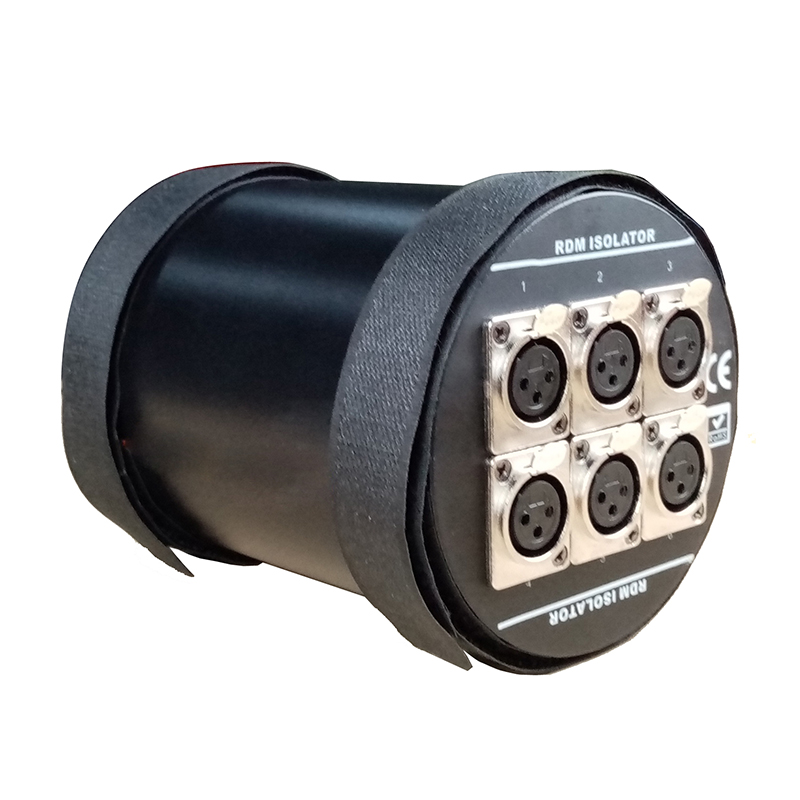
One input, six amplified branches. This six-way splitter takes a single DMX512-RDM feed from the desk — a lighting console or a compact dmx light controller — and divides it into six outputs, re-amplifying the data on the way through. Every output carries the same information, so all six branches stay in step with each other and with the control position.
A distribution point that hangs on the truss. The body fixes with a strap and pad onto truss tube, so it can live beside the dmx led stage lighting it feeds instead of in a rack at the side of the stage. Jumpers from the splitter to the first fixture on each branch stay short, and repatching during a changeover happens at working height.
Where it sits in the chain. Put it between your dmx 512 controller and the fixture branches: the desk sees one output, the rig sees six. That removes the single long daisy chain that fades toward its last fixture, and it keeps a damaged jumper on one branch from reaching back into the console output.
Made by a dmx lighting controller manufacturer that builds the rest of the chain. LITEVISION produces this unit inside a data distribution range that also covers DMX, RDM and ArtNet models, alongside the desks and fixtures either side of it. Rental companies, theatres and studios use it where dmx lighting systems have outgrown one line and nobody wants the split to be the part that fails at 7pm.
Key Features
- Six live outputs from one input. A single DMX512-RDM feed becomes six branches, each re-amplified on the way out, so a rig of dmx led stage lighting and moving heads keeps its level even on the branch that sits furthest from the desk.
- Two-way RDM across the split. The return path is preserved, so a dmx light controller that speaks RDM keeps remote addressing and fixture discovery on all six branches instead of only at the input.
- A protection circuit on every interface. Each of the six interfaces carries its own protection circuitry rather than sharing one, so a wiring fault is dealt with at the branch where it happened.
- Dedicated supply for the signal stage. The in/out signal processing circuit runs on its own power supply, separate from the rest of the electronics, which keeps switching noise away from the data path.
- Strap it where you need it. Fixing is by strap and pad onto truss tube — no rack rails, no shelf, no 19-inch space to find in a crowded rack room.
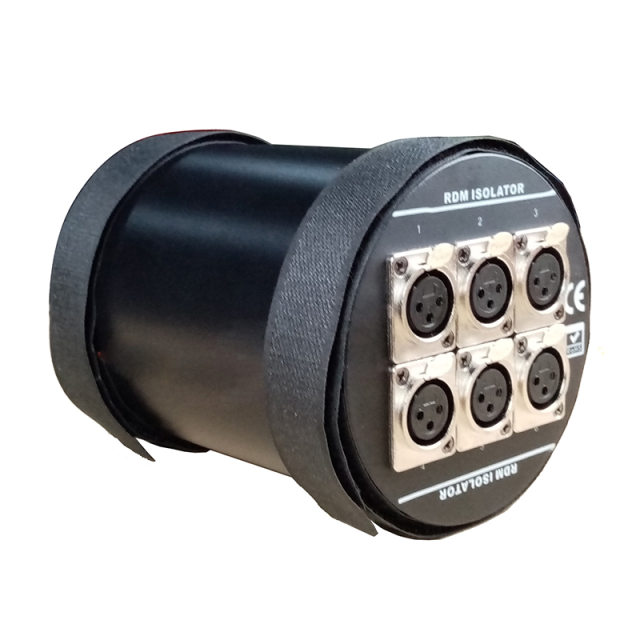
- Panel-mounted sockets in a metal body.
- The XLRs sit in the end panel of a black metal housing rather than on flying leads — an arrangement that survives being patched in a hurry, night after night.
- Address fixtures from the desk, not from a ladder.
- With an RDM-capable dmx controller for moving heads at the control position, you can reach any fixture on any of the six branches and change its start address remotely.
- On a rig trimmed high above the stage, that is the difference between a five-minute correction and a lift, fall protection and two people.
- Find the fixture you actually mean. RDM identification makes a chosen fixture respond, so the lamp that flashes is the one you are addressing.
- On a branch feeding a dozen identical heads, that beats reading labels with a torch. Read back what the fixtures report. Beyond addressing, the two-way link carries fixture parameters back into the dmx lighting control system, so the state of a branch can be checked from the desk before doors rather than during the show.
- What the desk has to support. The splitter passes DMX512-RDM as it arrives; the RDM functions themselves live in the console.
- A DMX-only desk still gets six clean, amplified branches, and remote addressing, discovery and read-back appear once an RDM-capable controller is connected. Why the split does not silence the return path. RDM is a conversation, and a splitter that passed data one way only would cut the answers off.
- This unit carries the protocol on both the in and out circuits, so a reply from a fixture on branch four reaches the desk by the route the question took.
Truss Mounting & Rigging
- Pick the split point first. Mount the unit near the middle of the six branches you plan to run; a splitter strapped to one end of the truss leaves you with four long runs and two short ones.
- Strap it to the tube. Wrap the strap around the truss and through the body, with the pad against the metal so the housing neither marks the finish nor rattles when the rig is humming.
- Angle the sockets toward the accessible side. Face the connector panel where a technician can reach it from a ladder or a lift; you will repatch it in poor light far more often than you expect.
- Run the input with a service loop. Bring the DMX512-RDM feed to the input and leave slack, so the unit can be unstrapped and lowered for inspection without disturbing the run back to the desk — a loop worth leaving on dmx lighting systems that stay rigged between shows.
- Fan out and label both ends. One output per branch, with matching numbers at the splitter end and the fixture end; labelled jumpers turn a mid-show fault into a one-minute swap.
- Check the chain before the first show. With the desk live, confirm that all six branches respond and that RDM discovery sees the fixtures you expect — cheaper to find a dead branch on the ground than after the truss is flown.
Applications
- Touring rigs with a moving package. Six branches across a downstage and an upstage truss let a dmx controller for moving heads feed each position separately, so a re-patch on one truss does not disturb the other.
- Theatre and school stages on a fixed grid. Where the truss stays put and the cabling is installed once, each lighting position gets its own path back to the desk and later changes can be made from the control position.
- Bars and clubs that run dmx led stage lighting. Small venues often put every fixture on one long chain; six outputs let the stage wash, the dance-floor heads and the bar spots sit on separate branches.
- Studios with a set that changes weekly. Moving heads, LED panels and practicals arrive on different days; separate branches mean new fixtures can be added to an output without re-patching the lamps that already work, and the dmx 512 controller keeps a clean picture of what is where.
- Fixed installations that keep growing. A room that adds fixtures every season can take another branch from the splitter instead of rebuilding the line, so the dmx lighting control system expands at the split point rather than at the console.
- Rental stock and prep benches. A splitter in the prep area lets a whole branch be tested as a unit before it goes out, and a six-way layout makes it obvious which jumper to replace when a case comes back with a fault.
Specifications
| Property | Value |
|---|
| Signal standard | DMX512-RDM, two-way |
| Inputs | One DMX512-RDM input |
| Outputs | Six DMX512-RDM outputs, each amplified |
| Isolation | Complete optoelectronic isolation of the signal transmission |
| Per-interface protection | Independent protection circuit on each of the six interfaces |
| Signal circuit supply | Dedicated power supply for the in/out signal processing circuit |
| Mains input | AC 90-240 V, 50/60 Hz |
| Mounting | Strap-and-pad fixing directly to truss |
| Connectors | Modular XLR, individually replaceable |
| Housing | Black metal body with panel-mounted XLR sockets |
| Intended environment | Indoor stage, studio and rack-room use |
Ordering & Delivery
- Start with the rig, not the part number. Tell us how many fixtures sit on each branch, which desk is driving them and whether RDM is in use; that is enough to confirm the splitter is the right node in your dmx lighting control system.
- Confirm quantity, packing and minimum order. As a dmx lighting controller manufacturer we handle mixed shipments of desks, splitters and fixtures routinely — ask for the packing details and the minimum order quantity for your configuration before the order is fixed.
- Fix lead time, payment and trade terms in writing. Production lead time, payment terms and international trade terms are agreed per order, so ask your sales contact for the current schedule rather than assuming a stock position.
- Plan spares with the fleet. If you are standardising several dmx lighting systems across a rental inventory, say so at the start; connector modules and documentation can then be lined up with the same delivery.
- Agree the after-sales route before you need it. Warranty cover, how a faulty unit is handled and how replacement parts reach you are set out with the order; as a dmx lighting controller supplier we would rather agree that route at the quotation stage than during a load-in.
| Document | What it covers |
|---|
| Specification sheet | Signal standard, output count, isolation and power data, ready to drop into a project file |
| User manual | Truss mounting, strap routing, addressing and the checks to make before first power-up |
| Connection diagram | The input and six output terminals, plus the removal route for each XLR module |
| RDM quick reference | Addressing and fixture discovery across the six branches |
| Spare parts list | Connector modules and the fixings used for truss mounting |
| Packing list | What ships with each unit, confirmed against your order |
| Compliance documents | Tell us the destination market and we will confirm which paperwork can be supplied |
Technical Support & Model Matching
More than 30 engineers with an average of 15+ years in professional lighting stand behind every order — the same people who answer your technical questions. Tell us your venue, rigging height, throw distance and whether a console or a compact dmx light controller is driving the rig; we help match models, check protocol and channel fit, and build a package that works as one system. If a fixture misbehaves on site, we work through the fault with you and sort out spares. Installation and commissioning guidance come with the order. Founded in 2016, exporting since 2022, LITEVISION serves buyers in more than 80 countries from offices in the USA, Taiwan, Mexico and China.
FAQ
Does RDM still work on all six outputs?
Yes. The unit carries the DMX512-RDM protocol on both the input and the six outputs, so the two-way conversation survives the split. An RDM-capable dmx controller for moving heads can address, identify and read fixtures on any branch exactly as it would on a single unbroken line.
Will it work with the console I already own?
The splitter distributes standard DMX512 and passes RDM as it arrives, so it works at protocol level with any dmx 512 controller that outputs a standard DMX512 signal. Remote addressing, fixture discovery and parameter read-back appear when the desk on the other end supports RDM; with a DMX-only desk the six branches still run normally and those functions simply stay dormant.
Can I replace a damaged XLR socket myself?
The connectors are modular, so each XLR module comes out on its own. A socket bent during a patch change is swapped at the workbench rather than sent back with the whole unit, and a spare module in the case turns the repair into a few minutes' work.
Is this a rack unit or a truss unit?
This model is built for truss: it fixes with a strap and pad onto the tube and has no 19-inch front panel. If your installation lives in a rack, tell us the rack height and the number of outputs you need, and we will point you to the format that fits — as a dmx lighting controller manufacturer we build both.
What happens if one branch has a cabling fault?
Each of the six interfaces has its own protection circuit, so a fault on a branch is dealt with at that interface rather than at the shared input. Check that branch's jumper and connector first; the other five branches should still be running and the desk keeps its patch.
Can it be used outdoors or in a damp venue?
It is made for indoor work: truss over a stage, a studio grid, a rack room. In a tent, a semi-open stage or anywhere condensation forms, the housing needs protection — describe the conditions and we will advise on placement before you commit the unit to a run.