Product Overview
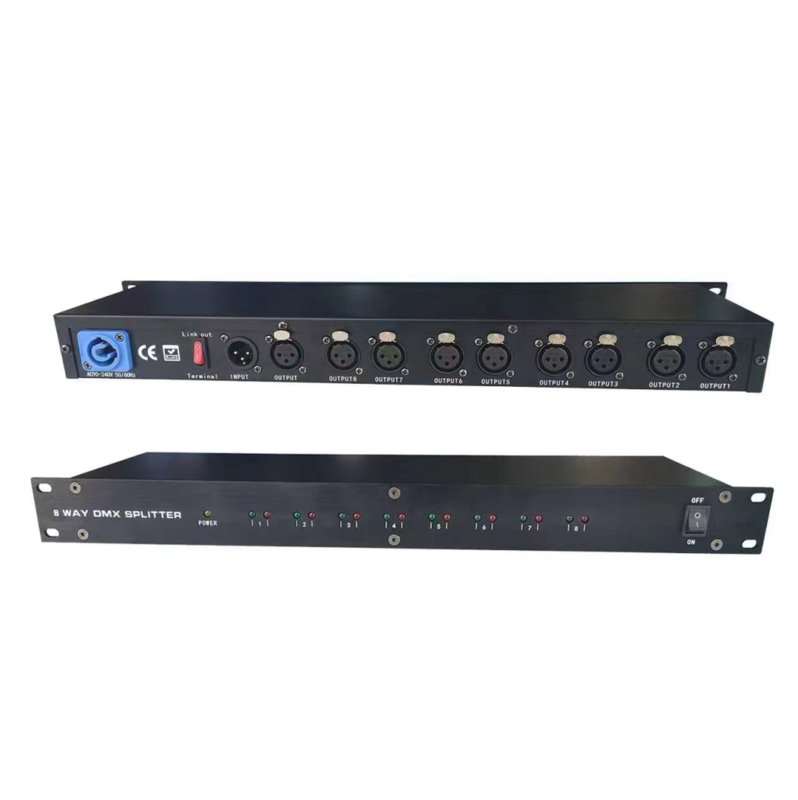
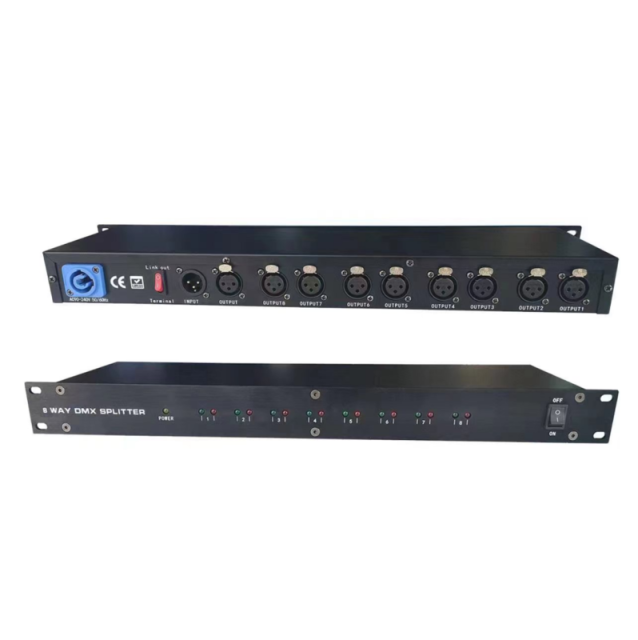
This is an eight-way DMX splitter — a DMX512 distribution amplifier that takes one incoming feed and sends it out again over eight separate branches. It is a single-purpose box: one DMX input, a LINK OUT connector, eight labelled outputs and no menus to work through.
Rental houses, installation companies and venue technicians are the people who buy this unit, and they buy it for one reason: a rig that has outgrown a single daisy chain. We build it as a DMX lighting controller manufacturer, which is why it is a plain, serviceable box rather than one full of features nobody opens in a dark rack. Distributors stock it because it solves a problem on almost every project they quote.
The failure it removes is the one that costs the most show time: a chain wired fixture to fixture stops dead when a single connector fails in the middle. With this unit in the rack, each branch of the DMX lighting system runs to its own area off its own driver, so a bad cable costs you one part of the stage instead of the whole show.
In a working rig it sits directly downstream of the DMX 512 controller. Everything before it is a single universe; everything after it is eight short, clean runs that end at the last fixture in each area. That is the whole idea — keep the controller's output on one short cable and let the splitter do the travelling.
Key Features
- Isolation on every output. All eight ways are photoelectrically isolated, each with its own protection circuit. That is the difference between an active splitter and a passive fan-out: a shorted cable on one branch does not take the other seven down with it.
- Ground isolation between branches. The unit breaks the electrical ground path between the branches of the star, which is the standard cure for flicker, dropouts and fixtures that die for no obvious reason on a rig fed from more than one supply.
- Active amplification and reshaping. The incoming DMX signal is amplified and rebuilt before it leaves each output, so long runs to a balcony rail or a delay position stay reliable instead of degrading with distance.
- Past the 32-device ceiling. A single RS485 line will carry 32 devices; star wiring from this unit lets a show grow beyond that without stacking splitters or guessing which fixture is dragging the line down.
- A panel you can read at a glance. INPUT, LINK OUT and OUTPUT 1 to 8 are printed on the front, the status LEDs face the operator, and a rocker switch is the only control on the box.
- Rack-standard build. A 1U chassis that bolts into the same rack as the dimmers and amplifiers, with screw-mounted connectors that survive season after season of repatching.
- Mains with nothing external. The power supply is built in, with the mains socket and fuse on the rear panel, so there is no inline adaptor to lose in a flight case.
- Standard DMX512 in and out. It does not care what generates the signal — a lighting desk, a laptop interface or a DMX LED controller all connect the same way, whichever DMX lighting controller supplier the console came from.
Console & Signal Chain Compatibility
- Any DMX512 console. It speaks plain DMX512 — no proprietary protocol, no driver, no software version to match. If your DMX lighting controller outputs standard DMX, it will drive this unit.
- All the usual receivers. Dimmers, colour changers, moving lights, LED fixtures and hazers connect to the outputs exactly as they would to the console, because the splitter only repeats the signal it is given.
- DMX only, deliberately. There is no RDM and no ArtNet inside this model. It is the pure distribution stage of a DMX lighting control system: nothing to configure, nothing to fail in a menu, nothing to relearn when a different operator takes the desk.
- XLR connections throughout. The input, the LINK OUT and the eight outputs use XLR sockets, so the unit patches with the same cables as everything else in the rig.
- Made for dense moving-head rigs. Where a DMX controller for moving heads is already close to its fan-out limit, this is the unit that lets the same controller address more fixtures with a clean signal on every branch.
- Chainable with LINK OUT. The link connector carries the same signal to a second unit, so a 16- or 24-branch system is built from identical boxes rather than a special order.
Applications
On a touring rig the splitter usually lives in the dimmer rack and feeds one branch per truss. The console goes in once and each truss gets its own run, which matters when a moving head takes a knock and shorts its DMX line mid-show. Rental companies treat it as the piece that turns a DMX controller for moving heads into something able to feed eight separate parts of a stage.
In theatres, school halls and multi-purpose venues the unit stays in the rack year after year. The wiring stays legible — eight numbered outputs, one per lighting position — so a technician can unplug a single branch instead of the whole universe when a fixture fails. It is also what makes a venue easy to hand back to its own staff after commissioning.
Clubs and bars use it to break one room into zones: bar top, dance floor, entrance, terrace. The DMX LED controller stays behind the bar, one feed goes to the splitter, and each zone gets a clean branch that can be serviced without darkening the rest of the room.
For arena and stadium shows, one DMX lighting controller position can reach front truss, delay positions and back truss without three long home runs. Signal holds up because every branch is driven fresh from the splitter instead of being tapped off the end of the previous run.
Specifications
| Specification | Detail |
|---|
| Model | DMX-8I |
| Function | 8-way DMX512 distribution amplifier (signal splitter) |
| DMX input | 1 input |
| DMX outputs | 8 outputs, each with an independent protection circuit |
| Isolation | Photoelectric isolation on every output, with full electrical ground isolation between branches |
| Signal handling | Amplifies and reshapes the incoming DMX signal |
| Link | LINK OUT connector for feeding a second unit |
| Indicators | Front status LEDs for power and outputs |
| Input voltage | AC90V–240V |
| Mains frequency | 50 Hz / 60 Hz |
| Power rated | 15 W |
| Dimensions | 19" 1U, 530 × 190 × 110 mm |
| Gross weight | 2.3 kg |
Installation & Commissioning
- Decide the rack position first. Put the unit near the dimmers and leave the rear accessible for the mains lead and the DMX input; everything else is patched on the front.
- Feed it from the console. Keep the cable from the desk to INPUT short, because the whole point of the splitter is that the controller's output no longer travels the length of the venue.
- Run one output to each physical area. A truss, a side stage, a balcony rail or a run of LED battens each get their own branch, so a fault stays inside one part of the DMX lighting control system.
- Use LINK OUT when eight is not enough.
- Terminate the last fixture on every branch. DMX is a bus, and a 120 Ω terminator at the end of a long branch is standard practice — far cheaper than chasing an intermittent fault during a show.
- Check the LEDs before you address anything. Power and output status tell you straight away whether a branch has data, which turns a cable hunt into a two-minute check.
- Keep it off dimmed power. The splitter needs a constant mains supply, so take it from the rack's direct supply rather than a dimmer channel that ramps with the show.
Ordering & Delivery
- Confirm the branch count. Eight outputs covers most rooms; if the venue needs more, plan a second unit and a link cable rather than assuming one box will do.
- Confirm the connector standard.
- Confirm what feeds it.
- Whether the signal comes from a console, a laptop interface or a DMX LED controller, the unit takes standard DMX512 — send us the controller model if you want the output stage checked against it.
- Get lead time, minimum order quantity, payment terms and shipping terms in writing.
- Production schedules move with the season, so lock the dates for the week you actually need the units.
- Ask what comes in the carton and how bulk orders are packed, especially if the units go straight into your own distribution rather than onto a shelf.
- Quote the whole chain together.
- As a DMX lighting controller manufacturer we supply the splitter, the console and the fixtures, so a project can be priced on one set of terms instead of three.
- Ask your DMX lighting controller supplier for the current documents — specification sheet, manual and compliance paperwork — so nothing in your submittal is out of date.
| Document | What it covers |
|---|
| Specification sheet | Electrical and mechanical data — input voltage, rated power, dimensions and gross weight — for your submittal file |
| User manual | Panel layout, connector pinout and the setup sequence for the unit |
| Connection layout | A star-wiring plan showing the input, the eight branches and the link connector |
| Packing list | Carton contents and gross weight for freight and customs paperwork |
| Warranty statement | Coverage terms for your market — ask your sales contact for the current version |
| Compliance documentation | Market-specific paperwork for tender files, supplied on request |
| CE marking | Carried on the rear panel of the unit |
Technical Support & Model Matching
More than 30 engineers with an average of 15+ years in professional lighting stand behind every order — the same people who answer your technical questions. Tell us your venue, rigging height, throw distance and existing control setup; we help match models, check protocol and channel fit, and build a package that works as one system. If a fixture misbehaves on site, we work through the fault with you and sort out spares. Installation and commissioning guidance come with the order. Founded in 2016, exporting since 2022, LITEVISION serves buyers in more than 80 countries from offices in the USA, Taiwan, Mexico and China.
FAQ
Do all eight outputs carry the same signal?
Yes. Every output carries the same incoming universe from your DMX 512 controller, so a fixture on output 3 and a fixture on output 7 with the same address behave identically. Plan addresses across the eight branches exactly as you would for one long chain — the splitter changes the wiring, not the patch.
Does this splitter support RDM?
No. This model is a pure DMX512 distribution amplifier, so there is no RDM round-trip and no remote addressing. As a DMX lighting controller manufacturer we also build RDM and ArtNet units in the range, and those are the ones to look at if you want to read or change fixture addresses from the desk. On a fixed rig where addresses are set once and left alone, the DMX-only version is the simpler and more predictable box.
How is it different from the six-way splitter?
Branch count and mounting. This unit gives you eight outputs in a 19-inch 1U chassis that lives in a rack; the six-way model gives you six outputs in a body that straps to a truss. Both isolate every output. If your DMX lighting controller position is a rack and the runs go out to fixed positions, take the eight-way; if you are building a DMX lighting control system that moves every week, the truss version saves rigging time.
What connectors does the unit use?
The panel carries XLR sockets for the input, the LINK OUT and the eight outputs, the same connector family as the rest of a standard rig. That makes it a direct plug-in between your DMX controller for moving heads and the fixtures, with no adaptor tails. If your installation standard is 5-pin rather than 3-pin, tell us before the order is placed so we can confirm what is possible.
Can I link two units together?
Yes — the LINK OUT connector passes the incoming signal on to a second unit, so a venue that outgrows eight branches is handled with another identical box. Keep the link cable short and treat each unit as its own star point; the isolation you are buying lives inside each chassis, and chaining does not change that.
Where should the unit be mounted?
This is a rack-mount distribution amplifier, so plan it into a dry, protected position — a dimmer room, a rack, or a covered spot side stage. It is not built to sit open on an exposed truss in weather. If a venue has no protected position available, tell us before you order and we will talk through how installers normally handle that room.