Product Overview
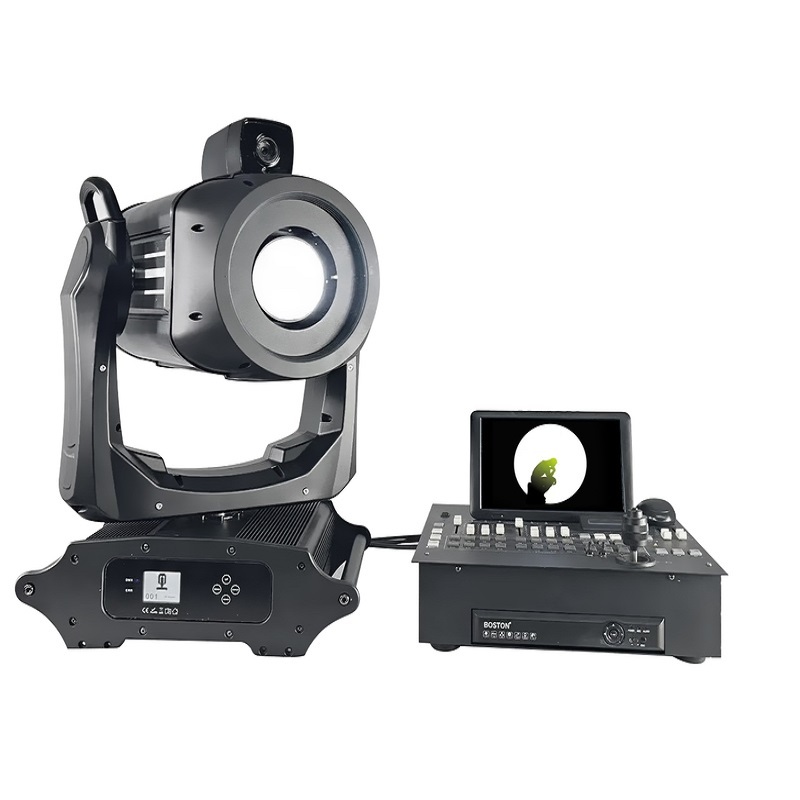
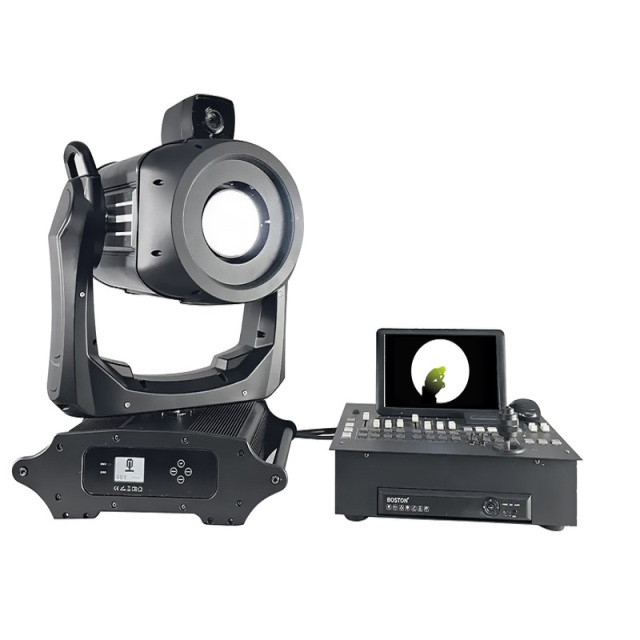
This system pairs an LED follow spot light head with a dedicated control console carrying a 20x zoom camera, a joystick and a preview screen. The head throws the light; the console is what the operator actually looks at and drives. Buying both together is what makes the workflow possible. It exists because front-of-house positions are far from the stage. The head projects the length of an arena and zooms from a tight picking spot to a broad pool, so a performer standing at the far end of the floor is still a defined figure rather than a smudge of light. That reach is also why the system carries a camera: at those distances an operator cannot aim reliably by eye alone. One person runs the whole moving head light show position. They frame the performer on the camera preview, steer with the joystick, and change how quickly the head responds as the number changes pace. There is no second operator calling positions and no separate follow-spot chair in the roof. Typical users are touring rental houses, theatres and opera houses with a fixed front-of-house position, TV studios that need a controlled spot on a presenter, concert and stadium production teams, and large worship or conference venues where the stage is deep and the audience sits a long way back. It works alongside the rest of a rig rather than in place of it. The console also functions as a moving head light controller for other fixtures on the plot, so it can carry more of the show than just the follow spot if that suits the way you run a console. As a follow spot light manufacturer, we build both halves as a matched pair, which is why the joystick response, the axis direction settings and the camera framing are already tuned to this head.
Light Head & Optical Performance
- Stepless linear electronic focus.
- Focus is racked from the console with no mechanical lever, so the edge stays sharp as a performer walks toward the light rather than drifting soft mid-number.
- 0–100% linear dimming.
- Fades are smooth and repeatable, which matters when the follow spot has to fade out under a musical cue instead of cutting hard.
- Electronically adjustable aperture with an automatic size function.
- Tighten the beam to keep spill off a backdrop, a set piece or a camera frame without sending anyone up to the fixture.
- Yoke-mounted led moving head spot light with a circular front lens.
- Because the source moves instead of the operator, a single mounting position can serve the whole stage from one rigging point.
Colour, Frost & Shutter Control
The colour wheel gives you white plus red, yellow, blue, green and rose red — enough for the standard stage looks without adding a separate colour scroller to the rig. Two colour palettes are available, so a designer can keep one set of colours for one act and a different set for the next.
CTO correction runs through 3200K, 4500K, 5600K and 6500K, the span between a warm tungsten stage and a cool daylight look. That is what lets the spot sit inside the rest of the rig's colour temperature instead of fighting it, and it shows most clearly on camera, where a mismatched spot reads immediately on skin tone.
The atomization effect softens the beam edge and can be brought in gradually. A hard-edged spot is right for a dance number or a reveal, while the softened version suits a ballad or a close-up, where a sharp circle drawn across a face looks harsh.
Colour and frost changes can be given a gradient rather than snapping from one state to the next, so a look can move with the music. In a moving head light show built on slow transitions, that is the difference between a visible step and a smooth change the audience never notices.
The shutter and strobe on this dmx moving head light are electronically controlled, which gives the operator instant blackouts and clean accents from the same console, without leaving the joystick to reach for a separate control surface.
Camera-Assisted Targeting
- Set the operator position.
- The console preview is what the operator works from, so the position needs a clear sight line for the head rather than for the person — the back of the house, a side-stage riser or a booth all work, because the operator is watching a screen.
- Frame the performer with the camera.
- The camera gives 20x zoom at 5 megapixels, enough to fill the preview with a single figure from the far end of the room and to keep them large in frame as they move downstage.
- Set the axis direction on the console.
- The console can flip the positive and negative direction of the X and Y axes at any moment, so the joystick moves the way the operator expects regardless of how the head is hung or which way the operator is facing.
- Drive with the joystick.
- Up, down, left and right with an adjustable speed — slow for a controlled walk, quicker when the performer covers ground.
- Custom three-phase motors on pan and tilt keep the movement fast and stable rather than jerky.
- Hold the position through the number.
- This is the working difference between this system and a pre-programmed moving head spot light: the operator is following a live person and correcting continuously, rather than replaying a cue and hoping the performer hits their mark.
- Recover from a knock.
- The head carries an automatic photoelectric reset and correction system, so if it is disturbed or loses its reference it returns to its original position on its own.
Console & DMX Control
| Console role | Moving head light controller for this follow spot system |
| Control channels | 240 in total |
| Fixtures controlled | Up to 12 lights |
| Channels per fixture | Up to 16 |
| Programs | 12 |
| Scenes | 480 steps in total |
| Scene pause time | 0.1–25.5 s per step |
| Scene fade speed | 0.1–25.5 s |
| Display | 10-inch LCD |
| DMX output | 3-pin XLR |
| Storage | 128K memory card |
| Joystick | Up / down / left / right, with speed adjustment |
| Axis setting | X and Y direction reversible at any time |
| Monitoring | Live camera preview on the console screen |
Installation, Rigging & Commissioning
- Confirm the position before anything is ordered.
- The follow spot light needs a sight line to every part of the stage it is expected to follow, upstage corners included, and the operator needs a sight line to the console.
- Check the mounting point with the venue. This head hangs from a yoke mount, so the truss, bracket or platform has to be rated for it and any clamp or half-coupler has to match the venue's rigging hardware.
- Send us the rigging plan; as your moving head light supplier we will confirm mounting and clearance before the units ship.
- Bring power to both ends.
- This led moving head light runs on standard single-phase mains at 110–240V, 50/60Hz, and the console needs its own supply at the operator position rather than a long extension back to the dimmer room.
- Run the data.
- DMX512 travels from the console to the head on a 3-pin XLR cable; treat this dmx moving head light like any other fixture on the run and keep the cable clear of dimmer racks and power lines.
- Address the fixture and patch the console.
- Set the head at 16 channels and patch it so the joystick, the axis settings and the scene memories all drive the parameters you expect.
- Align the camera with the beam at first focus.
- Aim the head at a known point on stage, then bring the camera onto that same point until the centre of the preview matches where the spot actually lands.
- Run a full-stage test before the first show.
- Sweep the beam to the stage corners, the front edge and the deepest upstage position, and store those positions as scenes so the operator starts every number from a known place.
System Specifications
| Light source | 1000W LED |
| Total power | 1200W |
| Input voltage | 110–240V, 50/60Hz |
| Beam angle | 5–30° |
| Projected light distance | 120–200 m |
| DMX channels | 16 |
| Colour | White, red, yellow, blue, green, rose red |
| Colour temperature correction | CTO 3200K / 4500K / 5600K / 6500K |
| Frost | Atomization effect, gradient available |
| Pan / Tilt | 540° / 210°, custom three-phase motors |
| role | Photoelectric reset and automatic correction |
| Fixture dimensions | 650 × 580 × 980 mm |
| Fixture weight | N.W. 38.5 kg / G.W. 42.5 kg |
| Flight case | 530 × 430 × 320 mm, 23 kg |
Ordering & Documentation
- Technical documents.
- Ask your sales contact for the datasheet, the DMX channel chart for this dmx moving head light, the user manual and the photometric file for the exact configuration you are quoting, so the paperwork can go straight into a tender or a client pack.
- Warranty.
- Confirm the current warranty period and what it covers on this led moving head light and its console — the LED module, the pan and tilt motors and the control electronics — and ask specifically whether it is parts only or includes labour.
- Lead time.
- Production and shipping timing depend on quantity and configuration, so confirm both against your show date before the order is placed.
- Quantity.
- As a moving head light supplier we quote single systems, multi-unit orders and rental fleet quantities, so ask what is possible for your order and whether heads and consoles can be supplied in the ratio you need.
- Payment and trade terms.
- Confirm the payment method, the currency and the Incoterms that apply to your destination before the order is confirmed.
- Returns and quality claims.
- Ask how transit damage, or a unit that does not match the specification, should be reported and what the reporting window is.
- Compliance.
- Tell us the destination market and we will confirm which test reports and declarations are available for that country — we only quote documents that exist for that market.
- Packing, spares and replacements.
- Ask how the head and the console are crated for export, whether the flight case travels with the system, and which spares are worth holding for a tour or a long run.
- Both halves come from us as the follow spot light manufacturer, so a replacement head or console is built to the same specification as the one you already own.
Technical Support & Model Matching
More than 30 engineers with an average of 15+ years in professional lighting stand behind every order — the same people who answer your technical questions. Tell us your venue, rigging height, throw distance and existing control setup; we help match models, check protocol and channel fit, and build a package that works as one system. If a fixture misbehaves on site, we work through the fault with you and sort out spares. Installation and commissioning guidance come with the order. Founded in 2016, exporting since 2022, LITEVISION is a moving head light supplier to buyers in more than 80 countries, with offices in the USA, Taiwan, Mexico and China.
FAQ
Can we run the head from our own DMX console instead of the supplied one?
Yes. The head takes DMX512 at 16 channels over a 3-pin XLR connection, so it patches into a house console like any other fixture on the plot. What you leave behind by dropping the supplied desk is the camera preview, the joystick and the axis-reversal setting — those functions live in the console, which is the moving head light controller for this system, not in the head.
Does the operator need a window or a clear view of the stage?
No window is needed. The operator works from the camera preview on the console, so the position can be at the back of the house, in a booth or at the side of the stage. What does matter is that the head itself has a clear line to every part of the stage it has to follow.
Which end of the zoom range should I use for a long throw?
At long throw, keep the beam toward the narrow end so the spot stays tight and bright on a single figure. Open it up when the stage is closer, when the act moves downstage, or when you want a wider pool covering a group rather than one performer.
Is the frost a fixed filter or can it be dialled in gradually?
It is an atomization effect with gradient control, so softness comes in gradually rather than switching on in one step. That makes it practical to go from a hard-edged spot on a dance number to a soft pool on a ballad inside the same moving head light show, without a filter change.
Can the system be installed permanently in a theatre, or is it only for touring?
Both. The flight case and the compact body suit a touring schedule, and nothing about the design ties it to the road — a fixed front-of-house position works just as well. What you should confirm for a permanent install is the mounting point and the mains supply at that position, since a led moving head light of this size draws real power and needs a rated fixing.
What is the difference between this and a standard moving head spot light?
A standard moving head spot light replays a cue: it goes where it has been programmed to go. This system is aimed live by a person, which is what a follow spot has always done. The camera, joystick and preview screen exist so that one operator can track a moving performer in real time from a position a long way from the stage.