Product Overview
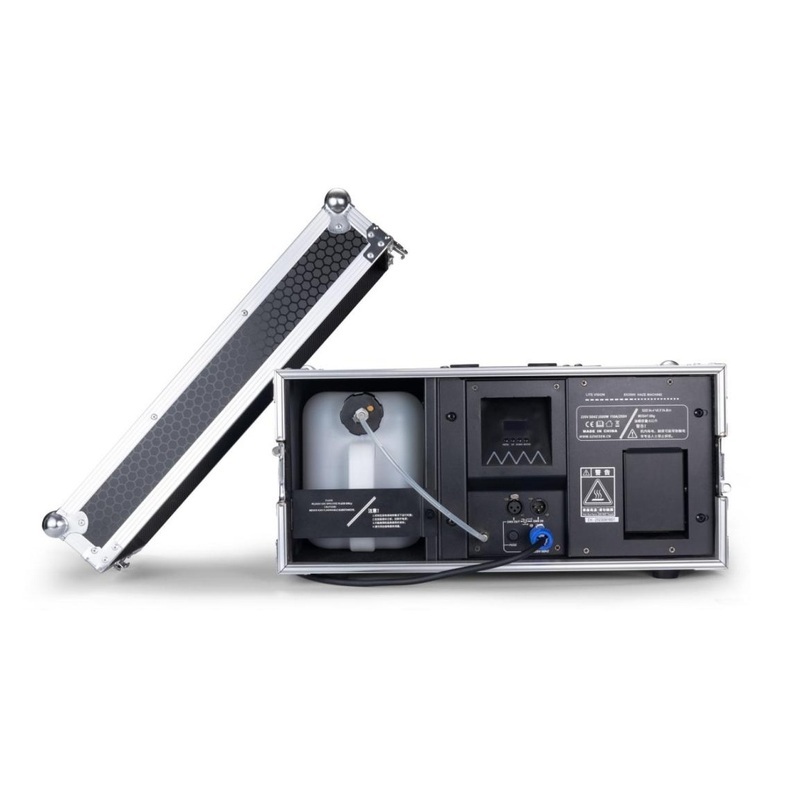
A 2,000 W oil base haze machine built by stage lighting manufacturers to keep a mid-size hall filled from the first cue to the last. Oil base fluid leaves a much finer particle in the air than water-based fog, so beam edges hold, gobos stay readable and a camera does not record a solid wall of white. It is the machine for rooms where one unit has to carry the atmosphere for a whole programme: touring rental fleets, mid-size theatres and halls, club rigs, and event companies that want the same model repeatable across several venues. Once the level is set, nothing about it needs an operator standing at the machine. In the range it sits between the 600 W entry model and the 3,000 W flagship — the middle of three oil base haze tiers, and the practical one for most venues. There is enough output to fill a hall steadily without turning the air milky, which is exactly what a laser light show and a beam-heavy design need from the haze layer. Channel behaviour, fluid questions and fault finding all go to the same team that builds the unit.
Key Features
- Continuous output, not a burst — the machine is designed to hold a working level for hours, so a long set does not lose its atmosphere halfway through the second act.
- About a minute of preheat — short enough to power up during a changeover instead of at the start of the day.
- A 6 L reservoir — fewer refills across a show night, and topping up is a rear-panel job rather than a case rebuild.
- Two DMX channels — works with any dmx controller, with no proprietary protocol and no adapter box to lose.
- XLR in and out on the rear panel — patch in from the console, daisy-chain to the next fixture, and reach the fluid and the connectors in the same place.
- 18 kg in its flight case — one person can lift, load and stack it, and the case protects the panel, nozzle and reservoir in the truck.
- A familiar layout for fleets — stage and lighting companies can put the same model into several rooms without retraining operators site by site.
- Made to sit under beams — pair it with moving heads and lasers and the haze gives a laser light show the volume it needs from the back row.
Output Tiers Compared
| 600 W class | About 3,500 cuft/min, 3 L reservoir, one DMX channel |
| 2,000 W class | 16,000 cuft/min, 6 L reservoir, two DMX channels |
| 3,000 W class | Up to 60,000 cuft/min, 10 L reservoir, two DMX channels |
| Small rooms and bars | 600 W class |
| Mid-size halls, theatres and touring | 2,000 W class |
| Arenas, large stages and long outdoor runs | 3,000 W class |
| Weight reference | 18 kg for the 2,000 W class, 42 kg for the 3,000 W class |
| Power | AC 220–240 V, 50–60 Hz across the range |
| Rig partners | Moving heads, profile fixtures, outdoor laser light show equipment |
Applications
- Touring and rental fleets — a cased machine a rental house, or one of the stage and lighting companies supplying them, can send out repeatedly with the same control layout in every venue.
- Mid-size theatres, halls and school venues — a level set once at the start of the evening and left to run, which is what a venue without a lighting department needs.
- Clubs, bars and live music rooms — a modest rig reads considerably larger when the air carries the beams.
- Festival and open-air stages — haze works harder outdoors, where throw distances grow and a breeze thins the air, and it is standard equipment on outdoor stage lighting rigs.
- Keep the unit under cover and check the siting with us before the event.
- Laser and beam-led designs — when the look is built around shafts and a laser light show, the haze layer is what makes the beams solid from the back of the room instead of a thin line.
- Mixed rigs — moving heads, profile fixtures and lasers from an outdoor laser light supplier all read better through haze, and one machine aimed across the beams can serve the whole stage.
Specifications
| Model | EK-2000 |
|---|
| Operating voltage | AC 220–240 V, 50–60 Hz, 10 A |
| Power | 2,000 W |
| Output | 16,000 cuft/min |
| Preheat time | About 1 minute |
| Fluid capacity | 6 L |
| Fluid type | Oil base haze fluid |
| Control | Remote control, DMX512, OLED panel |
| DMX channels | 2 |
| Net weight | 18 kg |
| Gross weight | 19 kg |
| Machine size | 517.5 x 260 x 220 mm |
| Package size | 544 x 405 x 248 mm |
| Supplied in | Flight case |
Set-Up, Fluid & Care
- Set the machine on a level surface, upstage or off to one side, with the nozzle aimed across the performance area rather than into the audience.
- Haze travels — you want it to cross the beams, not sit on the front row.
- Fill the reservoir with oil base haze fluid at the rear panel, keep the tube submerged and leave headroom at the top.
- Check the level before doors rather than during the interval.
- Run the signal cable — XLR in from the dmx controller or console, XLR out to the next fixture in the chain.
- Set the address and patch the machine into the venue's dmx lighting network.
- Tape the address inside the case so the next operator finds it without guessing.
- Power up, let it preheat for about a minute, then run a test burst and watch where the haze actually goes.
- On a stage with moving heads or outdoor laser light show equipment, small changes in aim make a large difference to how the beams read.
- Set the working level, write it into the show file and hand the remote to whoever is running the room, so the next person can repeat the same look.
- After the show, power down, let the heater cool, cap the fluid, wipe the nozzle and panel, and close the case.
- Store the machine upright and keep the fluid container separate from the case.
Ordering & Documentation
- As stage lighting manufacturers we build to order, so tell us the destination country and the plug and paperwork are matched to it.
- Describe the room — size, ceiling height, whether the position is covered, and whether the run counts as outdoor stage lighting.
- That decides the tier and how many units you need.
- Ask for the documents — specification sheet, DMX channel table, user manual, and a console profile if your programmer needs one.
- Request the current versions with your quotation so the paperwork matches the machine that ships.
- Confirm what is in the case — the haze machine, the fluid reservoir and tube, the power cable, and whether a remote handset is included in your order.
- Confirm the commercial side — lead time, minimum order quantity, packing, shipping terms and payment — with your sales contact and in writing on the quotation.
- If you are a rental house, or one of the stage and lighting companies standardising a fleet, say so at this stage.
- Line up the rest of the rig — moving heads, lasers and anything else sharing the stage.
- We are an outdoor laser light supplier as well as a builder of haze machines, so the effect can be specified as one package.
- Plan for the season — ask which spare parts we suggest keeping on the shelf, confirm local availability of oil base fluid, and check the warranty, repair and spare-parts terms that apply to your order, including how quality claims are handled.
- Three ways to run it.
- The rear OLED panel handles level, menu and status on its own, and it is the route most venues without a console use.
- The remote handset covers quick changes from the floor, and DMX512 hands control to the show.
- Inside a dmx lighting rig the machine occupies two channels and behaves like any other two-channel fixture, so it slots into a cue stack without a separate control box.
- Any dmx controller will drive it — the protocol is standard DMX512 rather than a vendor system, and there is nothing to install on the console beyond a two-channel patch.
- The channel map. Two channels carry the machine's functions; ask us for the DMX channel table before you build cues so the addresses in your show file match the unit that arrives on site.
- Support behind the panel.
- As stage lighting manufacturers we build the machine and its channel map, so a profile request or an unusual behaviour is answered by the people who designed it.
Technical Support & Model Matching
More than 30 engineers with an average of 15+ years in professional lighting stand behind every order — the same people who answer your technical questions. Tell us your venue, rigging height, throw distance and existing control setup; we help match models, check protocol and channel fit, and build a package that works as one system. If a fixture misbehaves on site, we work through the fault with you and sort out spares. Installation and commissioning guidance come with the order. Founded in 2016, exporting since 2022, LITEVISION serves buyers in more than 80 countries from offices in the USA, Taiwan, Mexico and China.
FAQ
How is this different from a smoke machine?
A smoke machine is for a dense burst at a cue — a cloud that rolls across the stage and clears. This machine produces haze: a fine, almost invisible layer that stays in the air and keeps beams, gobos and camera lighting readable for the length of a show. If the audience needs to see every shaft for two hours, haze is the tool; if you need one thick moment at the top of the second act, it is not.
How long does a full 6 L reservoir last?
That depends on the level you run and the length of your programme, so there is no single figure. Because the machine holds a set output, running it lower stretches the fluid further. Check the reservoir between acts and top it up before it empties rather than during a cue, and if you want an estimate for a specific show length, tell us the schedule and we will work through it with you.
Can I run it from my console?
Yes. It takes two DMX channels, so any console that can address a two-channel fixture will run it, and it sits inside a dmx lighting setup as a normal fixture rather than a proprietary system. If there is no console on site, the OLED panel and the remote handset do the same job. Ask us for the channel table before you build your cues.
Will it work on a 110 V supply?
No. The machine is built for AC 220–240 V, 50–60 Hz on a 10 A circuit. Check the supply and the plug arrangement in the venue before the load-in, and if the site runs a different voltage, raise it with us before the order so nothing is assumed on either side.
Can it be used outdoors?
It is regularly used on covered stages and at open-air events where the machine sits under a roof or a truss canopy. The housing does not carry a published weather rating, so treat it as an outdoor stage lighting machine only where it is sheltered from rain and standing water. Send us a photo of the intended position and we will tell you what we would do in that spot.
What fluid should I use?
Oil base haze fluid, matched to this machine's heater — not water-based fog fluid. Confirm the fluid specification with us before you change brands or buy locally, and never let the reservoir run dry, because the heater and pump operate reliably with fluid in them.
Can the haze be specified together with the beams?
Yes. Haze and beams are usually planned as one package, and because we are also an outdoor laser light supplier, the machine and the lasers can be specified and documented together. Tell us the rig you are building and we will confirm what pairs cleanly with this output level.