Low Fog, Haze and Smoke Compared
- Low fog is heavy and stays down. The output leaves the machine cool, spreads across the floor and rolls in a slow band instead of climbing into the truss, so the effect reads as ground mist, water or dry ice rather than as room fog.
- Haze and smoke are built for volume. An oil-based haze or smoke machine fills the whole room so beams become visible from truss to floor; a low fog machine gives you a defined layer with clear air above it.
- They answer different design questions. When the brief calls for moving head light beams cutting across the audience, that is a haze job. When it calls for the floor to disappear, it is a low fog job.
- The layer also changes what a laser light show looks like. Beams that would otherwise pass over the audience become visible lines where they cross the fog band, at head height rather than only up in the rig.
- Run them together. Many shows keep a light haze above for the beams and use low fog for the floor, so the stage has depth instead of one flat wash.
- It will not replace a smoke machine for punch effects. A short, dense burst that travels up and out stays a smoke machine's work; low fog is a sustained layer that is built over a minute or two and topped up during the show.
- In theatrical stage lighting the low layer is usually a scene effect rather than a constant. Professional stage lighting companies cue it for an entrance, a transformation or a finale — it is the image the audience takes home.
Product Overview
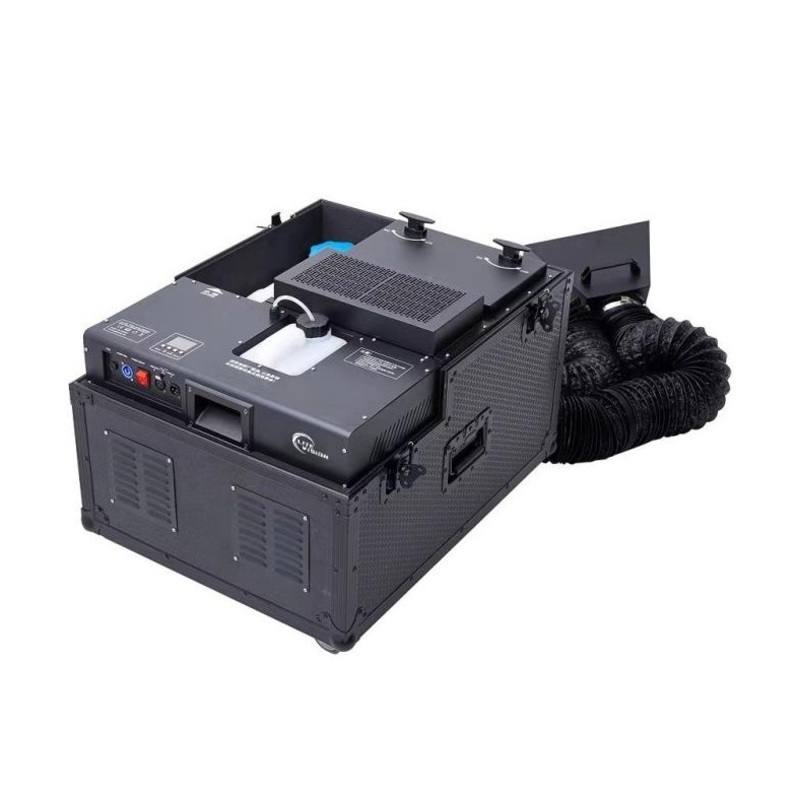
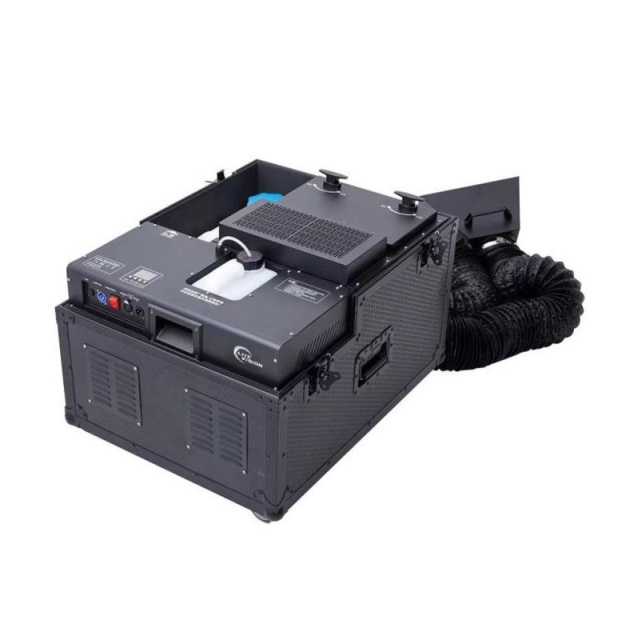
Rather than pushing a cloud up into the rig, it produces a heavy layer that settles at floor level and rolls slowly across the deck, so performers, set pieces and the front rows sit inside the effect instead of underneath it. It is the machine for the moment a director asks for a lake, a graveyard, a dream sequence or a walk-on that seems to happen above the ground. In theatrical stage lighting the floor is the first surface the audience reads. A low layer hides the stage deck, softens the edges of platforms and gives side light and back light something to bite into, while the air above stays clear so faces and costumes stay sharp from the back of the house. Output is what separates this model from a club unit. Warm-up takes about five minutes, so the machine can be brought up inside a scene change. We build this model as part of a full effects line. As stage lighting manufacturers we also supply the haze, smoke, spark and laser units that share the same stage, so a floor package can be specified, packed and supported by one team rather than three.
Control and Patching
- Pick the operating mode first. The machine runs from the LCD panel on the unit, from the hand-held remote, or from DMX — decide which one the show will use before you run cable.
- On DMX it takes a single channel. Give it one slot in the universe and note the address on the patch sheet; there is no multi-channel personality to learn and nothing to map beyond that one value.
- Set the address on the panel and test before you build cues. Raise the value and watch the output build — a one-channel machine is quick to prove, which is why it is worth doing during focus rather than at doors.
- Keep the remote with the machine. If your dmx controller sits at front of house, the remote is still the fastest way to test the unit or run a layer by hand while the desk is being patched.
- Patch it with the rest of the rig. The unit sits in the same universe as your dmx lighting, so the fog cue can live in the cue stack next to the wash and profile levels instead of on a separate operator.
- Treat it like any other fixture in the patch. Give it a name, a universe, a channel and a labelled cable end — operators find it faster when it is listed the same way their moving head lights are.
- Write the two values you use on the patch sheet: one for a full layer and one for a thin one. Whoever runs the next show will thank you, and the layer will look the same on night one and night thirty.
Venue Applications
- Theatre, opera and dance: a lake, a graveyard, an underworld entrance or a dream sequence, built during the scene change and held under the performers while the air above stays clean.
- Concert and arena tours: the machine sits upstage and lays a layer across the whole performance area between numbers, so the next song opens on a different floor. Rental fleets and professional stage lighting companies often place one per side on wide stages.
- Theme parks, dark rides and walk-through attractions: a continuous band of fog along a path or a queue line, where the effect has to be there for the whole operating day.
- Nightclubs and live music venues: the drop, the first beat and the reveal, run from the booth on one channel with nobody standing next to the machine.
- Corporate launches, car reveals and weddings: a floor that reads as water or cloud for a first dance or a product reveal, with the machine hidden behind a set piece.
- Film, television and photo shoots: a controlled layer at floor level that stays below the frame line, so the floor can be dressed without fogging the faces.
- Laser and multimedia productions: one machine covers a wide front-of-stage area, and the fog band a laser light show cuts through stays the same width and density on every night of the run.
- Rental stock and dry hire: teams buying from stage lighting manufacturers want one unit that covers theatre, touring and event work — fewer models to keep, service and explain to clients.
Specifications
| Model | EK-L3000 |
|---|
| Power | 3000 W |
| Voltage | AC220V, 50 Hz, 15 A |
| Output | 32,000 cubic feet/minute |
| Warm-up time | 5 minutes |
| Fog fluid capacity | 3 L drum |
| Water tank | 16 L |
| Control | Remote control, DMX512, LCD screen |
| DMX channels | 1 |
| Consumption at full output | 1.623 per hour |
| Net weight | 50 kg |
| Gross weight | 50.5 kg |
| Machine dimensions | 700 × 550 × 570 mm |
| Outer box dimensions | 715 × 560 × 580 mm |
Water and Fog Fluid System
Two reservoirs, two jobs. The water side is the larger of the two, which is what allows a layer to be held across a long scene without stopping to refill. Budget fluid from the published figure. Fill it where it stands. Lifting a full unit onto a stage edge is how tanks get spilled and backs get hurt. Drain and clean between runs. Standing water left in the tank between tours is the usual reason a machine is slow to build a layer on the first cue; empty the tank and follow the cleaning routine in the manual before the unit goes back on the truck or into storage. Keep the fluid consistent. Low fog fluid is not interchangeable with oil-based haze fluid, and mixing grades across machines on the same tour makes the layer behave differently from venue to venue — which is why stage lighting manufacturers publish a fluid spec for each model.
Ordering and Delivery
- Check the supply on site before anything else. The machine runs on AC220V at 50 Hz on a 15 A circuit, so give it its own breaker rather than sharing a ring with the lighting bar. If the venue runs a different supply, raise it before the order is scheduled so we can tell you what is possible.
- Agree quantity, price tier and lead time with your sales contact. As a stage lighting equipment supplier we quote minimum order quantity, volume tiers and production lead time per project, so the figures you receive reflect the units and the date you actually need.
- Put the commercial terms on the quotation. Payment method, currency, trade terms and the packing data are confirmed in writing before production starts, so your freight forwarder can plan the collection.
- Tell us which dmx controller you run, so the channel table and patch notes match the desk you actually use on site.
- Ask for the file set your programmers need. If your dmx lighting desk is programmed in advance, request the channel table with the order so the show file is built before the machine lands.
- Agree warranty, returns and spares cover in writing. Warranty period and scope, the route for a quality claim and the spare parts worth holding are set per order — your service team should know the process before the first show, not after it.
- Request the compliance documents your market needs. Tell us the country of installation and we will confirm which standards and test reports can be supplied with the shipment.
| Document | What it covers |
|---|
| Specification sheet | Power, output, tank capacities, dimensions, weights and packing data |
| User manual | Filling, control menus, warm-up and the daily maintenance routine |
| DMX channel table | Channel layout and the value ranges behind each function |
| Coverage and output data | Planning figures for layer width and output |
| Installation notes | Floor placement, clearance, cable routing and control connection |
| Compliance documents | Standards and test reports for your market, confirmed on request |
| Spare parts list | Recommended holding parts and replacement guidance |
Technical Support & Model Matching
More than 30 engineers with an average of 15+ years in professional lighting stand behind every order — the same people who answer your technical questions. Tell us your venue, rigging height, throw distance and existing control setup; we help match models, check protocol and channel fit, and build a package that works as one system. If a fixture misbehaves on site, we work through the fault with you and sort out spares. Installation and commissioning guidance come with the order. Founded in 2016, exporting since 2022, LITEVISION serves buyers in more than 80 countries from offices in the USA, Taiwan, Mexico and China.
FAQ
How many channels does it take in the console?
One. The machine uses a single DMX channel, so it takes one slot in your dmx lighting patch and nothing more. Set the address on the LCD panel, raise the value to check the output, and it is ready to cue.
Can I run it from a controller at front of house?
Yes. Any dmx controller that outputs DMX512 can drive it, and because the machine needs only one channel it will run from the smallest desk in the rack. The hand-held remote stays useful for testing during focus, or for a manual layer when the console is not up yet.
Will it fit into the same cue stack as my moving head lights?
It will. The unit sits in the same universe as your moving head lights, so it appears in the console beside them and can be triggered inside the same cue list. Most operators keep the fog on a separate playback fader so they can top up the layer without disturbing the beam looks.
Is low fog only for theatre?
No. Theatrical stage lighting is simply where the effect is most often specified, because the layer can be cued to a scene rather than left running. The same machine is used for concert openings, walk-through attractions and reveals; what changes is how long the layer is held and how often it is topped up.
Do you supply the rest of the effects package?
Yes. Working as a stage lighting equipment supplier we cover haze, smoke, spark and low fog units plus the controllers and cases around them, so a floor package can be specified as one order with one channel list and one spares conversation.
Is this model aimed at rental companies or at venues?
Both, for different reasons. Rental fleets and professional stage lighting companies buy it because one unit covers a wide stage and repeats cue to cue across a tour. Venues buy it because the layer is cued from the console the rig already uses, and nobody has to stand beside the machine during the show.
Can it be used with a laser light show?
Yes, and it is a common pairing. The layer is built first, then the laser light show runs over it live, usually from the same desk. Because the machine holds a steady band of fog, the beam pattern looks the same on the last night as it did on the first.
How much space and manpower does it need on site?
Plan for a two-person lift and a level spot with clearance around the housing — take the footprint and weight from the specification table when your crew plans the layout. Place it upstage or at the side of the deck and let the layer roll out across the floor rather than putting it in the middle of the performance area. If it is going into a tight set, confirm clearance and cable routing with us before load-in.