Product Overview
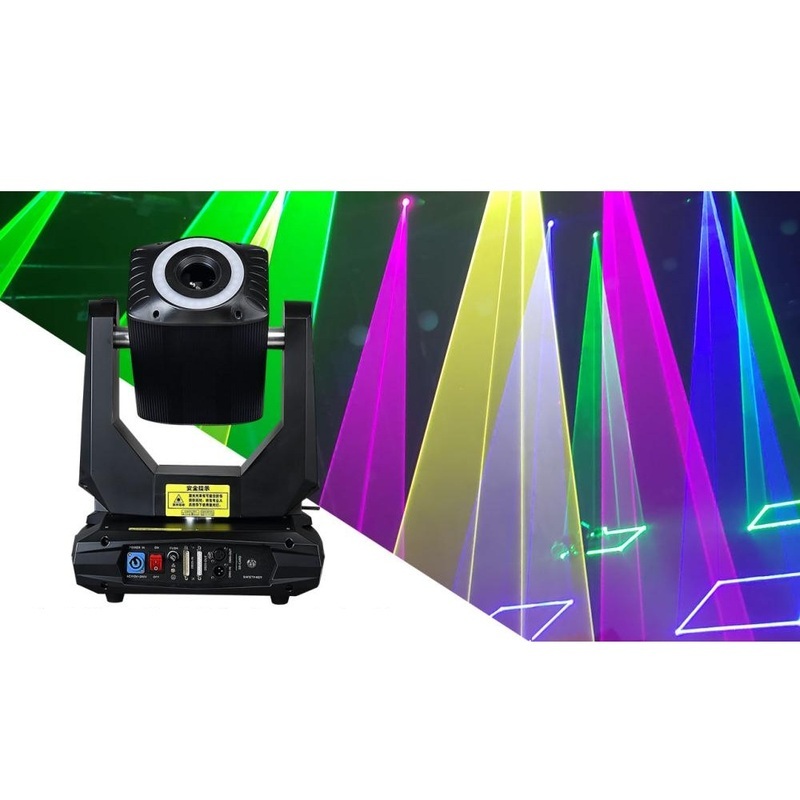
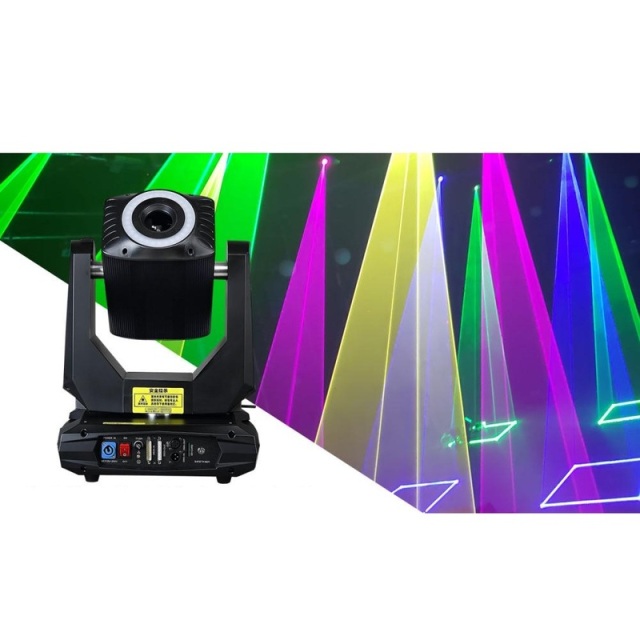
The LTLB-1200 is a full-colour moving head laser light for indoor stages, built around a 12W laser engine with an LED ring set into the front of the housing. The ring keeps the fixture visible in the rig even between laser cues, so the head reads as part of the lighting picture rather than a dark box on the truss. It is the larger of the two laser heads in the LTLB family. The control set, the scanner and the ring are shared with the smaller version, so the practical difference on site is scale — how much room and how many people the beams have to carry — rather than a different way of working. Pan and tilt cover a wide arc, enough to sweep a dance floor or a stage from a single hanging position without re-bracketing between shows. As a moving head laser light supplier we see most buyers put it where a fixed laser projector used to sit — bolted to one wall, unable to follow the room — or add it to a rig that until now has carried only beams and washes. A moving head gives the operator the same patterns from any angle, and one fixture covers positions that used to need several fixed units.
Beam & Pattern Library
- A library that works on arrival — 140 patterns and five pages of animation are stored in the fixture, so a club or small venue can be running a moving head light show on the first night without a programmer building every cue from scratch.
- Single pattern mode — in DMX the head holds one pattern while the desk drives the changes around it, which is how a dmx moving head light stays consistent night after night instead of drifting from the look the designer set.
- Write-in — a pattern can be drawn in over a set time rather than appearing whole, so a designer can open a track with the shape growing across the room instead of dropping in at full size.
- Billowing and zoom — the pattern can be given movement and size inside the fixture itself, which cuts the number of cues a show has to store and keeps the desk free for the parts that actually change.
- Rotation, movement and speed — the pattern can be turned, repositioned and run faster or slower from the desk, so one pattern carries several moments in a set rather than needing a new one for each.
- Blanking and strobe — the beam cuts to black instantly for accents and strobes into a drop, which is the difference between a laser that punctuates the music and one that simply sits on top of it.
- Colour over the same map — colour is driven from the desk alongside the effects, and analogue modulation keeps the change continuous rather than stepped, so a fade moves with the track instead of jumping between shades.
Control & Console Integration
- Settle the control route first — whether the head is driven from a lighting console or from software drawing the cues decides how it is cabled, addressed and written into the show file, so talk it through with us as the moving head laser light manufacturer before anything goes on the truss.
- Get the chart and the profile before rehearsal — as the moving head laser light supplier we hold the channel map and the profile file for your desk and software version, and having them loaded first is what makes the first rehearsal a rehearsal rather than a troubleshooting session.
- Address and test on the bench — set the address, run the head through its effects and confirm every channel responds before the unit is flown.
- A fault found at the desk costs minutes; the same fault found in the air costs the rig.
- Run the two signal paths separately — a dmx moving head light sits on the console's data chain, while ILDA arrives on its own connector from the laser operator's machine, and mixing the two runs into one cable path is where most on-site confusion starts.
- Build the show file around the map — once the channel order is fixed, save it with the show instead of rebuilding it per venue.
- The same file then transfers to any unit running the same firmware.
- Record the map on the case — write the mode, address and cue layout on the flight case or in the show file, so the next operator can rebuild the moving head light show without starting from zero.
Rigging & Operating Conditions
- Indoor positions only — this is an led moving head light for dry, low-dust rooms, not a fixture for an outdoor truss, a beach stage or a dusty warehouse floor.
- Mount on the yoke and set the angle — the bracket adjusts so the head can hang from a truss and tilt down onto a floor, or stand on a riser and aim across a room.
- Lock the angle before the fixture goes up.
- Work inside the stated ambient window — running the head within the room temperature the moving head laser light manufacturer specifies is what slows diode attenuation, and a laser that runs hot loses output long before it stops working.
- Keep dust off the aperture — the front lens and the optics behind it decide how clean the pattern looks, so put a check of the aperture into the maintenance routine rather than waiting for a night when the pattern reads soft.
- Rig for the longest throw in the room — position the head around the distance it actually has to cover rather than around the easiest point on the truss, because pattern clarity falls away with distance.
- Plan the position as you would for any stage light moving head — leave room to pan across the floor without clipping a truss leg or a flown screen, and keep the beam path clear of anything that will break the pattern.
- Check alignment from the floor before doors — stand where the audience stands and confirm the beams land where the design says.
- Small trim adjustments at the bracket are far easier before the room fills than after.
Applications
Clubs and discos. Above or behind the dance floor is where this led moving head light does most of its work. The beams fan across the crowd, the onboard library carries the room between the moving-head looks, and a resident operator can change the show week to week without commissioning new content. Concert and festival stages. On a festival build the fixture usually sits in the layer above the band, cutting through haze while the wash and beam heads handle the stage picture. It is the stage light moving head that adds a laser layer to a plot that already has beams and washes, without changing how the rest of the rig is hung. Mid-size indoor venues. Rooms with a stage at one end and a flat floor in front of it are the sweet spot: the throw is longer than a bar but shorter than an arena, so one moving head laser light covers the floor from a single hanging position at the back of the room. Rooms adding a laser layer. A venue that already runs beams and washes usually wants laser without a second control system and a second operator. This head goes on the existing DMX line and takes its cues from the same desk, so the laser light show becomes one more group in the show file rather than a separate rig. Rental and dry-hire stock.
Specifications
| Specification | Value |
|---|
| Rated voltage | AC100~240V, 50/60Hz |
| Power consumption | ≤100W |
| Scanner / scan angle | 25kpps, max ±30° |
| Input signal | ±5V, linearity distortion |
| Beam diameter & divergence | 3 × 6.5 mm; 1.5 mrad |
| Pan / tilt | X axis 540°, Y axis 270°, 2 × 3-phase 42 motors |
| Control | DMX512 (6 / 40 channels), ILDA, music (black out), automatic, master-slave |
| Control interface | 3-pin DMX512, 25DB ILDA |
| Operating environment | Dry, low dust, 0~35 °C |
| Carton size / gross weight | 34.5 × 23 × 48 cm / 9.5 kg |
| 2-in-1 flight case / gross weight | 66 × 46 × 65 cm / 41 kg |
Technical Data & Documents
| Document | What it covers |
| Specification sheet | Electrical, optical, motion and packing data for this moving head laser light, in one sheet for a project file |
| DMX channel chart | Channel-by-channel map for both channel modes of this dmx moving head light, laid out in the order the desk will show them |
| Fixture profile | Console and software profile for the firmware version running on your unit |
| User manual | Setup, addressing, menu navigation and the effect set explained step by step |
| Photometric file | Beam and pattern output data for modelling a moving head light show before anything is rigged |
| Dimension drawing | Housing, yoke and mounting dimensions for rigging plans and load calculations |
| ILDA wiring notes | Connection and settings for running the head from laser software |
Ordering & Delivery
- Confirm the output class against your room — we would rather check the throw and the audience size with you before the order than ship a head that is more or less than the room needs.
- Agree the commercial terms — quantity, unit price and any volume breaks are quoted per order and move with the batch, so ask for current figures rather than working from an older list.
- Confirm the delivery date — production and shipping time depend on quantity and season.
- Give us the date the fixture has to be on site and we will confirm the current lead time against it.
- Choose how it travels — units go out in the standard carton or paired in the two-in-one flight case.
- Tell us whether the head is joining touring stock, a rental fleet or a fixed install, and the packing follows that.
- Settle payment and trade terms — payment method, incoterms and destination port are fixed on the order confirmation, so confirm each one in writing before dispatch rather than agreeing anything verbally.
- Agree the after-sales route — warranty period and scope, how a repair is handled and who covers return freight are agreed with the order.
- Ask for the current terms in writing and keep them with the contract.
- Ask for the documents with the order — the specification sheet, channel chart, profile file and photometric data can all be included, so tell us which console and software version you run.
Technical Support & Model Matching
More than 30 engineers with an average of 15+ years in professional lighting stand behind every order — the same people who answer your technical questions. Tell us your venue, rigging height, throw distance and existing control setup; we help match models, check protocol and channel fit, and build a package that works as one system. If a fixture misbehaves on site, we work through the fault with you and sort out spares. Installation and commissioning guidance come with the order. Founded in 2016, exporting since 2022, LITEVISION serves buyers in more than 80 countries from offices in the USA, Taiwan, Mexico and China.
FAQ
How do I choose between this head and the 3W version in the same family?
The choice is about the room rather than the workflow, because both heads run the same way. The 3W version stays with a small club floor; this one is the stage light moving head for a mid-size indoor venue or a festival stage, where the same patterns have to carry to the back of a longer room. Send us the room depth and the truss height and we will tell you which one the throw supports.
Which channel mode should I run?
Take the short map when the head is one group among many on a compact desk and you need pattern, movement and colour control. Take the long map when a programmer wants each effect on its own channel and the show is built cue by cue. Both maps come from us as the moving head laser light supplier, so ask for the chart for the mode you plan to run before the show file is built.
For a fixed club install, is DMX or ILDA the better route?
A fixed install normally runs on DMX, because the venue's desk already carries the beams and washes and the laser becomes one more group in the show file with no extra operator. ILDA earns its place when there is a laser operator on the team or the room runs a scripted laser light show that has to be drawn rather than triggered. Plenty of rooms have both patched and pick per show — tell us which way you lean and we will send the matching setup notes.
How many heads does a mid-size room usually need?
It comes down to room depth, truss height and how densely you want the beams layered. A club floor is often covered by one head working alongside the existing moving lights, while a wider room usually takes several spread across the truss. Send us the plan — we mark positions from drawings regularly and can tell you what a given layout will do before you order.
Can it run a show on its own with no console?
Yes. The standalone modes let it work without a desk: it can follow the level in the room, step through its internal sequence, or copy another unit on the same link. That is what keeps an led moving head light working in a bar or a multi-use hall between sets, when nobody is at a console. Set the music trigger in the finished room rather than in a workshop, because it reacts to the level around it.