Product Overview
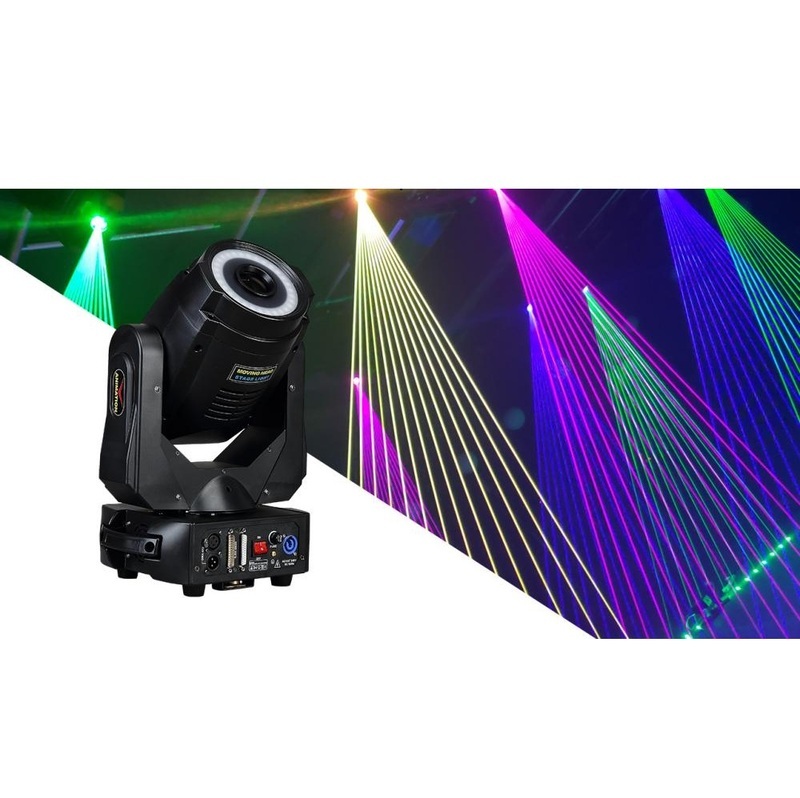
This is an indoor moving head laser light: a 3 W full-colour laser engine in a moving head body, with a ring of LEDs around the front aperture. The laser draws the beams, patterns and animation, while the ring keeps the lens lit so the fixture reads as a lit object from the back of a dark room.
Because both light sources live in one housing, a single fixture covers work that usually needs a laser projector and an led moving head light side by side. The head pans 540° and tilts 270° on two three-phase 42 motors, so a pattern can be swept across a floor or a back wall instead of being locked to one aim point.
We build and test it as a moving head laser light manufacturer in Guangzhou, so questions about pattern pages, channel maps or spares go to the team that assembles the fixture rather than to a trading desk.
It suits people who work a room rather than a stadium: club and bar installers, rental houses adding a laser to their stock, festival stage builders and integrators fitting out a mid-size venue. It is one layer of a show, not the whole show.
Two things it is not: a wash fixture, and an outdoor unit. Buy it for the beam and pattern layer of an indoor show. If you need general coverage or a weather-rated head, another fixture in the range does that job.
Laser, Scanner & Beam Quality
- 3 W of full colour.
- Three watts gives saturated red, green and blue mixed continuously by modulating the diodes, so colour changes glide instead of stepping through a wheel.
- 25 kpps scanning.
- The scanner draws 25,000 points per second, which is what keeps circles round and animation pages smooth rather than visibly stepped.
- Dense pages and full laser light show sequences stay legible at the distances a club or mid-size hall actually works at.
- Up to ±30° of scan angle. That is enough to throw patterns across a dance floor and up a back wall from a truss or shelf position without re-aiming the bracket between sets.
- Analogue modulation with a ±5 V input. The laser rises smoothly out of black instead of switching on hard, and the ±5 V input signal is what positions the pattern and sets the scan angle.
- A tight beam with low divergence.
- The spot holds its shape over the throw, which is why fans, tunnels and aerial geometry read crisply in haze instead of blooming into a soft smear.
- Why the scanner matters more than the wattage.
- A moving head laser light is judged on edge quality and colour: text stays readable, circles close cleanly, and a pattern sweep looks drawn rather than projected.
Control, Patching & Documentation
- Decide which source owns the show.
- A lighting console over DMX512, laser software over ILDA, or one of the standalone modes — pick the owner before the fixture is patched, not after it is flown.
- Six channels carry the practical controls a small venue needs; 40 channels break out the individual effects for a programmer who wants them.
- Pull the channel chart and manual from your moving head light supplier before the unit arrives.
- Every dmx moving head light ships with its chart, so the personality can be built or loaded while the fixture is still in its carton.
- Add ILDA if you run laser software.
- Set the fallback mode.
- With nothing attached, master-slave, automatic and music-with-blackout keep the room lit on nights when there is no operator.
- Tell us the desk and software version you run and we will confirm what is available or how to build the personality from the chart.
Installation, Environment & First Run
- Hang it from the yoke.
- It mounts on a standard clamp with a safety cable and balances like any led moving head light of this size, so existing truss positions and booth brackets usually work unchanged.
- Power it from a normal circuit.
- Keep the room dry and low on dust.
- Dust on the optics and moisture in the air are what dull pattern edges and shorten diode life, and the fixture is IP20 indoor only.
- Hold the surrounding air between 0 °C and 35 °C.
- That is the stated operating range, and a sealed booth corner or a spot next to a heater will cost you diode life over a season.
- Run the data line on the ground first.
- Address the unit, test the cable run and confirm the patch while it is still at working height — a dmx moving head light is only as reliable as the line feeding it, and DMX and ILDA are preferably kept on separate runs.
- Do the first laser light show with the room empty.
- Aim the head, run each page once and check where the beams actually land.
- The fixture ships with no safety classification or audience-scanning approval, so the risk assessment and operator competence for your venue stay with you.
Applications & Venue Fit
- Nightclubs and discos.
- The core use: patterns and aerial fans over the floor through peak hours, with the LED ring keeping the head visible between beams.
- Bars and lounges with a booth.
- Hanging over a DJ booth, it gives the floor the dj moving head light look with a laser layer on top, and the standalone modes cover the nights when nobody is programming.
- Live music and festival stages.
- Mid-size indoor stages and festival tents use it as the laser layer alongside beam and wash fixtures, taking its cues from the desk for drops and breakdowns.
- Medium indoor halls and multi-purpose rooms.
- Halls that host club nights, launches and parties use it because one moving head stage light covers the beam work a room that size needs without a full laser rig.
- Rental stock.
- Rental houses add it to the laser end of their inventory: a compact led moving head light that is quick to hang and easy to move between rooms on the same weekend.
- Private events and one-off parties.
- Mobile operators lean on the built-in pages and music mode for weddings, parties and corporate nights where there is no programmer and no time to build a show.
Specifications
| Model | LTLB-300 |
|---|
| Fixture type | Indoor moving head laser light with LED ring |
| Laser output | 3 W full colour |
| Scanner | 25 kpps, scan angle up to ±30° |
| Scanner input | ±5 V, analogue modulation |
| Beam diameter and divergence | 3 × 6.5 mm; 1.5 mrad |
| Pan and tilt | 540° / 270°, two three-phase 42 motors |
| Control modes | DMX512, ILDA, master-slave, automatic, music with blackout |
| DMX channels | 6 or 40 |
| Control interfaces | 3-pin DMX512, 25-pin ILDA (25DB) |
| Built-in effects | 140 patterns, 5 pages of animation |
| Power supply | AC100–240 V, 50/60 Hz |
| Power consumption | ≤100 W |
| Protection rating | IP20 |
Patterns, Animation & Effects
One hundred and forty patterns and five pages of animation are built into the fixture. That library is the reason a club can put a full laser layer on the floor without buying a media server, and it is where most rooms start before anyone opens a laser software session.
DMX effect control goes well past picking a pattern. Single-pattern mode, blanking, strobe, rotation, movement, billowing, zoom, write-in, speed and colour are each driven from the desk, so a build-and-drop moment can be made from the built-in pages alone.
The fast geometry — tunnels, fans, drawn shapes — is what a dj moving head light is usually asked for first, and it is already in the set. Nothing has to be authored to get a full night of looks out of the fixture.
Pages and animations are loaded before the unit leaves us, and as the moving head laser light manufacturer we keep the product mapping on file so a later unit can be matched to the same numbers in an existing show file.
The same pages slow down well. Run at reduced speed with blanking and write-in doing the work, a laser light show can be graphic and deliberate rather than fast — which is what a lounge or a launch night usually wants.
Packing, Delivery & Ordering
| Single unit packing | One fixture per carton, 34.5 × 23 × 48 cm, 9.5 kg gross |
| Two-unit packing | 2-in-1 flight case, 66 × 46 × 65 cm, 41 kg gross |
| Carton fit | Sized for one moving head stage light, so a small order travels without a case |
| Order route | Direct from the moving head laser light manufacturer; confirm stock and dispatch dates when you order |
| Sales contact | Your moving head light supplier contact confirms quantity, terms and paperwork for your market |
| Quantity | Ask about volume breaks before your season is booked |
| Lead time | Confirm against your install or show date; production schedules move with the season |
| Payment and trade terms | Agreed with your sales contact when the order is placed |
| Warranty, repair and spares | Request the current policy for your market before you commit to a fleet |
| Returns and quality claims | Check the carton on arrival and report any damage with photos and serial details straight away |
| Compliance paperwork | Tell us the destination market and we will confirm which test reports and declarations are available |
Technical Support & Model Matching
More than 30 engineers with an average of 15+ years in professional lighting stand behind every order — the same people who answer your technical questions. Tell us your venue, rigging height, throw distance and existing control setup; we help match models, check protocol and channel fit, and build a package that works as one system. If a fixture misbehaves on site, we work through the fault with you and sort out spares. Installation and commissioning guidance come with the order. Founded in 2016, exporting since 2022, LITEVISION serves buyers in more than 80 countries from offices in the USA, Taiwan, Mexico and China.
FAQ
Will one moving head stage light cover my room?
Scan angle decides that: the head scans to a maximum of ±30°, which is enough to throw patterns across a dance floor and up a back wall from a truss or shelf position. Real coverage depends on hang height and the distance to the surface, so send us the room dimensions and we will tell you where to place it for the spread you want.
What is the difference between the 6-channel and 40-channel modes?
Six channels give you the practical controls for a club patch — pattern choice, colour, movement and speed. Forty channels break the same fixture into individual effects so a programmer can run blanking, strobe, rotation, zoom and write-in separately. Both run as DMX512 over the 3-pin interface, so a dmx moving head light at 6 channels drops into a small venue patch without eating a whole universe.
Can I drive it from laser software as well as a lighting desk?
Yes. There is a 25-pin ILDA port for laser content and a 3-pin DMX512 interface for the head and its functions, and the fixture also runs master-slave, automatic and music modes with nothing attached. Tell us which software and which desk you use and we will confirm the combination that suits your setup.
Does it work in a low-ceiling bar or booth position?
Yes — the body is compact and the head tilts 270°, so it can be aimed down onto a floor from a booth shelf or a low truss, which is where most dj moving head light installs put it. In a low room, keep the beams above head height and away from mirrors and glossy surfaces that throw them back into the room.
Do the laser effects need haze to be visible?
Projected patterns and animation land on floors, walls and bodies with or without haze. Beams, fans and tunnels are aerial effects and need some haze or smoke in the air to read properly, so rooms already running a hazer get the full look, while dry rooms get the projected patterns plus the LED ring.
Is there a console profile and channel chart for this fixture?
Every unit ships with its channel chart. Tell your moving head light supplier contact which console and software version you run, and we will confirm whether a matching profile is available or how to build the personality from the chart in a few minutes.