Product Overview
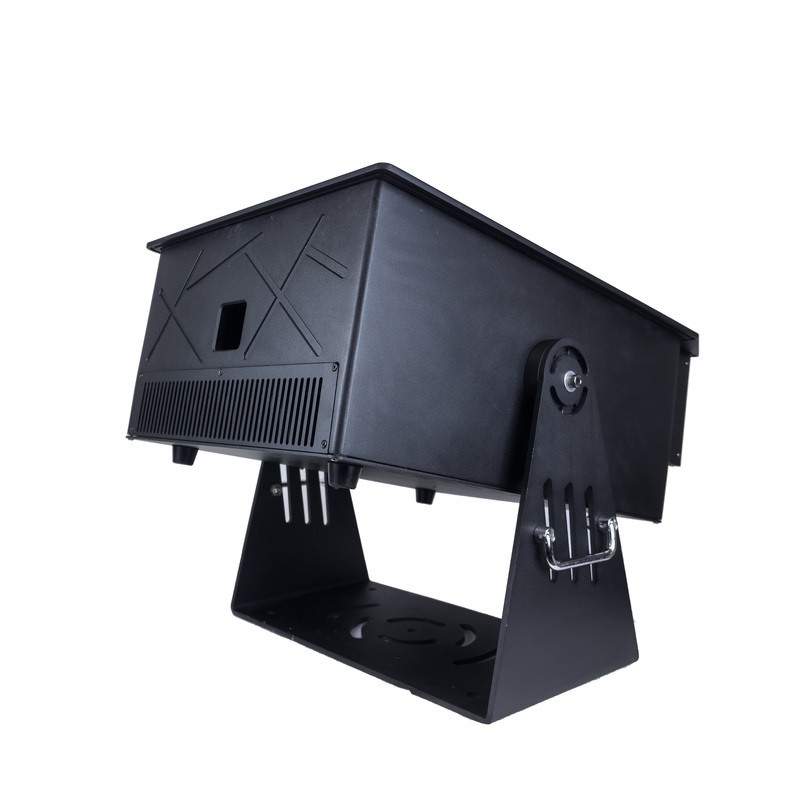
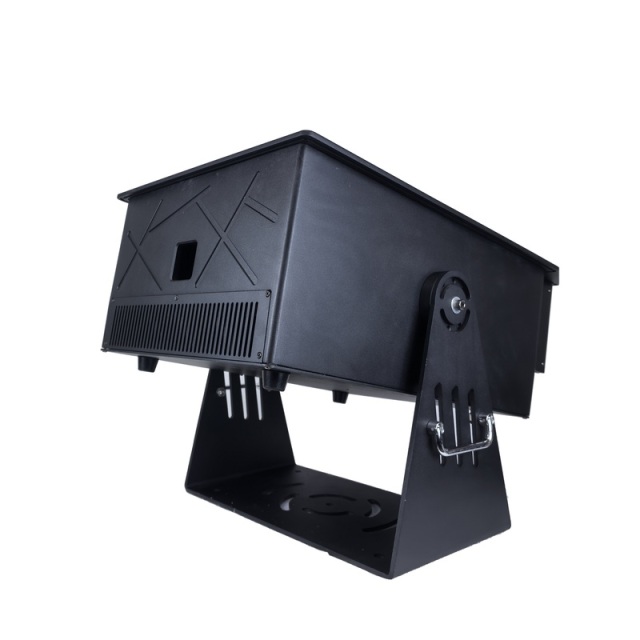
A 30 W rgb laser light in a sealed IP65 housing, the LTLS-30O is built to stay mounted outdoors for a season rather than go back into its case after every show. It throws beams, graphics, animation and text across façades, plazas, stage backdrops and attraction structures. Control is not tied to a media server. Run it on its own, address it on DMX, or drive it from ILDA software: a programmable laser light show projector lets a venue open with something moving on the wall and be refined once a designer is involved. Nothing here is built for one-off hires. As a laser light show equipment manufacturer we specify the enclosure, the bracket and the sealing around years of weather rather than around a weekend of use, because the unit is expected to stay exactly where it was aimed. The body is a matte black metal housing on a U-shaped bracket with locking knobs and side mounting holes, so the head can be aimed and locked at the angle the structure allows — it hangs like a lighting fixture rather than a projector that needs its own weather box.
Optical System & Effects
- 30 W of rgb laser light — 8 W of 638 nm red, 10 W of 520 nm green and 12 W of 450 nm blue, combined behind a single large output lens.
- Wavelengths chosen for colour — as an outdoor laser light manufacturer we specify each diode separately rather than quoting one RGB figure, and the 638 nm and 520 nm choices are what keep a mixed magenta, amber or cyan reading as that colour once the beam lands far from the fixture.
- TTL and analog modulation — the diodes accept both: analog for smooth dimming and colour fades, TTL for clean on/off switching on beam and strobe effects.
- 35 kpps galvanometer — 35,000 points per second is the headroom that separates a graphics-capable scanner from a beam-only effect; it traces a logo outline fast enough that the line does not break up.
- Scanning angle up to 60° — a wide sweep lets one unit cover a façade or a plaza without re-rigging the bracket; on laser stage lighting outdoor work that is often the difference between one fixture and two.
- More than 200 effects on board — the internal library covers abstract patterns and animated sequences, so a laser light show projector outdoor installers have just hung can open a site with a working display before any designed content arrives.
Control & Programming
- DMX 14 or 19 channels — two personalities for one fixture: the shorter map covers the core parameters, the longer one hands the programmer more to cue. Confirm which fits your cue structure before the channel table goes into the console.
- ILDA software control — feed the scanner from ILDA software when the show needs graphics, logos or animation that the on-board patterns do not cover; this is the route for designed content rather than library effects.
- Master/slave — set one unit as master and let the others follow, the simplest way to run a row of lasers through the same effect without a console or a programmer.
- Automatic operation — the fixture runs a sequence on its own with no control signal at all, which is what a venue without a technician on shift actually needs.
- Sound control — a built-in microphone drives the display from the music; on a dj laser light show projector this is the setting that lets a club run all night without a cue list.
- Addressing — every unit needs its own DMX address. When several lasers share a universe, plan addresses and channel modes before the rig is handed over, not during the first rehearsal.
- Cue-stack behaviour — a timecoded show treats the laser as one more DMX device, so it sits in the same cue list as the rest of the rig rather than running from a separate laptop.
Applications & Show Types
Façade and landmark work is the most common brief for outdoor laser light show equipment: the fixture is bracketed to a building face, bridge or tower and throws beams and graphics across the public space below. Because the housing is sealed, it stays on the structure between events instead of being taken down and re-hung.
City beautification and cultural-tourism installations lean on the aurora curtain — slow, wide, colour-washed sweeps that read as Northern Lights across a building front or a hillside, running to a schedule every night without an operator on site.
Theme parks, attractions and entrance structures use it for animation and character sequences, and for logo or sponsor projection during events, where a scanner that traces an outline cleanly matters more than raw beam power.
On festival stages, in clubs and at DJ sets it works as a dj laser light show projector, cutting through haze above a crowd while the rest of the rig lights the performers — a laser on the road without a separate weather enclosure around it.
Rental houses and AV integrators adding a weather-rated fixture to their stock treat it as a laser light show projector outdoor clients can leave installed for a season, which takes the install-and-strike labour out of every booking.
Mounting & Site Setup
- Confirm the structure and the fixing points can carry outdoor laser light show equipment at the tilt you want, including the load the bracket puts on the wall.
- Agree the beam path before anything is fixed: where the beam lands, what it crosses and who can walk into it. On laser stage lighting outdoor work this is the decision everything else follows from, so settle the safety measures with the person responsible for the site.
- Bolt the U-shaped bracket up, hang the body on it and set the tilt with the locking knobs. The side mounting holes give an alternative fixing when the bracket position does not suit the wall.
- Leave the ventilation grille clear. Do not recess the unit into a closed box or cover the vented side — the housing is sealed against weather, not against its own heat.
- Run power: the input range covers the supplies used in most markets, but the circuit and the distribution still want planning before more fixtures go on the same run.
- Run control next — DMX on a standard cable, or the ILDA feed if the content comes from software — and set the address at the same time so nobody is guessing on site later.
- Check the front window once the bracket is tight, and make sure the fixing has not twisted the housing. A window handled during installation is the usual reason a beam looks weak on the first night.
- Look at the temperature of the position itself. A mounting point in direct summer sun against a dark wall runs hotter than the air around it, so leave space for air to move across the body.
Specifications
| Laser source | 30 W RGB — red 8 W/638 nm, green 10 W/520 nm, blue 12 W/450 nm |
| Modulation | TTL and analog |
| Scanner | 35 kpps galvanometer with large lens |
| Scanning angle | Up to 60° |
| Rated power | 600 W |
| Input voltage | 100–250 V |
| Control modes | Built-in effect library, sound control, automatic operation |
| DMX channels | 14 / 19 |
| Other control | Master/slave, ILDA software control |
| Laser lifespan | More than 10,000 hours |
| Working temperature | -10 °C to 45 °C |
| Protection rating | IP65 |
| Dimensions | 49 × 32 × 24 cm |
| Weight | 41 kg |
Ordering & Delivery
- Send the project brief first: site type, mounting height, throw distance, the surface to be covered and the control method you expect. We quote from that brief rather than from a model number alone — that is the only way to be sure the fixture fits the wall it is going on.
- Confirm the control configuration the site needs: whether the show will run from a desk, from ILDA software or from the fixture itself, plus the bracket position and the cable runs around it.
- Ask for the current revision of the documentation before drawings or a tender response go out, so the figures you circulate match the unit being built.
- Confirm the compliance paperwork your market requires. Laser display rules differ by country and the applicable documents are agreed per order rather than assumed.
- Confirm the commercial terms in writing: order quantity and any quantity break, production lead time, payment method and trade terms.
- Agree the warranty period and what it covers, together with the process for a return or a quality claim if a unit arrives damaged or fails in service.
- Confirm packing and freight; the case dimensions and gross weight are agreed at quotation so containers, lifting gear and storage can be planned.
| Document | What it covers |
|---|
| Specification sheet | Electrical, optical and physical figures for tender documents |
| User manual | Menu structure, control modes and the setup sequence |
| DMX channel table | Channel maps for both personalities, for console programming |
| ILDA control notes | How the scanner is driven from ILDA software |
| Beam and photometric data | Scan angle and beam behaviour for layout drawings |
| Packing and transport data | Case dimensions and gross weight for freight planning |
Technical Support & Model Matching
More than 30 engineers with an average of 15+ years in professional lighting stand behind every order — the same people who answer your technical questions. If a fixture misbehaves on site, we work through the fault with you and sort out spares. Installation and commissioning guidance come with the order. Founded in 2016, exporting since 2022, LITEVISION serves buyers in more than 80 countries from offices in the USA, Taiwan, Mexico and China.
FAQ
How far does the beam travel, and how much of a surface will one unit cover?
There is no single throw figure worth quoting, because reach depends on ambient light, haze and how bright the surface itself is — a white façade and a dark hillside behave very differently. As an outdoor laser light manufacturer we would rather work from your site: send the mounting position and the dimensions of the surface, and we will run the layout through with you.
Is it safe to project over an audience?
Laser display safety is assessed on site: it depends on the laser class, the beam height above people and the rules where you operate. Any laser stage lighting outdoor installation should have its beam path measured and its exclusion zones agreed before the first show, and you can ask us for the technical information your safety officer needs to sign the installation off.
What does IP65 actually protect against?
IP65 means the housing is dust-tight and protected against water jets from any direction, which is what lets outdoor laser light show equipment stay on a wall between events instead of being struck after each one. It does not make the unit submersible or safe to pressure-wash, and the output window still has to be cleaned and the housing looked over after installation.
Can we run our own graphics, logos and text?
Yes — designed content goes in through the ILDA path, where the scanner traces what the software sends it. A programmable laser light show projector resolves detail according to how many points each shape needs, so a very intricate logo may need simplifying to hold its outline at distance; send the artwork and we will tell you what will read cleanly on your surface.
How many units do we need for a building façade?
Start with the surface rather than the fixture count: one unit usually covers one face or one feature, and a second is added where the beam has to wrap a corner or reach a separate elevation. Because each rgb laser light can carry its own DMX address, every face can run its own image instead of repeating the same pattern across the whole building.
Can it be serviced without taking it down?
The routine work is done in place: the output window can be cleaned and the ventilation grille cleared with the unit still on its bracket, which is why the mounting position should leave room in front of the lens and around the vent. Anything inside the sealed body is a workshop job, so plan access to the fixing points in advance. If a beam looks weak, check the window first — a marked or dusty window is the usual cause, and cleaning it takes minutes.
Can the fixture be moved if the display layout changes?
It can be unbolted and re-hung, but it is a fixed-position unit rather than a touring fixture: the body and bracket are built to be aimed once and locked. If the display moves between venues, say so when you specify — a laser light show projector outdoor crews transport regularly needs cases and a handling plan agreed before it ships.
Does it work indoors, or is it only for outdoor shows?
It works indoors as well; the sealed housing is simply more protection than a club or a hall needs. For bars, clubs and one-off events the sound-activated mode is the usual setting, which is what makes it a practical dj laser light show projector as well as a permanent outdoor fixture.