Product Overview
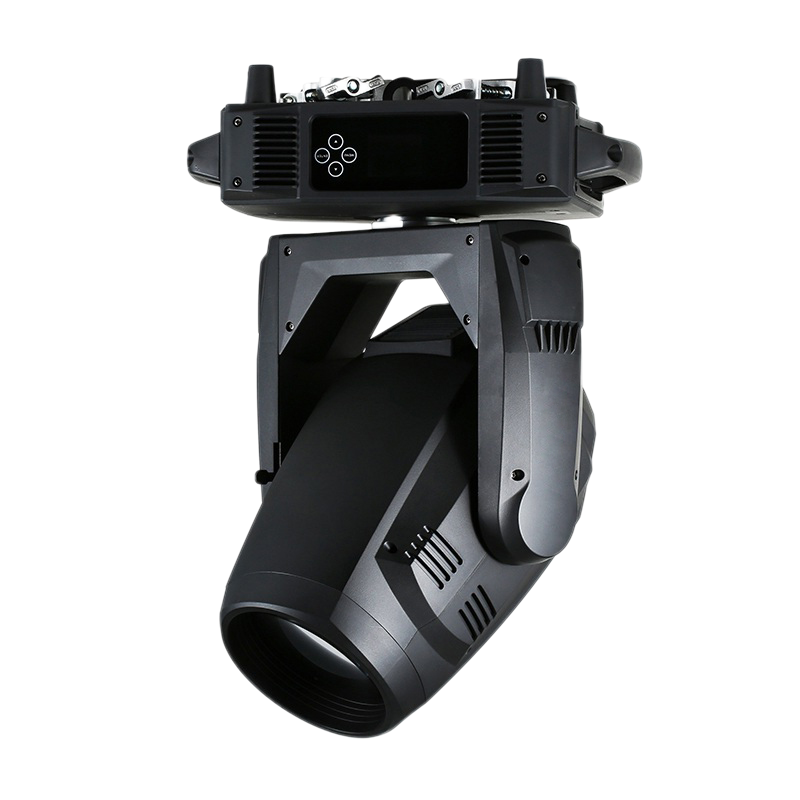
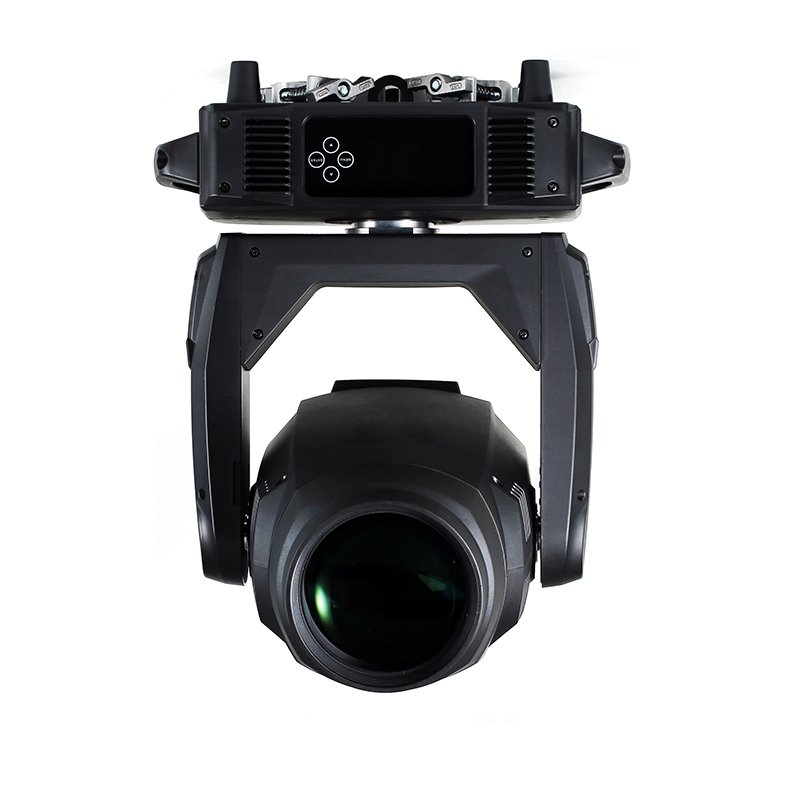
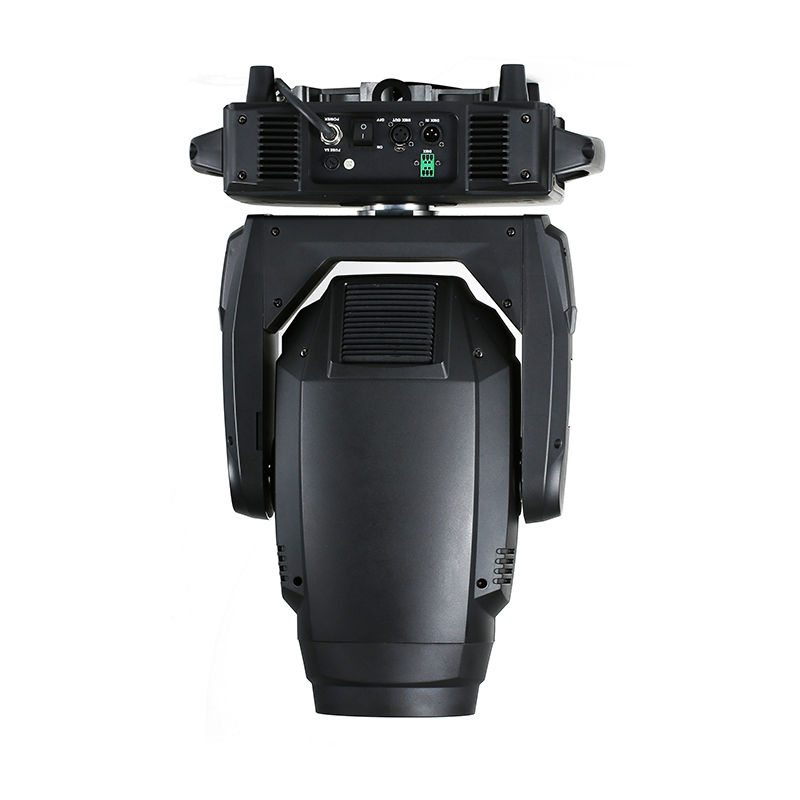
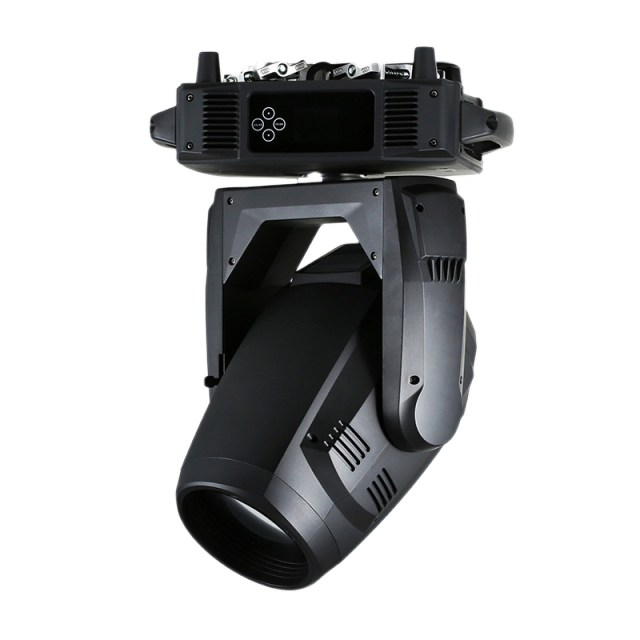
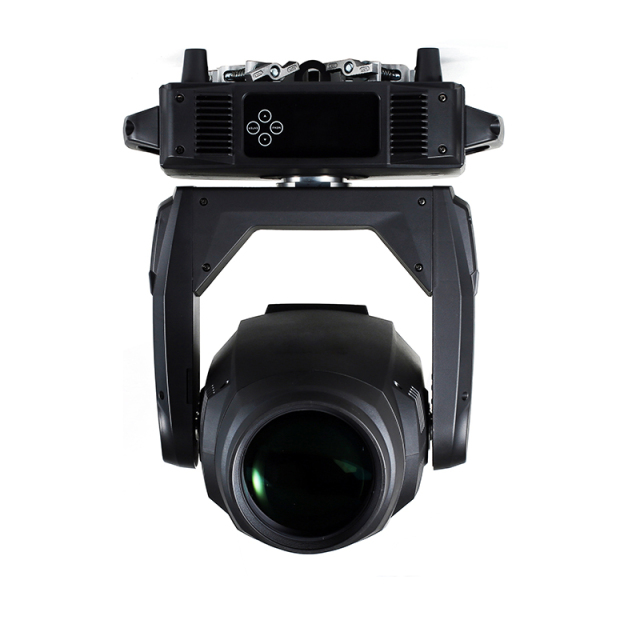
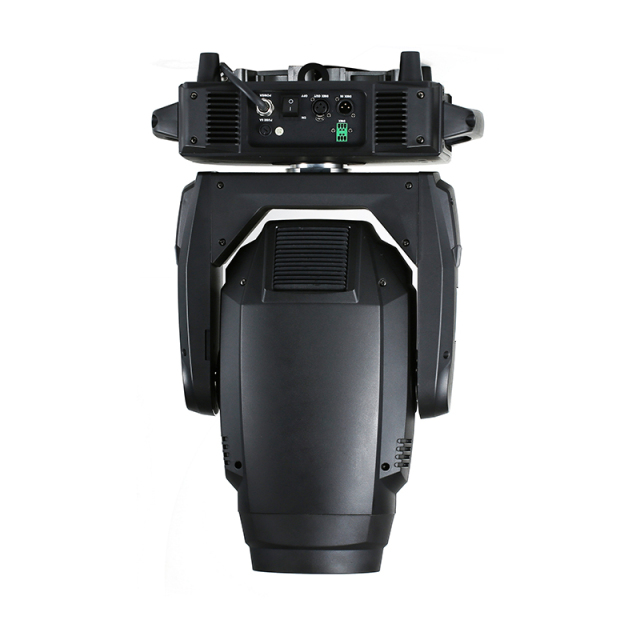
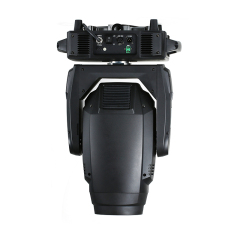
This is a beam spot wash 3in1 moving head, which means one fixture covers the three jobs a rig usually spreads across different models: an aerial beam, a gobo spot and a wide wash. A rental company can hang the same unit on the back truss as the beam and on the front truss as the wash, and a distributor can answer all three enquiries from one line. The body is a matte black moving head stage light with a large front lens, a yoke bracket for clamping and vented panels around a fan-cooled head. It reads as a working fixture rather than a showpiece: black housing, visible cooling, and a head that travels well past a right angle on both axes. We supply it as a bsw moving head light supplier to rental fleets, distributors and installers, and the conversation usually starts with the rig rather than the datasheet — throw distances, the console in use, how the truss is built and what power is available on site. The rear panel carries power in, DMX in and DMX out plus a DMX shortcut interface, so a swap mid-show is a matter of three connections. It is an indoor fixture for stages, clubs and halls, and it is meant to be re-hung week after week: a two-person lift onto the truss, a standard clamp on the yoke, and a menu a technician can read from the floor.
Beam, Spot & Wash Optics
- One fixture, three optical settings. The beam spot wash 3in1 design carries separate angle ranges for each job, so coverage can be planned before any fixture is on site.
- Beam at 2.6° — the tightest setting. As a moving head beam light this is the mode that carries to the back of a hall: a parallel shaft with hard edges, strongest in haze and ideal for back-truss silhouettes and sky-facing effects.
- Spot at 7–32° — pattern work. Here the fixture behaves as a moving head spot light, projecting gobos onto the stage floor, set pieces and upstage cyc, with a rotating wheel so a pattern can be indexed exactly where the act needs it.
- Wash at 11.2–36.5° — coverage. Used as a moving head wash light, the wide end colours a full stage or dance floor while the narrow end keeps the pool tight around a performer.
- The three ranges are what decide fit: match the beam end against the longest throw in the room and the wash end against the widest trim height, then check the spot range against the distance to the set.
- Switching is a programming decision, not a hardware change — the fixture stays in the same clamp and moves from shaft to pattern to wash between numbers.
- That is the practical argument for a hybrid rig: the same six fixtures, ordered from one bsw moving head light supplier, can look like a beam rig, a pattern rig or a wash rig on three different nights.
Effect System
The colour wheel carries 9 colours plus white, with half-colour positions between the slots and a two-way rotating rainbow effect. Half positions matter in practice — a tone that sits between two slots can still be dialled in rather than settling for the nearest primary.
Two gobo wheels work together: 13 fixed patterns plus white, and 8 rotating gobos plus white. The rotating wheel indexes to any position and the patterns can be jittered, which is what separates a moving head spot light from a decorative effect — the pattern lands where the act is, and it can move from there.
Prism 1 is 8-facet and prism 2 is 16-facet; both rotate and the two stack. A single prism fans one shaft into a row of beams, and stacked they turn the head into a wall of light for a chorus or a drop.
Atomization is independent of everything else in the optical path. It softens the edge without touching colour or gobo, which is how a hard beam becomes a moving head wash light for a ballad and returns to a shaft for the next track.
Dimming is 0–100% linear and the strobe runs to 25 Hz with random and pulse options. A slow fade reads as a fade rather than a set of steps, and the strobe covers everything from a blink to a full-speed hit without a second fixture.
Every layer is set separately — colour, fixed gobo, rotating gobo, prism, frost, dim and strobe can be combined in any order, so one fixture holds a library of looks rather than one signature effect.
Display, Control & Diagnostics
- Address it. The LCD is backed by a rechargeable battery, so the DMX address and the menus can be set while the fixture is still in its case or sitting on the stage floor with nothing plugged in.
- Patch it at the desk. Choose 29 or 25 channels depending on how much of the parameter set needs to be exposed; to the console it is a standard dmx moving head light, and an RDM-capable desk can find it, change its address and keep the patch tidy without sending anyone up the truss.
- Run a self-test. With no DMX signal connected, reset detection can be set to manual or automatic, which is how pan, tilt, wheels and prisms get checked before the doors open.
- Get light without a desk. Nine built-in programs are held in the fixture — enough for a focus call, a warm-up or a stand-alone look at a small event.
- Work it from the console. Address changes, lamp strike and machine reset can be sent remotely, so a changeover does not need a ladder.
- Keep it current. Software updates travel down the DMX data cable, the display flips 180° for an upside-down hang and the menu switches between English and Chinese — small things that matter when a moving head stage light is being serviced at two in the morning.
Placement, Rigging & Power
- Pick an indoor position. The fixture is IP20, so it belongs under a roof — covered stages, solid-roof tents, clubs and halls. Rain, sea spray, wash-down and dripping ceilings are all out.
- Check the spot. Ambient temperature needs to stay between -10 ℃ and +45 ℃, and the vented panels need clear air around them; the head is fan-cooled and a fixture buried in drape will run hotter than one with breathing room.
- Hang it properly. A moving head beam light of this weight goes on the yoke bracket with a rated clamp rather than a hook, and the clamp has to suit the truss tube instead of the other way round.
- Fit the safety rope. One ships with the fixture and it goes around the truss independently of the clamp, every time, even for a one-night stand.
- Wire it up. Power in, DMX in and DMX out sit on the rear panel — the standard three connections of a dmx moving head light. Daisy-chain the data, keep the power run inside the capacity of your distribution and terminate the last unit on the line.
- Leave room to move. The head travels a long way on both axes, so check clearance from truss, set and neighbouring fixtures before anything is powered.
- Test before the show. Run the self-test, flip the display if the moving head stage light is hung upside down, and watch the full pan and tilt travel once to be sure no cable snags.
Applications
- Touring and rental fleets. The beam spot wash 3in1 build means one flight case covers three fixture types, so the truck pack gets smaller and the crew learns one menu tree instead of three.
- Clubs and live venues. Hang it as a moving head spot light over the dance floor for pattern work, then open it out for the headline set without re-rigging between acts.
- Theatre, school and multi-purpose stages. On the front truss as a moving head wash light it colours a set and covers a stage that changes shape every week.
- Distributors and resellers. As a beam spot wash moving head manufacturer we see this model ordered alongside beam-only and wash-only units, because it closes the gaps between them in a catalogue.
- Concerts and arena stages. Beam from the back truss for the aerial moments, spot from mid-stage for the vocal line, wash from the front for the crowd.
- Corporate launches and event work. A single unit can carry a small stage on its own, and two channel modes let it fit a compact event desk or a full console.
- Multi-purpose rooms. A venue that hosts a conference on Thursday and a gig on Friday gets beam, pattern and colour out of the same six fixtures.
Specifications
| Specification | Value |
|---|
| Model | Multi C380BSW |
| Light source | SIRIUS HRI 371 W discharge lamp |
| Colour temperature | 7650 K |
| Light source life | ≥1500 hours |
| Power supply | AC 100–240 V, 50/60 Hz |
| Power consumption | 530 W (at 90 V) |
| DMX channels | 29 / 25 |
| Pan / Tilt | 540° / 270°, 16-bit precision |
| Dimensions | 657 × 422 × 301 mm |
| Net weight | 24.0 kg |
Ordering & Delivery
| Term | Details |
| Minimum order quantity | Confirmed with your sales contact for the quantity you need |
| Volume pricing | Quoted against quantity and configuration |
| Lead time | Confirmed against the production schedule when the order is placed |
| Payment terms | Agreed with your sales contact at quotation |
| Trade terms | Agreed at quotation for your destination |
| Warranty | Ask your sales contact for the current warranty statement and what it covers |
| Returns and quality claims | Raised with your sales contact, with photos and unit details |
| Packing | Export packing confirmed per order |
| Supplied with each fixture | Instructions and safety rope |
| DMX channel table | Request with your order for patching and previz |
| Specification and photometric files | Request for tenders, submittals and previz |
| Spare lamps and parts | Ask your sales contact about availability |
Technical Support & Model Matching
More than 30 engineers with an average of 15+ years in professional lighting stand behind every order — the same people who answer your technical questions. Tell us your venue, rigging height, throw distance and existing control setup; we help match models, check protocol and channel fit, and build a package that works as one system. If a fixture misbehaves on site, we work through the fault with you and sort out spares. Installation and commissioning guidance come with the order. Founded in 2016, exporting since 2022, LITEVISION serves buyers in more than 80 countries from offices in the USA, Taiwan, Mexico and China.
FAQ
How do the 29-channel and 25-channel modes differ?
Both modes drive the same colour, gobo, prism, frost and movement parameters; the 25-channel mode packs the show into a shorter footprint for desks where universes are tight, and the 29-channel mode exposes the longer parameter set. As a beam spot wash moving head manufacturer we send the channel table out with the fixture, so it is clear which parameter sits in which slot before anything is patched.
Is this a replacement for a dedicated beam, or something you add alongside one?
It replaces one in most rooms. A dedicated moving head beam light is built around a single narrow angle; this fixture gives that narrow shaft plus the spot and wash ranges, so a rig that used to need two model types can be built from one. Where an existing beam is already paid for and working, it sits next to it as the pattern and wash source instead.
Will this dmx moving head light work with the console we already run?
Any desk that speaks DMX512 will drive it. RDM adds the convenience of finding the fixture and changing its address from the console without a climb, and the two channel modes let it fit a compact event desk with a small universe as well as a full touring console.
Can it drop into a rig that already has channel definitions and show files?
Yes — the patch is a standard DMX512 map with 29 and 25 channel options, so the work is in remapping the parameters already in use. As a bsw moving head light supplier we can check the channel table against your current show file before the fixtures ship, which is usually faster than discovering the difference at a focus call.
What routine upkeep does the fixture need between tours?
Keep the vents and the fan path clear of dust and haze residue, check that the yoke and clamp hardware are tight, and log the lamp and light source hours shown on the display so a lamp change is planned rather than forced. If a wheel, prism or board misbehaves, describe the fault together with the unit's history so the right part goes out the first time.