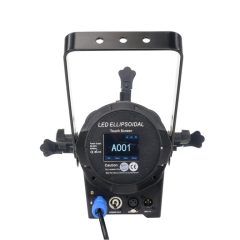
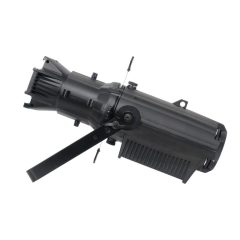
Product Overview
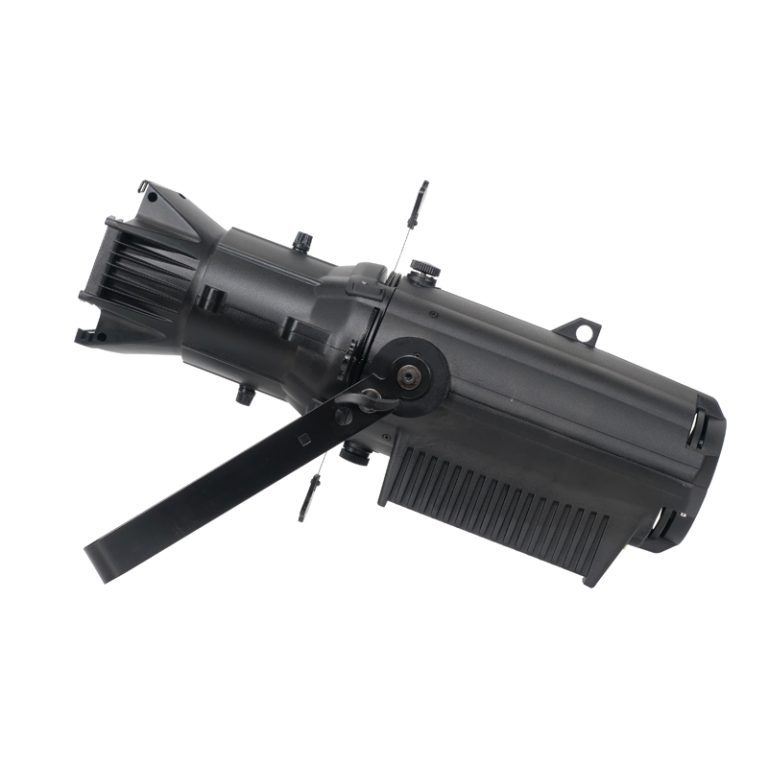
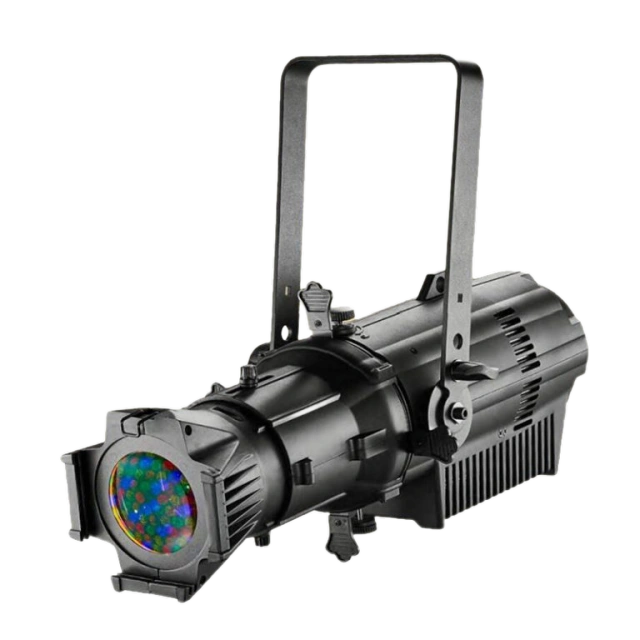
The Opera TPR300C5 is a 300W/350W LED ellipsoidal profile: one COB engine inside a die-cast aluminium barrel, a lens tube at the front, a touch panel at the back and a yoke bracket across the top. Two colour engines share that body — RGBW 4-in-1 at 350W, or a five-colour RGBAL engine at 300W — and both run from 100 to 240V, so there is no voltage variant to specify for different markets.
The lens sets the beam on this interchangeable lens spotlight: 19°, 26°, 36° or 50°, changed by hand rather than by buying a different fixture. Focus runs on the barrel, gobo patterns drop into the slot above the lens, and a front-of-house position is aimed and locked in a couple of minutes with the unit already hanging.
This is one model in a wider catalogue that runs from profile and Fresnel fixtures through to wash, beam and follow-spot units, plus the DMX control, data distribution and power boxes that sit around them. LITEVISION is a Fresnel stage light manufacturer as much as a profile builder, so a venue can take its hard-edged specials and its soft-edged cover from one factory, on one control philosophy, with one spares list.
It is a DMX profile fixture that stands in for a tungsten profile lantern of similar class. The working method is familiar — hang, focus, set, repeat — but there is no lamp to change between shows, and far less heat sitting in the roof void over a long run.
Key Features
- That matters most in theatre stage lighting when the profile is the audience's key light rather than one wash among many.
- Warm tungsten to cold daylight from the desk. The RGBAL 5-in-1 engine tunes from 2,700 K to 12,000 K, so a candlelit interior and a cool daylight exterior come out of the same fixture instead of a gel box.
- Clean on camera. Dimming frequency is selectable from 500 Hz to 25,000 Hz, which is what keeps the ellipsoidal profile out of banding on high-frame-rate and slow-shutter shots.
- Four dimming curves. Standard, Incandescent, Quick and Linear — choose the one that matches your console and cue style, so a slow fade on a high CRI stage light keeps its shape at the bottom of the travel instead of dropping out early.
- Same fixture next season. The channel map, lens set and spares list stay consistent from one order to the next. That is the detail a reseller needs when the same model goes into several venues, and it is a fair question to put to any Fresnel stage light manufacturer you shortlist for a mixed rig.
Cooling, Noise And Maintenance
Noise where the audience sits. Cooling is handled by a copper-tube fan at the rear of the body, and the fan is the only thing in this led profile light that moves — there is no lamp house to cool, no discharge ballast and no pan or tilt motor adding to it. Where you hang the unit still decides how much of that fan anyone hears. Over the proscenium arch, on a box boom or up a side ladder it disappears into the room; directly above the stalls in a quiet play it is the closest sound source to the audience. Send us the hang position with the order and we will tell you what to expect in that specific room instead of quoting a bench figure that means nothing once the fixture is in a roof void. Heat in a roof void. A roof void is the hardest place in a building for any lantern: warm air collects up there and often has nowhere to travel. Three things keep this DMX profile fixture out of trouble — an LED engine in place of a filament, a die-cast aluminium body that works as a heat sink, and clear space at the rear where the fan draws. The rated working range is -30 to 40 °C, so a cold church hall in January is not the problem; a sealed loft that passes 40 °C after a full technical rehearsal is. Run the rig for a whole evening before the first preview, then check the air temperature at the fixture rather than at the floor. Never pack drapes or blackout against the rear of the body, and never park the next fixture hard against it on the bar. Haze leaves an oil film on the front glass that softens the edge and costs output, so wipe the lens with a soft dry cloth at each get-in and keep the gobo slot clean. Do not spray cleaner into the body or into the fan intake. A fan that has become noticeably louder after a year is usually a fan working against a blocked intake rather than a fan on its way out — clear the rear first, and if the noise stays, talk to us before the run opens. Working to camera. Consider the studio key light position: the fixture holds a mark for a whole record day, and with no lamp to change there is no mid-shoot re-focus after a colour shift. Dimming runs from 500 Hz to 25,000 Hz, so set the frequency that clears your shutter and frame rate rather than leaving whatever the menu opened on.
Lens Choice And Setup
- Measure the throw from the hang position to the stage floor, the set or the wall you are lighting.
- Match the lens to the coverage you want. A 19° lens throws a narrow, bright pool for one performer or a tight special; 26° and 36° cover most mid-throw work; the 50° spreads the same profile light across a small stage or a conference set.
- Fit the lens you need into the barrel. Because this is an interchangeable lens spotlight, a 36° bought for a tour becomes a 19° for a drama season in a few minutes — which is why one fixture can hold front of house and a side position in the same plot.
- Hang the led profile light on the U-shaped bracket, balance the body, aim and lock off. The bracket lets the fixture sit above or below a bar without changing the focus geometry.
- Address the DMX profile fixture from the touch panel or over RDM: set the DMX address, pick the channel mode, and leave it in Auto run if there is no console in the room yet.
- Focus the ellipsoidal profile by hand at the barrel and check the beam edge against the set before the first cue rather than during it.
- Keep the rear fins clear and wipe the front glass with a soft cloth at each get-in. Dust on the lens costs output and softens the edge; a fixture boxed in by scenery runs hotter than one on an open bar.
Where It Gets Used
Theatre and drama. A profile belongs at the front of house and on box booms, where a hard edge and a repeatable focus matter more than raw output. In theatre stage lighting the same positions get re-set every morning for a different show, and a fixture that can be aimed, focused and locked by one technician keeps that turnover short.
School and college auditoriums. Assemblies, plays, visiting concerts and prize evenings all run through the same rig. Pick the lens that suits the room, set the positions once, and the staff running the space have an interchangeable lens spotlight that does not need re-focusing for every booking.
Studio and broadcast floors. A high CRI stage light is the key or the backlight that has to match the camera rather than fight it. The fixture holds the same mark for a whole record day, and the operator is not chasing colour between takes.
Multi-purpose venues. A room that hosts conferences on Monday and a play on Friday gets more from four fixtures with two lens options than from eight fixed units — which is where a profile light with a swappable lens earns its keep.
Rental and resale. Rental stock has a harder life: a different crew each week, a focus session from scratch at every get-in, and a truck in between. Where the plot also needs soft cover, this profile pairs with a Fresnel from the same Fresnel stage light manufacturer, so front light and washes can come off one purchase order.
Specifications
| Property | Value |
|---|
| Light source | COB LED — RGBW 4-in-1 at 350 W, or RGBAL 5-in-1 at 300 W |
| LED lamp | Philips, 90 pcs × 3 W |
| Colour rendering | Ra ≥ 90 |
| Colour temperature | 2,700–12,000 K on the RGBAL 5-in-1 version |
| Lens | 19° / 26° / 36° / 50°, interchangeable |
| LED life | Over 50,000 hours |
| Dimming | 500–25,000 Hz, four curves: Standard, Incandescent, Quick, Linear |
| Strobe | 1–25 flashes per second |
| Control | DMX512, RDM, Art-Net; Auto run and Master/Slave |
| DMX channels | 5 / 10 (RGBAL version) |
| Power supply | AC 100–240 V, max 300 W / 350 W |
| Housing and cooling | Die-cast aluminium body, copper-tube fan |
| IP rating | IP20, working temperature -30 to 40 °C |
| Weight and packing | Net 10.5 kg, gross 12 kg; 72 × 33 × 31.5 cm, 1 pc per carton |
Ordering And Delivery
- Fix the engine and the lens when you order. RGBW 350W or RGBAL 300W, and which of the four lenses ships fitted. Extra lenses and the optional iris are worth adding to the same order rather than later.
- Tell us the position, not just the model. Give us the throw distance and the size of the pool you need, and we will confirm which profile led light version and which lens to start with, along with the spare lenses the rest of the plot will want.
- Buy from the factory. Orders are built at our Guangzhou facility — LITEVISION is one of the led spot light manufacturers that both builds and exports its own catalogue, so the specification you sign off is the specification that goes on the line.
- Compare like with like. When you line up led spot light suppliers, ask each one for the same four things: engine type, channel map, lens list and the qualification report. Those four decide whether two quotes are for the same fixture.
- Minimum order quantity. Confirmed per market and model mix — ask your sales contact for the current level and for batch quantities.
- Lead time and shipping. Production scheduling and freight are quoted per order.
- Payment and trade terms. Agreed on the proforma for each order — confirm the terms and the Incoterm with your sales contact before paying.
- Warranty, repair and spare parts. Covered by our warranty, repair and spare parts policy; ask which coverage applies in your region and what the spares route looks like.
- If something arrives wrong. Report it to your sales contact as soon as the carton is opened, with photographs and the serial number, so the unit and its batch can be traced. Document | What it covers --- | --- Specification sheet | Light source, optics, control, weights and packing, in a form you can forward to your own client User manual | Menu structure, DMX addressing, focus, gobo fitting and service notes DMX channel table | Channel layouts for the RGBAL version, ready to patch into the console Photometric data | Beam angle and illuminance for the 19°, 26°, 36° and 50° lenses Fixture library files | Console personality files for programming and previz Compliance documents | Declarations for the market you are shipping into Spare parts list | Fan, driver, lens and touch-panel references for service planning
Technical Support & Model Matching
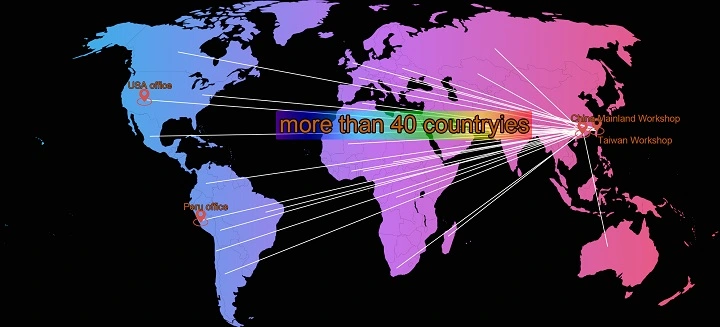
More than 30 engineers with an average of 15+ years in professional lighting stand behind every order — the same people who answer your technical questions. Tell us your venue, rigging height, throw distance and existing control setup; we help match models, check protocol and channel fit, and build a package that works as one system. If a fixture misbehaves on site, we work through the fault with you and sort out spares. Installation and commissioning guidance come with the order. Founded in 2016, exporting since 2022, LITEVISION serves buyers in more than 80 countries from offices in the USA, Taiwan, Mexico and China.
- Component selection. The COB LEDs are Philips parts. Engine, housing and cooling are chosen together so the fixture runs inside its thermal limits rather than at the edge of them.
- Assembly and optical alignment. The barrel is built, the glass reflector seated and the lens tube aligned, so focus stays smooth across its travel and the beam edge stays clean at every angle.
- Burn-in and testing. Each unit runs a thermal, electrical and longevity check before it leaves the line — the pass that catches a fan starting to stall or a driver drifting during a long theatre stage lighting cue stack.
- System debugging. Fixtures are linked and driven from a console, and where a buyer sends sample programme material we run that show file against the rig before it is packed.
- Independent QC sign-off. The inspection team does not report to the production line. Every machine is checked, a formal qualification report is issued, and only then is the unit released to the warehouse — the document buyers ask for when they audit led spot light manufacturers for a tender.
- Packing and paperwork. One fixture per carton, with the packing list, qualification report and compliance declarations travelling with the shipment.
- Continuity and scale. More than 50,000 units leave the facility each year, and the QC department maintains the CE, RoHS, UL and ISO 9001 documentation that regulated markets ask for. The channel map and lens options do not change between orders, which is the practical difference when you compare led spot light suppliers on continuity rather than on the first quote.
- Every unit is tested before it is packed. Thermal, electrical and longevity checks run on the line, so a fixture that fails on heat or on its driver does not reach a carton.
Certification you can put in front of a client. The range is CE, RoHS, UL and ISO 9001 certified, which is the paperwork a tender panel or a school board usually asks to see alongside the specification.
One line, one build. Production runs on automated lines at the Guangzhou factory at more than 50,000 units a year, with engineers monitoring the process rather than a batch being signed off at the end.
The channel map does not drift between orders. Every RGBAL unit ships as a 5 or 10 channel fixture with the same menu structure and the same lens fitting, so a show file patched this season addresses the same way when the second batch lands next season.
Ra ≥ 90 is the build standard, not a sample. The colour rendering figure is what each fixture is made to, which is the whole point of buying a high CRI stage light: the tenth one has to match the first, on the same camera and against the same scenery.
Serial numbers travel with the fixture. A fault reported with its serial number can be traced back to the production batch and the test record behind it, which turns a claim into a conversation instead of an argument.
Ask before the big order. A pre-production sample, the test record for your batch and the compliance documents for the destination market are all reasonable things to request, and far cheaper than finding a gap after the container has landed.
FAQ
Should I order the RGBW 350W or the RGBAL 300W version?
Take the RGBAL 5-in-1 where the room needs a tunable white: it dials from 2,700 K to 12,000 K, so a warm interior scene and a cool daylight look sit in the same rig without gels. Take the RGBW 4-in-1 at 350W where deep saturated colour matters more than white tuning. It is the same profile light body, the same four lenses and the same control either way — the engine is the only difference, so the choice comes down to the programme you light most often.
Can it run without a lighting console?
Yes. Besides DMX and RDM there are Auto run and Master/Slave modes, so a single profile led light can hold a fixed look in a rehearsal room, a conference space or a venue with no desk. Treat it as the fallback that keeps the room lit when the console is not there, not as a replacement for a programmed show.
Is it suitable for outdoor or semi-outdoor positions?
No. This is an indoor led profile light rated IP20; covered positions away from rain and heavy dust are fine, an open-air stage or a facade is not. The fixture is rated to work between -30 and 40 °C, so an unheated room in winter is not the problem — weather is. If you need an outdoor-rated unit, ask us about the weatherproof models in the catalogue.
How loud is it in a quiet auditorium?
Cooling is a copper-tube fan at the rear of the body, and it is the only moving part in the fixture. Where you hang it matters as much as the fan itself: a position above the proscenium is far less exposed than one directly over the audience. Tell us your hang position before you order and we will tell you what to expect in that room.
Does it take gobos, and can I add an iris?
The barrel carries a gobo slot, so steel or glass patterns can be dropped in and focused through the lens tube. An iris is optional rather than standard — add it to the order so it arrives fitted and checked with the fixture. Send us the pattern size you plan to use and we will confirm which holder you need.
Will it match the other fixtures in your catalogue?
Yes. The Opera profile sits alongside our Fresnel, wash, beam and follow-spot fixtures, so a plot can be filled from one source with one control approach. Ask for the channel map of each model you are weighing up and we will show you where they line up.