Product Overview
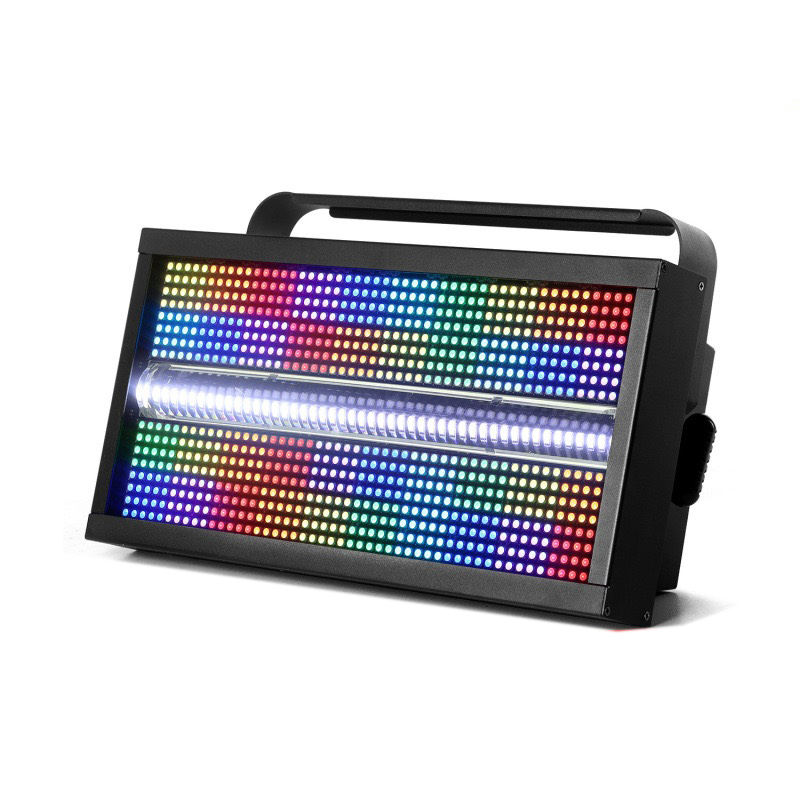
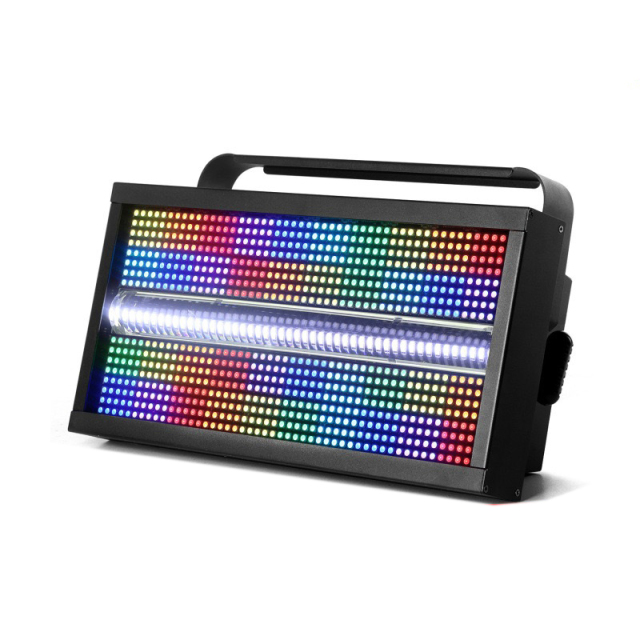
The Strobe L500 is a 500W LED strobe light with a colour matrix wrapped around a cool white core. The RGB and white emitters are addressed separately, so a saturated colour background and a hard white flash can run at the same time instead of one replacing the other.
It is rated IP20, which is the honest way of saying it belongs indoors or under cover — clubs, theatres, school halls, studios and roofed stages. Rain, sea air and permanent facade mounting are not what this panel is for; if that is your project, the outdoor models in the range are the right starting point and we will say so.
In professional LED stage lighting, the same fixture often has to serve a two-fader club rig in the week and a fully programmed show at the weekend. Eight DMX channel modes let this panel do both: start on a short patch, then move up to a zone-level layout when the cues need it, without changing the box.
As a LED strobe light supplier we ship to rental companies, venues and integrators in more than 80 countries, and the panel arrives with what a technician actually needs at load-in: connector types, channel lists and a direct line to the team that builds it.
Light Source & Zone Layout
- Two emitter types with different jobs. 800 × 0.3W RGB SMD LEDs fill the panel face while 48 × 5W cool white SMD LEDs form the tube through its centre. The white emitters are the higher-power half of the pair, which is why the flash reads so hard against the colour.
- Forty colour zones, six white zones. The RGB matrix is divided into 40 zones and the white tube into 6, so a colour chase can travel across the panel while the white core flashes on its own timing.
- Wide colour, tighter white. RGB output spreads across a 121-degree beam angle and the cool white is focused into 89 degrees — a split that suits LED stage lighting work, where colour has to reach the edges of a room and the white has to hit hard down the middle.
- Deep primaries for clean mixing. Red is specified at 620–630 nm, green at 515–525 nm and blue at 460–470 nm: saturated primaries that hold their hue when mixed into amber, magenta or cyan instead of muddying.
- A deliberately cold white core. The white LED stage lighting layer runs between 6500 K and 7000 K — close to daylight and noticeably cool, so the flash cuts through a saturated wash instead of warming it up.
- Fifty thousand hours, nothing to relamp. Average LED life is rated at 50,000 hours, and because the emitters are sealed SMD packages behind a flat face there are no lamps to change between shows. Routine work is cleaning the face and checking the connectors.
Control, Macros & Strobe
Eight channel modes, one fixture. A console or a simple DMX LED controller sees the same panel at anything from a compact patch to a full zone-level layout. Pick the smallest mode that still carries the zones and parameters your cues need, and move up only when a cue asks for more.
Macros for the nights when nobody programmed. There are 25 built-in RGB program macros and 9 cool white macros on board — useful when a band adds a song, when a DJ wants an effect light that moves without a programmer, or when a look is needed by the next downbeat rather than next week.
Strobe, shutter and pulse. Flash behaviour is not just on and off. The fixture offers strobe, shutter and pulse effects, so a hard stutter, a clean cut and a soft build can all live in the same cue stack.
From a slow pulse to 25 Hz. Strobe rate runs from 0.35 Hz at the slow end to 25 Hz at the top. The fast end blurs into a solid flicker for drops and build-ups, while the slow end gives a deliberate pulsing blinder for ballads and speeches.
Dimming that behaves at the bottom. Dimming is 0-100% smooth, which matters most in the last stretch of a fade: on an LED stage lighting rig most cues live in the bottom third of the fader, and that is exactly where stepped dimming shows.
Data on 5-pin DMX. Signal runs in and out on 5-pin DMX over a wired digital communication network, so the panel sits on the same chain as the rest of the rig and answers to whatever DMX light controller is at the front end.
Mounting, Rigging & Wiring
- Decide the aim before the truss goes up. Whether the panel is a strobe, a blinder or an effect light changes where it points: the bracket tilts from flat at the room to steeply down into a crowd, or back toward a low ceiling.
- Add an Omega bracket if your rig calls for one. It is a separate item and does not come in the box. Match the clamp to your truss before the first show rather than discovering the mismatch at load-in.
- Wire the data. Run from the previous fixture, keep the chain tidy and terminate at the end of the line as usual; the panel is happy anywhere on a chain that starts at your DMX light controller.
- Wire the power. Panels link through their power in and out connectors instead of each needing its own outlet. Add up the draw on the circuit before you chain another one on.
- Address it and run a flash test. Address and channel mode are set from the LCD menu with the four-button interface. Fire a test at the level you plan to use — a reversed data cable is much cheaper to find now than during soundcheck.
- Set the tilt for the room, not the rig. Write the trim and the tilt down so the next venue starts from a known position instead of re-focusing from scratch.
Applications & Pairing
- Club and bar main rooms. One or two panels behind the DJ or above the floor cover the white hits, the colour chases and the audience blinder that used to need separate fixtures.
- Live music and DJ sets. As an effect light it sits between the moving heads: colour sweeps across the matrix during a build, then a white hit lands on the drop.
- Theatre, school halls and worship spaces. When a flash has to be cued rather than punched, an operator can ride it from the console instead of reaching for a button on the back of the box.
- Studio and filmed performance. The white LED stage lighting core is cold and clean on camera, so it flashes without the yellow shift that warmer sources bring to a shot.
- Rental and touring inventory. One clamp, one data cable and a panel a single technician can lift into place keeps the truck list and the labour bill short.
- Product launches and brand events. A short flash on a product reveal, or a colour build behind a speaker, is quick to cue and easy to repeat across several venues.
- Pairing and system fit. The panel takes data from any DMX LED controller you already own. If you are building a row of them, address each one and plan the data and power chain in advance — tell us the width and we will work it out with you.
Specifications
| Property | Detail |
|---|
| Fixture type | LED strobe panel with an RGB matrix and a cool white core |
| Light source | RGB SMD matrix plus a cool white SMD tube |
| Max power consumption | 500W (2.7 A at 120V / 60 Hz; 1.4 A at 230V / 50 Hz) |
| Power supply | 100–240V, 50/60 Hz |
| DMX channel modes | 8 modes: 6 / 9 / 13 / 18 / 36 / 41 / 126 / 141 channels |
| Mounting | Bracket system with 180 degree tilt; ready for an Omega bracket (sold separately) |
| Dimensions | 159.5 × 405.0 × 250.5 mm |
| Weight | 6 kg |
| IP rating | IP20 |
| Housing | Black |
Ordering & Documentation
- Tell us the room and the rig. Venue type, trim height, throw and the controller at the front of the chain — console or DMX light controller — are enough for us to say whether one panel covers the job or whether you need a pair.
- Confirm the configuration. Quantity, clamp type and whether an Omega bracket should travel with the order are the details that change what actually ships.
- Ask for the documents you need. Specification sheet, user manual, DMX channel chart and photometric files are the four things most professional LED stage lighting projects ask for; tell us which ones your file or tender requires and we will confirm what can be supplied.
- Confirm the commercial terms. Minimum order quantity, volume breaks, lead time, payment terms and trade terms are quoted per order and per destination, so confirm them with your sales contact before a project date is committed.
- Check the compliance paperwork for your market. Requirements differ by country. Tell us where the panels are going and we will confirm which declarations and test documents can be provided for that market.
- Agree warranty and the after-sales route. Warranty length and scope, spare parts and the process for a quality claim sit in our warranty and repair policy — ask for the current version with your quote, and the LED strobe light supplier that built the panel is the one answering the claim.
- Fix the packing and the shipping plan. Cartons or touring cases, pallet quantities and the destination are agreed at order stage; on a long LED stage lighting tour it is worth planning how the kit travels before the shipping date is fixed.
Technical Support & Model Matching
More than 30 engineers with an average of 15+ years in professional lighting stand behind every order — the same people who answer your technical questions. Tell us your venue, rigging height, throw distance and existing control setup; we help match models, check protocol and channel fit, and build a package that works as one system. If a fixture misbehaves on site, we work through the fault with you and sort out spares. Installation and commissioning guidance come with the order. Founded in 2016, exporting since 2022, LITEVISION serves buyers in more than 80 countries from offices in the USA, Taiwan, Mexico and China.
FAQ
What do I need at the front end to control it?
Any desk or DMX LED controller that outputs standard DMX will drive it — there is no proprietary protocol and no dedicated software. It sits on the same chain as your other fixtures, and the eight channel modes mean a small controller can run the simple layouts while a larger desk takes on the zone-level ones.
Does the Omega bracket come with the fixture?
No. The panel ships with its own bracket, and an Omega bracket is a separate item that only matters if your clamp or truss setup calls for that pattern. Tell us what you hang on and we will confirm the match before the order is packed.
Can it be used as a steady blinder as well as a strobe?
Yes. The white LED stage lighting core can be held at a level and used as a straight audience blinder, with the colour matrix running behind it or left dark. Most operators keep the held look on one fader and the flash on another so the two can be mixed within a song.
How do I look after the panel between shows?
Wipe the face with a soft, dry cloth and check the data and power connectors and the bracket fixings at load-in. Nothing inside needs routine replacement, so most of the work is keeping the fixture dry, clean and correctly addressed.
Is a 500W panel enough for my room?
For club floors, halls, school stages and mid-size rooms it carries blinder and strobe duty on its own. Where the audience is stadium-sized, professional LED stage lighting rigs spread the flash across several fixtures rather than one — send us the trim height and the coverage you need and we will size the package instead of guessing.
Can several LED strobe light panels be run together as a wall?
Yes. Each panel takes its own address on the data chain, so a row of them can be treated as one surface or broken into separate looks. Tell us the width of the wall and how you want it divided, and we will map the addressing and the power chain with you.
Will it work with the lighting software we already use?
It speaks standard DMX, so any desk or software that outputs DMX can run it. Your programmer will want the channel chart to build a fixture profile — ask for it with the order and we will send the current version.