Product Overview
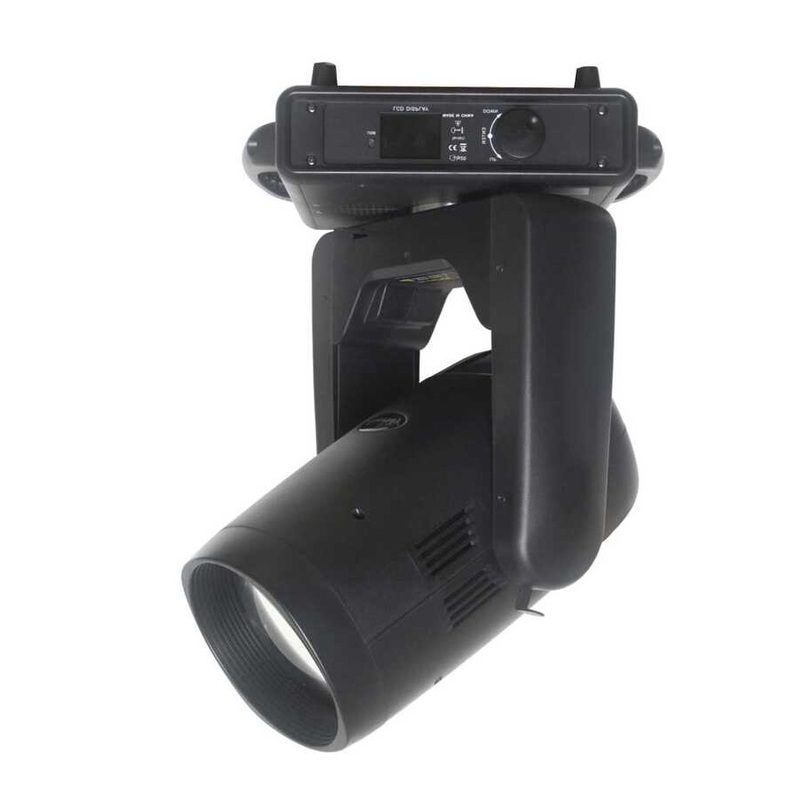
The Sword 680 is a lamp-based beam moving head light: an OSRAM 461 W discharge lamp behind a large front lens, focused down to a 1.8° angle so the output leaves the head as a hard-edged pencil rather than a soft pool. It is the fixture you hang when the beam itself is the picture — the line cutting through haze, the fan across the audience, the column that lands on a mark at the back of the hall.
The buyers are distributors, rental houses, venue technicians and club operators. If you are a moving head light supplier building a catalogue for your own market, it behaves like a spec-sheet product: a technical buyer can read the numbers, compare them with what they already stock, and know what the fixture is before anyone books a demo.
It is not a wash and not a 3-in-1. There is no CMY mixing and no zoom ring; the angle is fixed, so a look is built from the colour wheel, the gobo wheel, the two prisms and the frost filter instead. In a mixed rig it takes the long-throw aerial work while LED beam-spot-wash and framing units cover stage wash and cuts. It is also an indoor fixture — IP 20 — so it belongs under a roof, not on an open stage.
Across a moving head light show it works in two modes. Early on it is a position tool: a defined spot that picks a performer out of a dark stage and holds them. Later it becomes the effect — fans, spins and audience sweeps, often on the same cue list with the frost in and a softer edge.
As a beam moving head light manufacturer, we assemble and sign off every unit at our factory in Guangzhou before it is packed, and the control set is deliberately plain: one address, one channel block, one cable type. A technician who has never seen the fixture can have it running in a few minutes, which matters when a rig is being rebuilt in a different venue each week.
Beam Optics & Aerial Reach
- The 1.8° angle is the whole point of this moving head beam light. At that width the column stays narrow right across a deep room, so a beam aimed at the back of a balcony is still a defined line when it arrives rather than a spreading glow.
- The front optic is oversized for a beam head, and it sits ahead of a multi-group cemented lens design.
- What that buys you is a clean edge and a bright centre through the whole throw — the quality that makes a beam look solid on camera and in a photograph of the rig.
- On a moving head stage light, the beam angle also decides where you can hang the fixture. A 1.8° unit works from a rear truss, a side boom or a high ceiling position without sitting close to the performer, which leaves the front truss free for the fixtures that have to be near the stage.
- Haze or light fog is what turns the beam into an object.
- Without it you still get a bright, hard-edged spot on the performer and the floor, but the aerial column audiences remember only exists once there is something in the air for the light to hit — plan the atmospheric effect as part of the look, not as an afterthought.
- In a moving head light show, a tight angle lets a handful of units carry the geometry.
- Fans, crosses and chase lines stay crisp because the beams do not merge into one wash, and a small rig reads as a bigger one than the same number of wide fixtures would.
- Because the angle is fixed, the fixture is aimed rather than zoomed.
- Cue design works around where the beam lands, what shape it carries and how fast it moves — a different discipline from a zoom beam, and usually a faster one to program once the positions are set.
Hanging, Power & DMX Setup
- Plan the position before anything goes on the truss.
- For a moving head stage light on a rear or side position, check the trim height, the tilt angle needed to reach the far seats, and that the yoke can swing without fouling the truss or the fixture next door.
- Hang it on the U-shaped yoke with a clamp rated for the load, and check the tilt lock before the head is powered.
- The yoke is the lifting point — do not carry the unit by the head or the lens barrel.
- Connect power before data.
- Feed the fixture from a circuit that can carry its draw alongside the rest of the bar, and keep it on the same phase as the neighbouring fixtures so a shared supply does not surprise you at switch-on.
- Run data on 3-pin DMX cable from the console or a splitter, daisy-chaining from fixture to fixture and terminating the last unit in the line.
- Keep data cable away from mains cable on long runs, and do not change cable type halfway down a chain.
- Give every DMX moving head light on the line its own start address, set on the rear panel display, then patch the full 16-channel block in the console so pan, tilt, colour, gobo, prism and strobe land on the faders you expect.
- Build the fixture personality from our channel map rather than from guesswork, and check it in pre-vis before the day.
- Once one unit is addressed and behaving, copy the offset across the rest of the bar.
- That is how a moving head dj light rig of eight or twelve identical units gets up in a single pass, and it is also how a touring rig stays consistent when units are swapped between venues.
- Run a full test before doors: pan and tilt through their travel, every colour and gobo position, both prisms, frost and a strobe burst.
- Then push the head off its mark by hand and let go — the automatic position correction should bring it back.
- If it does not, that is a service question, not a programming one.
Colour, Gobo & Prism Effects
The colour wheel on this moving head beam light carries 14 colours plus open, with 3200 K and 5600 K correction filters sitting on the same wheel. A warm beam or a daylight beam is one wheel step away instead of a gel change, and the 7-colour rainbow plus the half-colour and water settings give you movement inside the colour itself when a single flat hue would sit still.
Seventeen fixed gobos plus open give the fixture its shapes. Scrolling walks a gobo across the beam to create motion without moving the head, and shaking adds a fast flutter that reads as texture in the air — useful on a break or a build where the beam should feel unstable rather than locked.
The two prisms do different jobs. The 48-facet splits the beam into a dense cluster of narrow fingers; the 16-facet opens it into a coarser, wider fan. Both rotate either way, so a prism turning against a pan movement produces the slow blooming effect that fills a large room without a wide lens.
A single frost filter softens the edge for the moments when a hard line is too graphic — a vocal, a speech, a slow number where the column should glow rather than cut. It sits in the light path, so it costs brightness; treat it as a deliberate look rather than a default position.
Club work is where these effects get used hardest. A moving head dj light on a ceiling position can hold a colour, drop a gobo, add the 16-facet prism and pull back to a tight column on the drop — and because everything is on wheels inside the head, the change is a cue rather than a re-focus.
The double-piece strobe is a separate effect, not a flicked dimmer. Two blades chop the beam, so the flash keeps a hard edge even at speed and the rate is adjustable from the console. Used sparingly it is the punctuation at the end of a section; run continuously it just makes the rig look broken.
Lamp Life, Heat & Service
- For a moving head light supplier, a 1500-hour lamp rating is a planning figure rather than a promise about how a fixture ages.
- Work out how many hours a week the unit actually runs, put the lamp change on the calendar ahead of that number, and you avoid the failure that always seems to land in the second half of a show.
- The lamp is a replaceable part, not a sealed assembly, so the fixture's working life is not tied to one lamp. Keep a spare lamp per group in the case and a swap becomes a job between get-ins instead of a lost week of hire.
- Change a lamp with the fixture cool and isolated.
- Bring the head down or reach it from a safe position, open the lamp access, fit the replacement without touching the glass envelope with bare fingers, and log the change date and hours before the unit goes back in the case.
- Heat is handled by axial smart fans that move air through the head and vary with load.
- Keep the fan path clear — do not hang the fixture pressed against a ceiling, a drape or another unit — and it will hold a stable temperature instead of chasing its own limit all night.
- Overheat protection cuts the power automatically if the internal temperature climbs too far. If a unit shuts down mid-show, that is the first thing to check: whether the airflow is blocked, whether the fixture is sitting in another unit's exhaust, and whether the room itself is unusually hot.
- Pan and tilt run on a three-phase noise-free stepping motor, and the cooling fans are the only other moving air, so the head is not usually the loudest thing on the truss.
- For an acoustic set or a broadcast with sensitive microphones, still position it away from the talent and listen to it in the room before the first show.
- Lamp hours belong in a service record per serial number for every DMX moving head light, especially in a rental fleet.
- A unit that goes out with a lamp near the end of its life is a customer complaint waiting to happen, and a log is the only way to know which case to open first.
Specifications
| Operating Voltage | AC 110–240 V, 50/60 Hz |
| Rated Power | 680 W |
| Light Source | OSRAM 461 W discharge lamp |
| Lamp Life | 1500 h |
| Colour Temperature | 8000 K |
| Beam Angle | 1.8° |
| Front Lens | 180 mm, high-precision multi-group cemented lens |
| Colour System | 14 colours + blank, with 3200 K and 5600 K colour filters, 7-colour rainbow effect, half colour and water effect |
| Gobo Wheel | 17 fixed gobos + blank, with scrolling and shaking effect |
| Prisms | 1 × 48-facet and 1 × 16-facet, both with bi-directional rotation |
| Frost | 1 frost filter |
| Dimming and Focus | 0–100% linear dimming, 0–100% linear focus |
| Strobe | Double-piece, 1–13 Hz, speed adjustable |
| Control | DMX 512 and RDM protocol, 3-pin DMX signal cable, 16 channels |
Movement & Transport Data
| Pan range | 540° |
| Pan sweep time | 2.4 s |
| Tilt range | 270° |
| Tilt sweep time | 1.4 s |
| Pan/tilt resolution | 16-bit |
| Drive | 3-phase noise-free stepping motor |
| Movement character | Fast and smooth, with precise role |
| Position correction | Automatic |
| Mounting | U-shaped yoke bracket |
| Net weight | 21.2 kg |
| Gross weight | 25 kg |
| Fixture size | 39.2 × 27.2 × 62.5 cm |
| Carton size | 537 × 499 × 640 mm |
Ordering & Delivery
- Send the brief first: venue type, trim height, throw distance, how many units you need and the console you run.
- As a beam moving head light manufacturer we would rather check that a fixed-angle beam suits the room before you commit than take an order for a fixture that is wrong for the job.
- Confirm quantity and terms with your sales contact. Minimum order quantity and any volume steps are quoted per order and per market, so ask for the current figure rather than working from last season's quote.
- Ask for the production and delivery schedule at the same time.
- Lead time depends on quantity and on what else is running through the line, so it is confirmed per order — get it in writing against your event date.
- Payment terms and Incoterms are agreed per order.
- Confirm the currency, the Incoterm and the documents your broker needs before the order is placed, so nothing is held at destination over paperwork.
- Ask what the warranty covers and how a claim is handled — the term, the parts included and the route for a repair.
- The same conversation should cover spares: lamps, fans and motor drivers are the parts that keep a lamp-based beam in service.
- Request the documentation you need to pass on: the specification sheet, the user manual, the DMX channel table and the photometric file for your lighting-design work.
- If a consultant or a tender needs CAD drawings or market-specific compliance documents, say so when you order and we will confirm what is available for your region.
- Packing and shipping are quoted with the order.
- If your units travel, ask whether flight cases can be quoted alongside the fixtures — they are a separate item from the carton the unit ships in, and cheaper to plan with the order than to add later.
- Report any damage or performance problem as soon as the unit is unpacked, with photos and the serial number.
- A claim raised against the shipment is far easier to resolve than one raised a month later, after the unit has been in a truck.
Technical Support & Model Matching
More than 30 engineers with an average of 15+ years in professional lighting stand behind every order — the same people who answer your technical questions. Tell us your venue, rigging height, throw distance and existing control setup; we help match models, check protocol and channel fit, and build a package that works as one system. If a fixture misbehaves on site, we work through the fault with you and sort out spares. Installation and commissioning guidance come with the order. Founded in 2016, exporting since 2022, LITEVISION serves buyers in more than 80 countries from offices in the USA, Taiwan, Mexico and China.
FAQ
How far will the 1.8° beam carry in a large room?
The tight angle is what makes the distance work. Because this beam moving head light spreads very little across its throw, the column arrives at the back of a hall or an arena still narrow and still hard-edged instead of widening into a wash. In practice the limit is usually atmospheric rather than optical: without haze or fog in the air the beam is invisible between fixture and target, and all you see is the spot where it lands.
Will it drop into the console and software we already run?
The control set is DMX 512 with RDM over a 3-pin cable, using a 16-channel block. That is manageable for any desk that already handles a standard moving head profile, and RDM lets the console read back the address and identity without climbing the truss. Ask us for the channel map so you can build the fixture personality and check it in pre-vis before the units ship.
Can we add one unit to a rig that already runs LED beam and framing fixtures?
Yes, and that is the most common way it gets used. A moving head stage light with a fixed narrow angle sits alongside zoomable LED units without competing with them: the LED fixtures cover wash, cuts and mid-throw looks, while the lamp head takes the long aerial work. Matching it is mostly a matter of channel offset and cue naming rather than re-rigging.
Can it be used outdoors or under a tent?
No. This moving head beam light is IP 20 and built for dry indoor use — a truss in a hall, a club ceiling, a studio or theatre grid. Under a tent, on an open stage or in a humid coastal venue it will take in moisture and dust and start failing. For outdoor work, an IP65 fixture from the range is the right tool.
What does this fixture actually add to a moving head light show?
Geometry and punch. It gives you defined lines in the air rather than a general glow — fans, crosses, chase lines and audience sweeps that stay sharp because the beams do not overlap. It also layers well: a gobo through one prism, the second prism at a different speed and a colour on the wheel gives four different looks from the same position without moving the head.
Can we run it without a lighting console?
Its control set is DMX 512 with RDM, so plan on running it from a console rather than standalone. For a small moving head dj light position that is usually a compact desk or a laptop-based controller; for a venue rig it is the house console. If you need fixtures that run on built-in programs, a 3-in-1 model in the range is a better fit for that job.
Why choose this over an LED beam or a 3-in-1 fixture?
If the job needs the hardest possible beam down a long throw, the discharge source gives a quality of column that the compact LED beam heads do not set out to match. The trade-off is a lamp with a defined service life and a replacement routine. If you want zoom, colour mixing and framing from one box, an LED beam-spot-wash or framing model is the better buy — as a beam moving head light manufacturer we supply both, and we will say so when the LED model fits your room better.