Smoke, Haze or Low Fog
- This machine: oil-base smoke.
- A heavy, fast burst that goes up and out, built for a defined moment such as a reveal, a drop or the first hit of a number, not for keeping a room atmospheric all evening.
- Oil-base haze.
- Thin, even and continuous, made to hang in the air for hours.
- A different machine for a different job: haze is what keeps a dmx lighting rig readable between the big moments.
- Water-based smoke.
- A thinner plume that clears sooner, and the usual choice where a venue limits what can be left in the air.
- It will not give you the weight this machine does.
- Low fog.
- Chilled until it crawls along the floor and spills off a stage edge.
- It needs its own machine and its own consumables, and it will not fill the air above the stage.
- Spark, flame and CO2. Momentary, high-impact and covered by their own safety rules.
- None of them does the work of smoke.
- Used together.
- One machine fills the room and another provides the moment, and that is the pairing most shows end up with, which is why stage lighting manufacturers keep both types in the range.
Product Overview
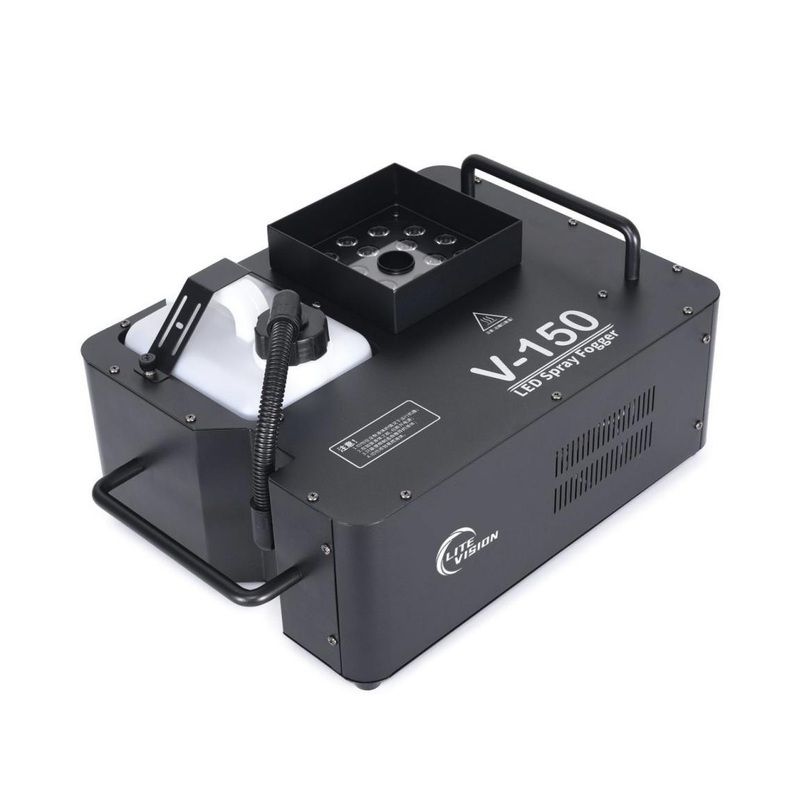
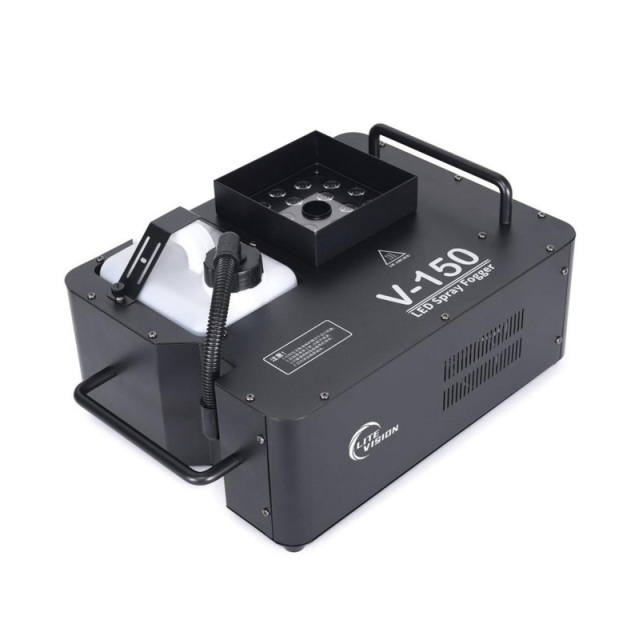
The V-1500 is an oil-base smoke machine built for the moment a show needs fog now, not in ten seconds. Fluid is driven through a top-mounted outlet as a dense plume that rises and spreads, so it fills the air above a stage instead of pooling around the base of the truss.
Oil-base fluid holds its body longer than water-based fluid, which matters when beams have to keep their shape through a whole cue. In a dmx lighting rig the smoke is what turns a beam into something the audience can see, and this is the type of smoke that stays in the air long enough to read from the back row.
Eighteen RGB beads sit around the top outlet, six red, six green and six blue, 54 W in total, so the plume is coloured as it leaves the machine. On a small stage that can carry the burst on its own; on a large one it puts a coloured core inside the wash the designer is already running.
The fluid drum lives inside the chassis under a top cap, with a flexible hose feeding the heater. The housing is matte black with a ventilation grille on one side and carry handles on both, so it can be repositioned by hand when the layout changes between numbers.
Rental desks, club installers and professional stage lighting companies buying from a stage lighting equipment supplier choose this class of machine for one job: a hit the audience can see from the back of the room. It suits a mid-size stage, a club main room, a school hall or an event floor where the effect has to land on a single cue rather than sit in the air all night.
Indoor Siting & Setup
- Check the supply against the rating plate before anything else, and make sure the plug and connector on site match it.
- A machine built for one supply will not run on another, and mismatched power is the most common reason an effect gets cancelled.
- Stand it on a flat, stable surface off the performance line, with the ventilation grille clear and nothing pressed against the housing.
- Smoke rises, so the outlet needs open air above it rather than a low ceiling or a drape.
- Fill the drum through the top cap, keep it below the fill line, and wipe up any spill before the machine goes live.
- Fire a test burst during the pre-show check from whatever will fire it in the show, and note the setting so the next operator can repeat it.
- Run a safety pass: hot surfaces around the outlet, cables routed so nobody walks on them, the unit secured against knocks, and one person briefed to switch it off if it starts to sputter.
- Rehearse the cue in context.
- Professional stage lighting companies that buy from a stage lighting equipment supplier run the effect with the beams and the music on rather than in an empty room, because a plume looks very different once the rig is lit.
Venue & Show Applications
- Club and live music rooms.
- In a dmx lighting rig, the burst lands the drop, the beams suddenly have a body to cut through, and the effect reads all the way back to the bar.
- Concert and festival stages.
- Sited upstage and off the performance line, the plume crosses the rig rather than the performers, and the spray carries high enough to reach a mid-size stage roof.
- Theatres, school halls and ceremonies.
- Where theatrical stage lighting is mostly fixed and the person at the desk may be a venue technician or a teacher, a machine that gives the same result on every cue is easier to live with than a system that has to be watched all night.
- Event, wedding and launch production.
- The first dance, the product reveal, the frame the photographer is waiting for: one unit on the floor and a short cue is all it takes.
- Theme parks and fixed shows.
- The same cue several times a day, all season, with the drum and the outlet the two things your maintenance team actually touches.
- Rental stock at stage and lighting companies.
- A self-contained unit with its drum inside the chassis is easier to hand to a crew than a machine with separate tanks and hoses.
Specifications
| Property | Value |
|---|
| Voltage | 220-240 V |
| Frequency | 50/60 Hz |
| Total power | 1,500 W |
| Working current | 7 A |
| Current limiting fuse type | Fuse (F) |
| Current limiting fuse rating | 8 A, 250 V |
| Oil drum volume | 3 L |
| Maximum smoke output | About 32,000 cubic feet/minute |
| Maximum spray height | About 6.0-8.0 m |
| Maximum fuel consumption at full output | About 6.3 min/L |
| Maximum continuous output | About 7 seconds |
| Output time on a full drum | About 15 minutes |
Oil, Refills & Daily Care
Run oil-base fluid of the grade supplied for this machine. Water-based fluid is formulated for a different heater and pump, and putting it through an oil-base machine gives you a thin plume and a residue problem at the same time. If you want to use a fluid from another brand, send us its specification first and we will tell you whether the heater is suited to it.
The drum fills through the top cap and is topped up between numbers rather than mid-cue. Running it dry is the fastest way to shorten the life of a smoke machine, because the pump keeps working while the fluid stops arriving. Keep the night's fluid beside the unit rather than back in the van.
Oil-base smoke leaves a light film, and it collects first on the outlet surround and the nozzle. Wipe both after a heavy show and dust the ventilation grille when you clean the rest of the rig, since a choked grille is the usual reason a machine starts to run hot. In theatrical stage lighting, where a unit often sits in the same position for a whole season, put that wipe-down on the maintenance calendar rather than waiting for a fault.
Between dates, empty or seal the drum and keep the machine upright in transit, because fluid that finds its way into the housing causes more faults than anything else on the road. Rental desks at stage and lighting companies tend to keep the drum cap, the hose and the manual together in one bag so nothing goes missing between shows.
Give the machine air. In a small room with the doors shut, the detector will notice long before the audience does, so agree extraction and detector isolation with the venue before the load-in rather than arguing about it afterwards.
Ordering & Documentation
- Start with the room rather than the machine.
- Most stage and lighting companies order a unit like this for a specific venue or a specific tour, so tell us the space, the ceiling height, how often the effect fires in a night, and whether it will stand on the floor or go into a set.
- Confirm the electrical version for your market, including supply, plug and connector, so the machine arrives ready for the venue instead of for an adapter.
- Ask for the paperwork your project file needs: specification sheet, user manual, control details and any compliance documents required where the machine will be installed.
- If it is going into rental stock, say so and we will include what your crew needs.
- Agree quantities, price breaks, payment terms and lead time with your sales contact.
- These are quoted per order, and because we build these as stage lighting manufacturers the schedule follows production in Guangzhou rather than a warehouse shelf, so the earlier we have your date the better.
- Agree how it ships.
- Tell us whether the machine goes into a flight case for touring or straight into a venue, and we will confirm the packing for the trip.
- Confirm warranty cover, how spares are handled in your region, and who to call if something fails on site.
- As a stage lighting equipment supplier we would rather settle that before the order than after a failure.
Technical Support & Model Matching
More than 30 engineers with an average of 15+ years in professional lighting stand behind every order — the same people who answer your technical questions. Tell us your venue, rigging height, throw distance and existing control setup; we help match models, check protocol and channel fit, and build a package that works as one system. If a fixture misbehaves on site, we work through the fault with you and sort out spares. Installation and commissioning guidance come with the order. Founded in 2016, exporting since 2022, LITEVISION serves buyers in more than 80 countries from offices in the USA, Taiwan, Mexico and China.
FAQ
Can the machine be flown from a truss?
It is built to stand on a flat surface, with a top-mounted outlet and carry handles on the sides. If your design needs the unit in the air, talk to us before the hang goes into the drawing, because on theatrical stage lighting builds we would rather work the method out with you than have it improvised at load-in.
Can it be used outdoors?
This one is for indoor use. Wind pulls a plume apart faster than a machine can build it, and the housing is not built for weather. If your show is outside, tell us the site and the conditions and we will point you at the model that suits it.
Do the RGB beads work without smoke?
The beads sit around the outlet to colour the plume as it leaves the machine, so with no smoke there is nothing for the light to catch. As stage lighting manufacturers we build them as part of the smoke effect rather than as a room light.
How soon after switch-on can I fire the first cue?
Give the heater time to come up to temperature before the first cue and use your pre-show check to fire a test burst. Firing cold is the usual reason a first hit looks thin and leaves a wet patch under the nozzle.
How many units will my room need?
For a mid-size stage, one unit upstage usually covers the air in front of the performance area. Professional stage lighting companies running wide rooms normally take two, one each side, and split the cues between them so the effect arrives from more than one direction.
How is the machine triggered?
Tell us what will fire it, whether that is a cue from the console, a switch at the machine or an operator calling it live, and we will confirm the control arrangement for your order so it matches the way your show runs.