Product Overview
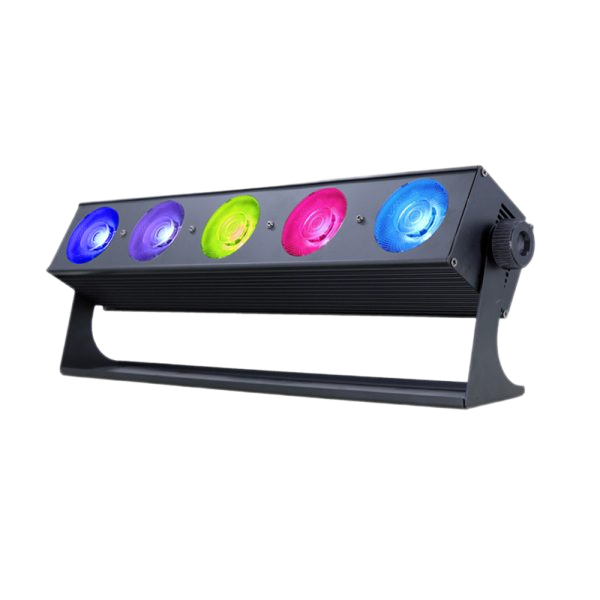
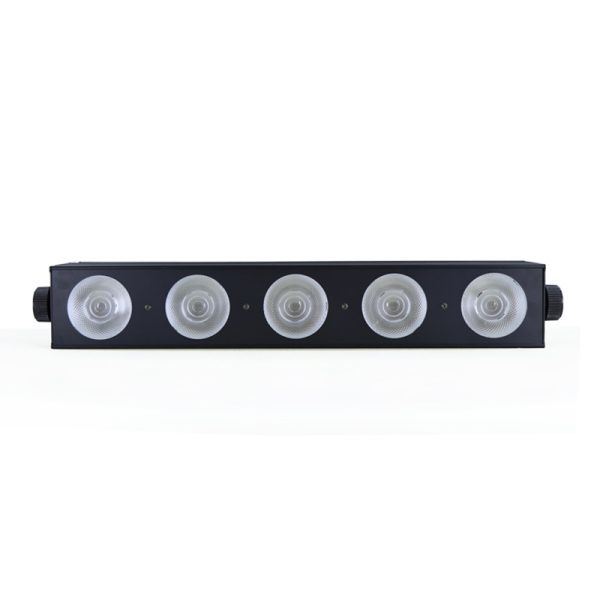
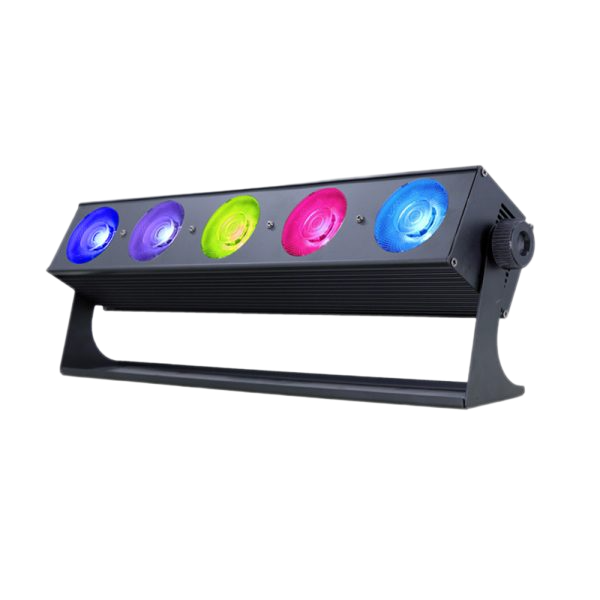
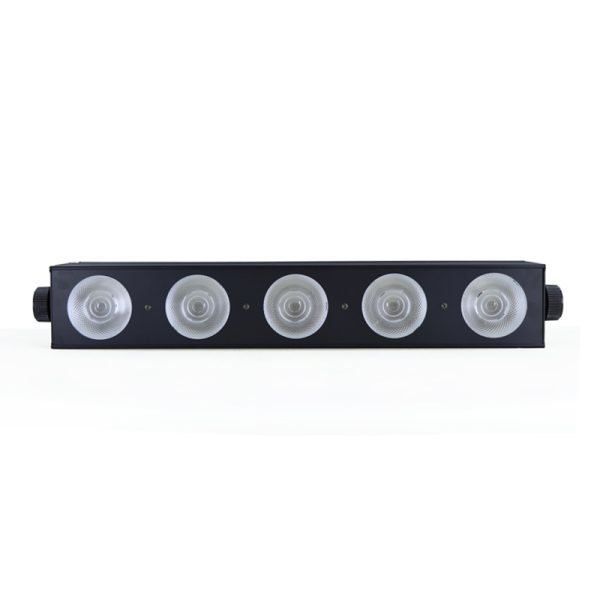
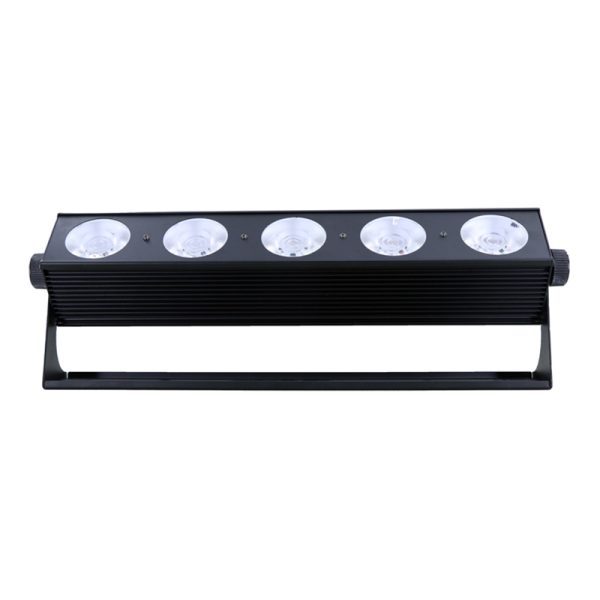
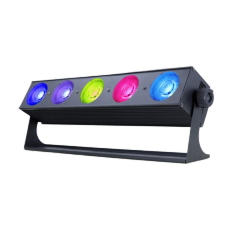
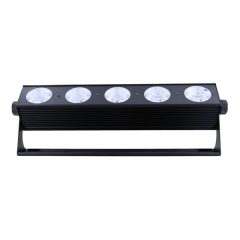
This is a linear wash bar carrying five 30W COB RGB 3-in-1 LEDs behind a row of lenses. Each of those five sources is wired and addressed on its own, so the bar works either as one continuous band of colour or as five controllable cells that can hold a gradient, a chase or a colour sweep along its length.
Rental companies, venues and installers choose led bar light fixtures for the jobs where a row of par cans is too bulky and a moving head is more than the position needs: a stage lip, a low set wall, the back wall behind a band, or the front edge of a riser. It sits low, stays out of sight lines and covers a wide, even band of light.
Think of it as the fixed-wash layer of a rig. It holds the base colour on a stage or a wall while the moving heads do the effects, and it hangs naturally on the same DMX line as profiles and moving washes. On a permanent install rather than a tour, it can be the main wash for the whole room.
This is an indoor fixture, built for stages, halls, clubs and interior architectural accents, and it runs from a standard lighting circuit. We build and support it as led stage lighting manufacturers working with rental fleets and installers, so the practical questions that come up later — patching, spares, matching units — land with the people who make it.
Control Modes & DMX
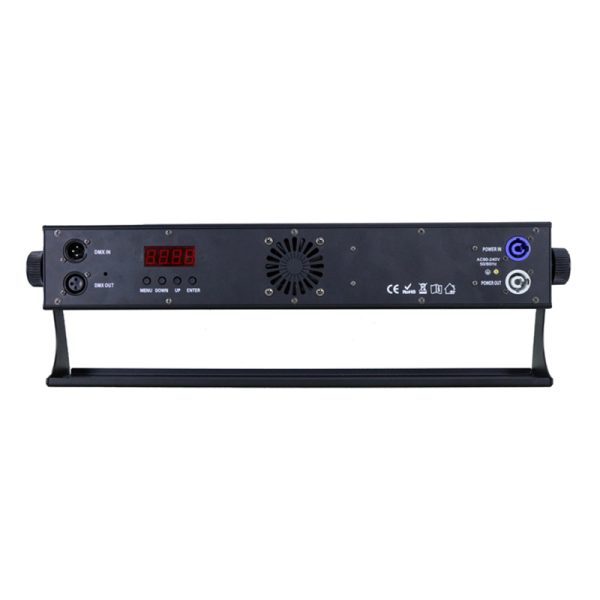
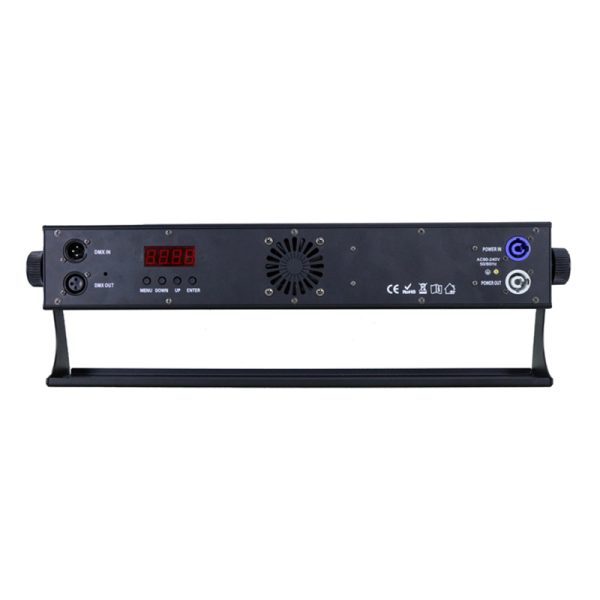
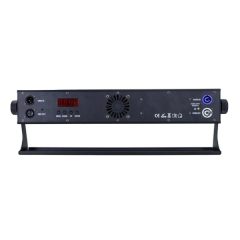
The rear panel carries the dmx led stage lighting connections — DMX in and DMX out — alongside a digital display, four menu keys and power in and out. Address, channel mode and operating mode are all set at the fixture, so patching and testing do not need a laptop balanced on the truss.
The bar offers 5, 9 and 19 DMX channels. The short modes suit a straightforward wash where the bar should stay out of the patch's way; the 19-channel mode is where the five COB sources can be addressed one by one for professional led stage lighting looks. Ask for the channel table before you patch, so the map your programmer builds matches the fixture.
Master/slave is the mode for a row of bars with no desk attached. Set one unit as the master and the others follow it over the DMX chain, so a wall of bars holds the same colour and makes the same change at the same moment.
Auto runs the bar through its colour changes without a controller, and sound-active makes it follow the music in the room. Both are what bar and club staff use on a night when nobody is sitting at a console.
Inside DMX the dimmer moves smoothly from 0 to 100% and the strobe runs from 1 to 25 flashes per second — enough range for a slow fade and a hard strobe from the same bar.
Mounting & Installation
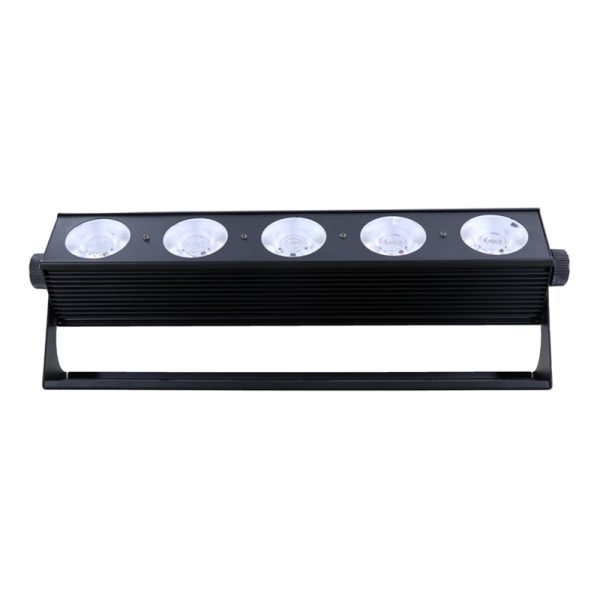
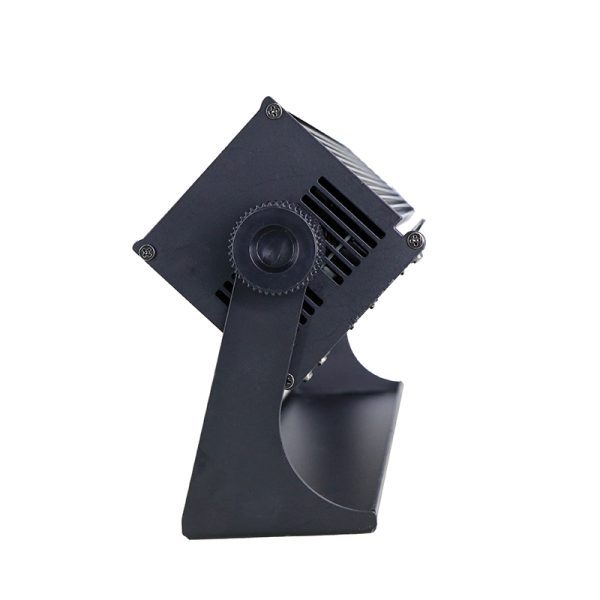
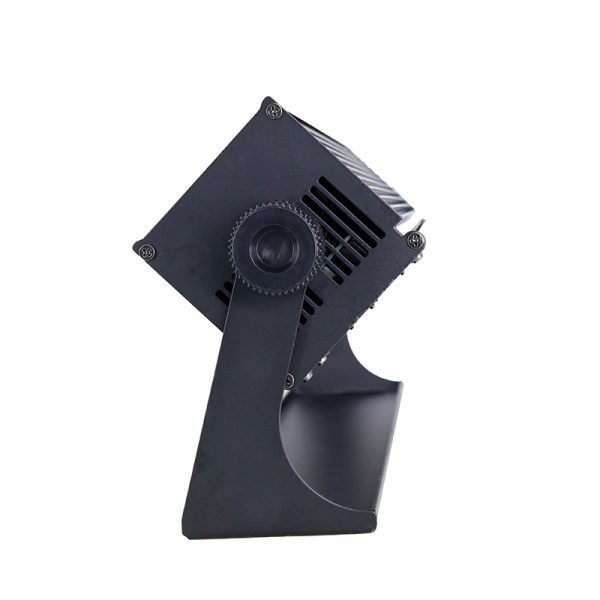
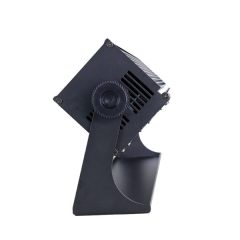
- Decide the angle before the bar goes up. The U-shaped bracket and side knobs set the tilt, so work out first whether it is grazing a wall, washing a stage floor or hanging straight down.
- Hang it or stand it. Use a clamp on a T-bar or truss for overhead positions, or stand the bracket on the floor for uplighting — a portable led wash light is usually re-aimed between shows, so leave the side knobs reachable.
- Add a secondary fixing. Run a safety cable through the bracket whenever the bar is flown, including short hangs.
- Aim and lock the tilt. Loosen both side knobs, set the angle, then tighten them evenly so the bar holds its position through the show.
- Wire the data. DMX in and out let you chain the bars in one line with the rest of the dmx led stage lighting on the rig, and the last fixture in the chain should be terminated.
- Plan the power. Power in and out sockets let you link led stage lighting bars on a single feed, but add up the draw of every unit first and check it against the circuit.
- Leave the air path open. The fan grille and the ribbed heat sink on the body need clear space, so keep the bar out of soft goods and scenery.
- Address and test while the bar is still on the ground. Set the DMX address and mode from the rear panel, then check dimming, colour and strobe where a fault is easy to reach.
Applications
- Stage lips and front-of-stage. A led bar light along the front edge lifts the performers from below and fills the shadows that overhead spots leave.
- Cycloramas and set walls. One bar carries a gradient along a flown cloth or a flat, so the backdrop changes with the scene instead of sitting in one flat tone.
- Clubs, bars and live rooms. Mounted on a back wall or above the bar, this kind of led wash light gives the room colour that moves with the set without a technician on a desk all night.
- Churches, schools and halls. Auto and sound-active modes cover services and events with no operator present, and DMX takes over when a production needs cues.
- Interior wall grazing. Aimed close to an indoor wall, the 36° spread produces a broad, soft column for hotel, hospitality and restaurant interiors.
- Rental stock. The bar travels as one unit, works with whatever desk the venue has and covers the small-wash jobs that professional led stage lighting inventory never has enough of.
- Sets that are filmed. If the bar will be on camera, tell us the frame rate you shoot at and we will confirm how it behaves under your shutter.
Specifications
Five addressable sources. Each of the five 30W COB RGB LEDs is driven separately, so the bar can hold five different colours at once or blend them into one continuous wash. Real pixel-level looks. Chases, gradients and colour sweeps run along a single bar instead of a row of separate fixtures — the feature that usually brings a buyer to a pixel led light supplier in the first place. 150W on a normal circuit. The whole bar draws 150W, which leaves headroom on a small distro for the rest of the rig. Light enough to re-aim alone. At 5.0 kg, one technician can lift the bar onto a T-bar or a wall bracket, tilt it and lock it off without a second pair of hands. Three beam angles in one model. 12°, 24° and 36° cover a tight shaft, a mid wash and a wide spread, which is what makes portable led stage lighting work across rooms with different mounting heights. Four operating modes. DMX512 for cueing, master/slave for a matching row, auto for changing colour on its own and sound-active for rooms with no operator. Channel counts that fit the patch. 5, 9 or 19 DMX channels let a simple wash stay small and a detailed look still have room — most led stage lighting bars give you one or the other. Cooling that watches itself. Fan speed follows temperature and the fixture backs its own output down if it runs hot, which matters on a long night under a low ceiling.
| Model | Archi Bar0545W |
|---|
| Product type | LED wash light, indoor bar format (IP20) |
| Light source | 5 × 30W COB RGB 3-in-1 LED, each individually controllable |
| Power consumption | 150W |
| Input voltage | AC 90–240V, 50/60 Hz |
| Beam angle | 12° / 24° / 36° |
| LED life | 50,000 hours |
| Control modes | DMX512, master/slave, auto, sound active |
| DMX channels | 5 / 9 / 19 |
| Dimming and strobe | 0–100% smooth linear dimming; 1–25 flashes per second |
| Cooling | Fan cooling with temperature control; output-managed temperature protection |
| Housing and electrical | Aluminium, matte black; 1.5 kV electrical strength, >2 MΩ insulation resistance |
| Ingress protection | IP20 |
| Net weight and packing | 5.0 kg; 580 × 140 × 200 mm |
Ordering & Delivery
- Confirm the beam angle. 12°, 24° and 36° are listed for this model; give us the mounting height and the distance to the surface and we will confirm which angle to supply.
- Confirm quantity and spares. Tell us how many bars the rig needs, and whether you want a spare bracket, fan or display board held for quick swaps.
- Agree the terms in writing. As a pixel led light supplier we work from an order confirmation, so price, payment method, trade terms and delivery schedule are settled before production starts.
- Say how the order ships. If the bars travel with the rest of a rig or in a consolidated container, tell us how you want the cartons marked and packed.
- Ask for the after-sales terms. Warranty scope, the process for a unit that arrives damaged and how spares reach you should all be confirmed on the order, in writing.
- Book the date you need it on site. Production and shipping schedules move with the season, so tell us the install date and we will confirm what is achievable.
- Document | What it covers --- | --- Specification sheet | PDF summary of every parameter User manual | Menu, addressing and operating modes DMX channel table | 5, 9 and 19-channel maps Photometric data | IES / LDT files on request Drawings | Dimensions and bracket hole layout Console profile | Prepared for the desk and software version you name Spare parts list | Bracket, fan, display board, lens assembly Compliance documents | Tell us your market and we will confirm what applies
Technical Support & Model Matching
More than 30 engineers with an average of 15+ years in professional led stage lighting stand behind every order — the same people who answer your technical questions. Tell us your venue, rigging height, throw distance and existing control setup; we help match models, check protocol and channel fit, and build a package that works as one system. If a fixture misbehaves on site, we work through the fault with you and sort out spares. Installation and commissioning guidance come with the order. Founded in 2016, exporting since 2022, LITEVISION serves buyers in more than 80 countries from offices in the USA, Taiwan, Mexico and China.
FAQ
Can this led bar light be used outdoors?
No. This is an indoor fixture rated IP20, so it belongs on stages, in halls, clubs and interior architectural positions where it is protected from weather. For façades, plazas and other exposed surfaces, ask us about the weather-rated bars in the Archi range.
How do I get separate control of each LED?
Use the 19-channel DMX mode, where the five COB sources can be addressed one by one; the shorter modes treat the bar as a simpler wash. Ask for the DMX channel table before you patch — as a pixel led light supplier we would rather hand your programmer the map than have it worked out at the venue.
Will it work with my existing console?
Yes. Control is standard dmx led stage lighting, so any console that outputs DMX512 will drive the bar, and address and mode are set from the rear panel. If you want a fixture library entry, tell us the desk and software version you run and we will confirm what is available for it.
How many bars do I need to cover a stage or a wall?
It depends on the beam angle, the mounting distance and how even you want the run to look. Two things help: overlap neighbouring bars rather than butt-jointing them, and remember that a 36° lens spreads wider from the same height than a 12°. Send us the length of the run and the distance the bars will sit from the surface, and we will work out how many led stage lighting bars that layout needs.
Can it run without a console?
Yes. Auto mode runs the bar on its own and sound-active mode follows the music, so a venue can use it with no desk at all. For a row of bars, master/slave copies one unit's behaviour across the chain — the usual setup for portable led stage lighting in rooms without a regular operator.
How does it differ from a moving head wash?
A moving head aims itself and gives you movement and effects; this bar gives you a fixed, even band of colour, five controllable cells and no motors to service. Most rigs use both, with the bar holding the base layer and the moving heads doing the movement. As led stage lighting manufacturers we build both, so we can talk through which mix suits the room.
Is there anything to service?
There are no lamps to change — the light source is LED — so routine work is mostly keeping the fan grille and the heat sink fins clear of dust. If a fan, display board or bracket ever needs replacing, those are the parts worth keeping on the shelf; ask us for the current spare parts list.