Haze vs. Smoke
Smoke and haze are sold as if they were the same effect, and they behave nothing alike. A smoke machine fires a dense cloud that rises, spreads and clears within seconds — the right tool for a drop, a reveal or a moment that needs a wall of white. An oil base haze machine releases a fine particle layer that fills the room and stays suspended, so the air itself becomes part of the lighting.
That is why haze is what stage lighting manufacturers reach for when a show depends on beams rather than clouds. A spot with nothing in the air shows you the fixture and a bright patch on the floor; the same spot in haze shows the beam itself, the color mix along its length and the shape it cuts as it swings.
A laser light projector works on the same principle. It draws lines in the air, and without particles those lines only exist where they land on a surface, so the audience sees dots on a wall instead of shapes overhead.
Programming is where this shows up most clearly. A laser light show is written as connected patterns — fans, tunnels and waves that are meant to join up — and an even base of haze is what keeps those patterns continuous from cue to cue instead of breaking into fragments.
Open-air work is the harder version of the same problem. On laser stage lighting outdoor projects the air moves and haze disperses faster than it does under a roof, so the useful setting is low and continuous close to the beams rather than a burst fired from the back of the site.
Product Overview
It heats oil, drives it out as an extremely fine particle layer and pushes that layer into the room with a fan, so the air itself starts to hold light. Haze is not the thick burst a smoke machine throws; it is a light, even veil that stays suspended, which is what makes a beam readable from the back of a room and a laser light projector worth its place in the rig. It is built for working venues — club floors, small theatres, school halls, rehearsal rooms and the outdoor stage lighting rigs a touring crew sets up and strikes in a day. Stage lighting manufacturers design this class of machine around one practical question: how long can it run before somebody has to walk over and touch it, and how evenly does it hold the room while it does. Stage and lighting companies rarely want haze in bursts; they want a base that stays put for a whole show. Set the output once, let the machine cycle on its own, and the room keeps an even density instead of drifting in and out of visibility between tracks. The same setting carries a wider space.
Key Features
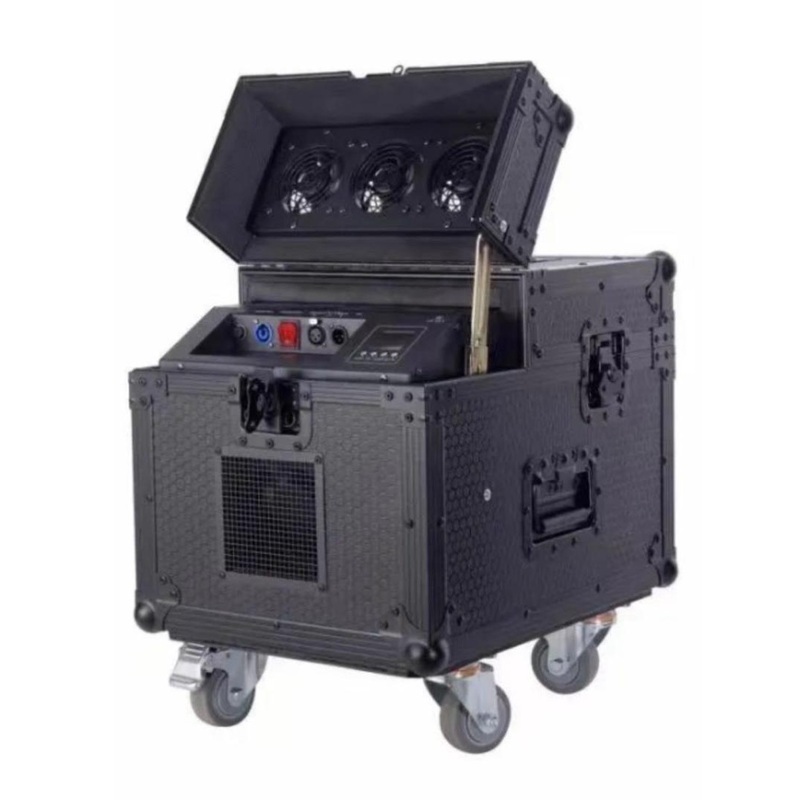
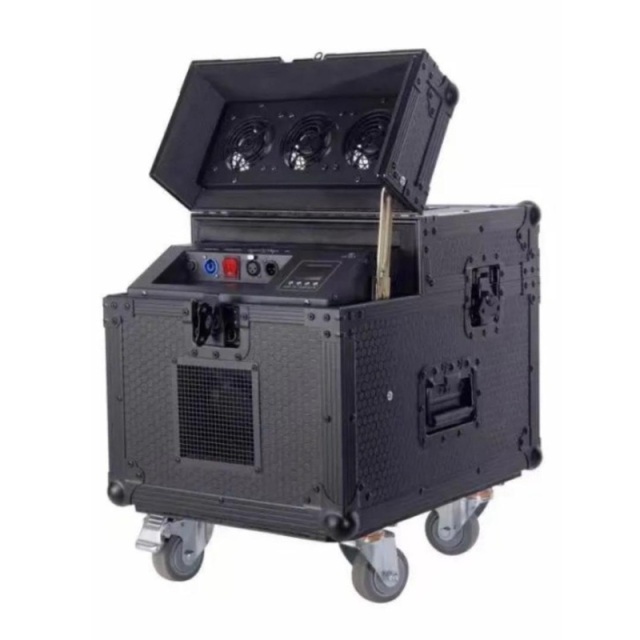
- Flight case body. The chassis lives in a black flight case with a hinged lid, caster wheels and side carry handles — wheel it in, open the lid and it is ready to run.
- Cooling that suits a working room. A fan bank sits behind the hinged lid and a grille covers the front of the case, so heat moves through the machine instead of building up inside it.
Control & DMX Setup
- Set the machine on the floor where the haze will cross the beams — the side of a stage, the edge of a dance floor, a downstage corner — and leave the front grille and the open lid clear so the fans can pull air through.
- Run mains power and a DMX signal cable to the front panel. Both connections sit next to the timer display, so setup work happens where you can see it rather than behind the case.
- Set the start address and patch the single channel into your DMX lighting rig. One channel is the whole footprint, so the machine never takes a block of the universe you had already planned for fixtures.
- If nobody is calling the show from a desk, set the run and pause times on the LCD timer instead; the machine then cycles on its own and the DMX controller you already run stays free for everything else.
- Raise the output until the beams of the laser light show read from the back of the room, then stop. Over-hazing flattens contrast, softens gobo edges and can put a visible veil between the audience and the stage.
- On laser stage lighting outdoor work, aim the output across the beams rather than up into open sky, and check the level again as the air cools through the evening.
Applications
- Club and bar floors. One unit at the side of a dance floor keeps a laser light show's moving beams and scan patterns visible all night, with the timer holding a steady level while the DJ works.
- Small theatres and school halls. Haze lets a single spot read across a deep room, and because the output stays low the front rows are not sitting in fog.
- Rental and touring stock. Quick to place, quick to set running and easy to hand to a client's own technician — the kind of line that goes out with a beam package without needing a specialist operator.
- Open-air stages. There is simply more air to fill outside, so a venue running outdoor stage lighting will usually set a higher output and place the machine closer to the beams than it would indoors.
- Long-throw and site-specific work. On laser stage lighting outdoor projects the beams travel much further before they reach the audience, and a steady base of haze keeps the far end of a pattern as readable as the near end.
- Distributor stock. Stage and lighting companies keep this model on the shelf because it covers the rooms their customers ask about most often — a club floor, a small hall, a bar with a stage in the corner.
Specifications
| Property | Value |
|---|
| Machine type | Oil base haze machine |
| Voltage | AC 230 V, 50-60 Hz |
| Power | 600 W |
| Output | 3,500 cubic feet/minute |
| Fuel consumption | 25 hours per liter |
| Maximum oil drum capacity | 3 liters |
| DMX channels | 1 (one channel on a DMX lighting desk) |
| Built-in controller | LCD timing controller (standalone; DMX controller optional) |
| Dimensions | 450 × 342 × 318 mm |
| Weight | 33.5 kg |
| Effect | Fine, slow-settling haze veil that stays suspended in the air |
| Typical venues | Clubs, theatres, school halls, rehearsal rooms and outdoor stages |
Ordering & Delivery
- Tell us the room and the rig — floor area, ceiling height, how far the beams have to travel and what console you run. We will confirm whether this is the right size and say so if a larger model in the range suits the space better.
- Confirm the power supply and plug type at the venue before the order is placed, so the machine arrives ready to connect.
- Confirm quantity, pricing, payment terms and trade terms with your sales contact. These are agreed per order, and batch quantities are quoted the same way.
- Ask for the documents you need to bid — the specification sheet, the channel chart for your DMX controller, compliance files for your market and a spare parts list.
- Stage and lighting companies ordering for stock should give the volume and the destination up front, so packing and paperwork are planned together.
- Confirm the production and shipping schedule for your order, and confirm the warranty and after-sales process that applies in your market before you commit.
- If the machine will be used in the open, tell us about the site so we can talk through operating conditions and protection before delivery.
| Document | Detail |
|---|
| Specification sheet | Current version from our sales team |
| User manual | Setup, timer programming and maintenance notes |
| DMX channel chart | Level-by-level definition of the control channel |
| Photometric data | Output and coverage figures for planning a room |
| Dimension drawing | Outline file for case and floor-space planning |
| Compliance files | Available for your destination market |
| Spare parts list | Wear parts and consumables worth holding in stock |
| Revision notes | Ask which revision ships with your order |
Technical Support & Model Matching
More than 30 engineers with an average of 15+ years in professional lighting stand behind every order — the same people who answer your technical questions. Tell us your venue, rigging height, throw distance and existing control setup; we help match models, check protocol and channel fit, and build a package that works as one system. If a fixture misbehaves on site, we work through the fault with you and sort out spares. Installation and commissioning guidance come with the order. Founded in 2016, exporting since 2022, LITEVISION serves buyers in more than 80 countries from offices in the USA, Taiwan, Mexico and China.
FAQ
Where should the machine sit in a room?
Wherever the haze will cross the beams rather than sit under them — the side of a stage, the edge of a dance floor, a downstage corner. Keep the front grille and the open lid clear so the fan bank can pull air through, and leave enough room around the case to reach the timer panel. Airflow matters more than height: a unit placed in a draught will have its haze pulled away before it reaches the fixtures.
Can it be used for outdoor stage lighting?
Haze is used outdoors all the time, and open-air rigs generally need more of it because the air moves. What we do not do is quote a weather rating for this machine, so if it will sit in the open, tell us about the site and we will talk through operating conditions and protection before you order. Under a roof, in a tent or on a covered stage, it behaves exactly as it does indoors.
Will haze set off smoke detectors?
Optical detectors can react to haze, and how a venue handles that is a venue question rather than a machine setting. Most rooms running haze isolate the affected detectors for the show or work to a bypass agreed with the fire officer. Settle it before the first night rather than during it.
Which oil does it take?
This is an oil base machine, designed to run on haze oil rather than the water-based fluid used in fog machines — the two are not interchangeable. Ask your sales contact to confirm the oil grade and pack size available for your market before you order.
Do I need a console to run it?
No. Once the cycle is set, the machine runs on its own, which is how most bars and small venues use it. Where a show is called from a desk, wire it into the DMX lighting rig and trigger it from there; it then behaves like any other channel in the plot.
Will it work with my laser light projector?
It will, and it is usually the piece that makes the effect work. A laser light projector draws lines in the air, and those lines only become visible where there are particles to catch the light — without haze the audience sees the points where the beams land and very little in between. Run the machine low and steady under the projector and the whole pattern appears.
Is it suitable for a permanent club installation?
Yes — a fixed club or bar is exactly the case this model is sized for, and it is the kind of machine stage lighting manufacturers specify when haze has to be on every night. The cabinet suits a floor position out of the way of foot traffic, and the machine will run continuously through service hours.