Product Overview
It turns haze oil into a fine, slow-settling mist that hangs in the air, so every beam, gobo and cue in the DMX lighting rig has something to travel through between the fixture and the audience. The people who buy it are usually rental companies, distributors and venue technical teams running theatrical stage lighting, concert stages and studio floors — work where the effect has to be there from doors to load-out, not for a single cue. LITE VISION is one of the stage lighting manufacturers that builds both the fixtures and the effects behind them, and this model sits at the top of the oil-based haze range. It is the unit for arena stages, big club floors, television studios with high grids and touring productions where the layer has to reach the balcony. In practice it replaces a pair of smaller hazers, or the habit of pushing a fog machine too hard to fill a large room. One machine with a large oil drum takes the job, keeps the crew off the ceiling, and gives the console a steady layer instead of a burst that has to be re-triggered. Local checks happen on the machine itself, without dragging a console across the stage.
Flight Case & Placement
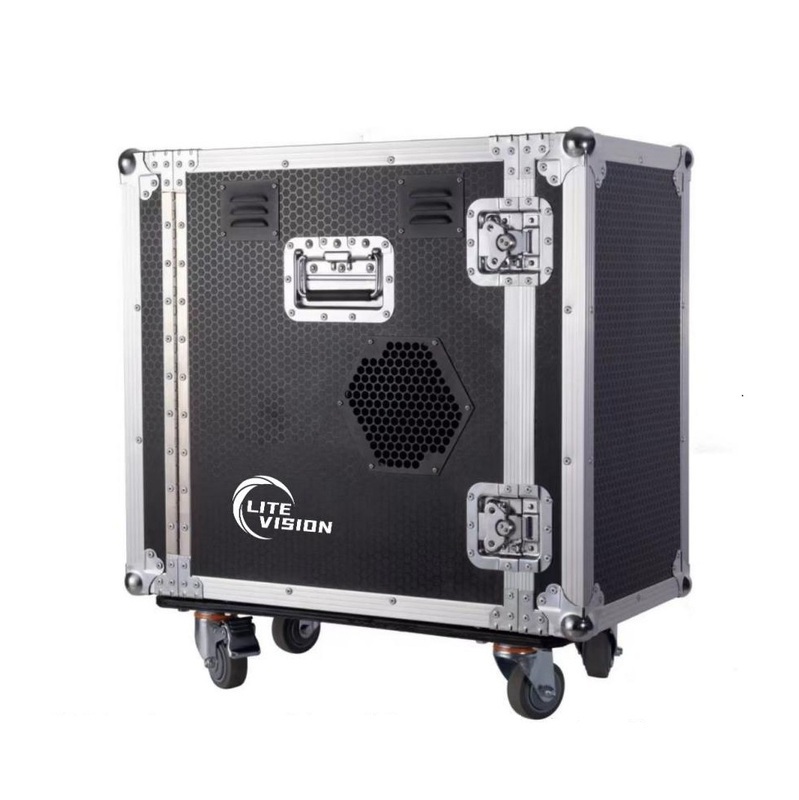
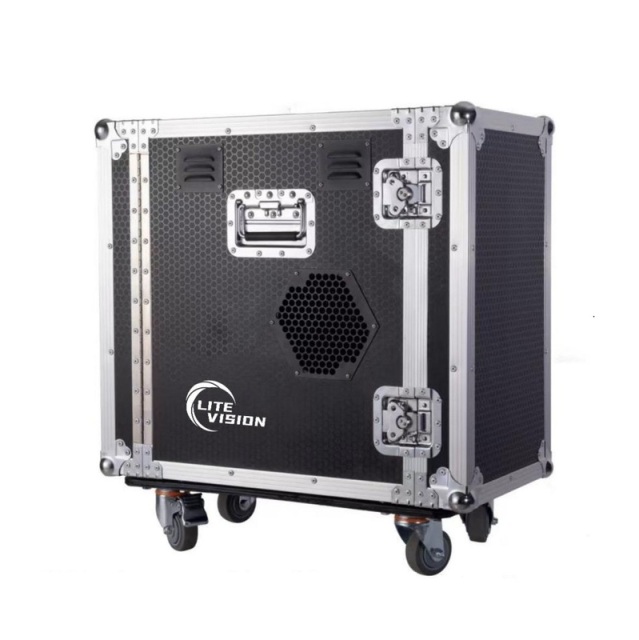
- Wheeled flight case. The machine travels in its own rolling case with caster wheels, recessed butterfly latches and a recessed handle, so it moves across a flat stage floor without being lifted.
- Two-person lift. At this size the loaded case is a two-person job up stairs, into a truck or over a loading dock; the casters do the work on flat ground and nowhere else.
- Position for beam definition. Set it upstage or to one side so the haze crosses the moving head light beams rather than sitting behind them, and keep it out of the front rows where the audience sits in the thickest part of the layer.
- Airflow.
- Leave the vented panels clear on all sides. A machine tucked behind a drape or under a riser runs hot and produces an uneven layer all night.
- Cable reach. Work out where the feed from the console or DMX light controller lands before you position the case; a signal run across a dance floor needs planning, and an extension cable packs smaller than a re-rig.
- Between shows. Cap the oil drum, close the case and store it upright. Oil left in an open drum collects dust that ends up on the heater.
Control & DMX Setup
- Power up and let it stabilise. Connect to the venue supply, switch on, and give the heater its full warm-up before the first cue; a machine that is rushed produces a thin, uneven layer for the first few minutes.
- Address it on the panel. The OLED display walks you through addressing and shows machine state, so one screen covers both setup and the pre-show check without a console at the machine.
- Patch into the console. The channel count is small, so the machine drops into a spare pair on any DMX controller and follows the same cue stack as the rest of the rig.
- Or work from the handheld remote. For venues with no console operator, or for a quick density change during sound check, the remote works with no DMX light controller in the chain at all.
- Test the layer before doors. Run a short burst at show level while the room is empty and look at it from the furthest seat — a density that looks right at the desk can be thin at the back of a balcony.
- Record the patch. Write the address and channel assignment into the show file so the next venue is a copy rather than a rebuild.
Output & Venue Coverage
- Room-scale coverage. Output is sized for arena and large-club volumes, where a smaller hazer only fogs the first few rows. Run it at a moderate level and the layer reaches the far seats without leaving a visible plume over the front block.
- Height and sightlines. High grids and balconies are where a small hazer gives up — the layer thins before it reaches the top tier. Setting the machine upstage and letting the layer build from the ceiling down keeps the upper rows in the same air as the stalls.
- Beam definition. A thin, even layer is what turns a moving head light into a visible shaft; gobos, prisms and colour changes all read harder when the air carries haze rather than smoke.
- Effect work. Laser light show patterns, beams and mid-air effects need suspended particles to catch the light, and haze gives them that without the rolling cloud a fogger leaves behind.
- Camera and broadcast. An even diffusion keeps faces separated from backgrounds on camera and does not pulse or plume between cuts, which is why studio floors run haze rather than smoke.
- Density on the fly. A light background for dialogue and an open layer for music numbers both come from the same machine, set from the desk between cues — most DMX lighting plots keep a spare pair of channels for exactly this.
Oil Supply & Run Planning
Refill rhythm. Consumption tracks how hard the machine runs: a full evening at high density pulls far more oil than one number with the layer low. Work refill windows from the machine's hourly consumption and plan them for intervals rather than mid-song.
Oil grade. Use the oil grade approved for this machine and confirm it when you order. The wrong viscosity shows up as weak output, spitting, or a residue that is hard to lift off lens faces.
Stock for the run. Budget oil by hours of effect rather than by number of shows — a dense laser light show sequence empties a drum far faster than a spoken-word set, and rehearsals and sound checks are stage time too.
Venue rules. Confirm haze use with the venue and the production before the get-in. Alarm systems, air handling and performer comfort all affect whether the layer can run at the density the theatrical stage lighting design asks for.
Support and supply. As a stage lighting equipment supplier working with rental companies and distributors, we help buyers size oil stock and spare drums for a tour, and put consumption figures into a form a production manager can budget from.
Specifications
| Model | EKL-3000 |
|---|
| Voltage | 220-240 V, 50/60 Hz |
| Current limiting safety parameters | 8 A, 250 V |
| Total power | 3,000 W |
| Warm-up time | About 4 minutes |
| Oil drum capacity | 10 liters |
| Maximum output smoke volume | 60,000 cuft/min |
| Number of DMX channels | 2 |
| Function | Remote control, DMX-512, OLED LCD screen control |
| Fuel consumption | 100% smoke consumption, actual fuel consumption 2.1 kg/hour |
| Net weight | 42 kg |
| Gross weight | 43 kg |
| Machine size | 675 × 360 × 720 mm |
| Outer box size | 690 × 380 × 730 mm |
Ordering & Delivery
- Tell us the rig. Send your venue voltage, the console or DMX light controller you plan to patch into, and the room size, and we will confirm the machine suits the job before it ships.
- Confirm quantity and terms. Ask your sales contact about minimum order quantity, tiering for larger orders and sample availability; fleet buyers, distributors and stage lighting manufacturers building their own packages usually start with one unit and scale from there.
- Lock the schedule. Production and shipping lead times move with the season.
- Confirm both against your show dates before you commit, and say clearly if the date is fixed.
- Agree payment and trade terms. Payment method, currency and Incoterms are set at quotation, so ask for them in writing with the offer.
- Packing and freight. Pass the outer carton dimensions and gross weight to your forwarder when you book, and confirm what else your shipment includes — cable, remote, documentation — before it leaves.
- Warranty, spares and claims. Ask which warranty terms apply to this model, how spare parts and oil reach you after delivery, and how a quality claim is handled — you are dealing with the stage lighting equipment supplier that builds the machine, not a reseller.
| Document | What it covers |
|---|
| Specification sheet | Electrical, output and physical data on one page, for tenders and distributor forwarding |
| User manual | Setup, addressing, OLED menu navigation and routine checks |
| DMX channel chart | What each channel does, ready to hand to the console or DMX light controller operator |
| Placement notes | Room sizing, refill intervals and typical positions in a theatrical stage lighting rig |
| Packing list | Case and carton dimensions, weights and what ships with the unit |
| Compliance paperwork | Market-specific test reports and certificates, requested at the time of order |
Technical Support & Model Matching
More than 30 engineers with an average of 15+ years in professional lighting stand behind every order — the same people who answer your technical questions. Tell us your venue, rigging height, throw distance and existing control setup; we help match models, check protocol and channel fit, and build a package that works as one system. If a fixture misbehaves on site, we work through the fault with you and sort out spares. Installation and commissioning guidance come with the order. Founded in 2016, exporting since 2022, LITEVISION serves buyers in more than 80 countries from offices in the USA, Taiwan, Mexico and China.
FAQ
How is oil-based haze different from the smoke a fog machine makes?
A fog machine fires a dense burst that rolls along the floor and disperses within seconds; oil-based haze is a far finer mist that stays suspended, so the whole room holds a light, even layer. That is what makes laser light show patterns, beam effects and gobo work visible from every seat, and it is why the look can be set once and left alone for the length of a set.
Will it run from the DMX controller we already use?
Yes. It speaks standard DMX-512 and needs only a couple of channels, so a spare pair on an existing DMX controller will drive it, and you can set the start address on the OLED panel to suit your patch. Cue stacks, group fades and chase effects behave exactly as they do with the rest of the rig.
Do we need to refill oil during a show?
That depends on how hard you run it. A long night of dense DMX lighting cues at full output will go through oil much faster than a quieter set run at low density, so most operators top up during the interval rather than mid-number and keep a second drum in the case store. Rehearsals and sound checks count as stage time, so add them to the plan.
Which rooms is this model right for?
Large ones: arena stages, big club floors, television studios and touring productions that need the layer to reach a balcony. In a small bar or a school hall it is more machine than the room needs, and a smaller haze unit from the same range will do the job with less oil and less weight. As a stage lighting equipment supplier we would rather point you to the right size than sell you the biggest box.
Can it be supplied under our own brand?
Yes — our OEM and ODM service covers badging, labelling and packing for distributors and stage lighting manufacturers who sell under their own name. Send the artwork and marking requirements with your enquiry so the factory can confirm what is possible on this model and what it does to the schedule.
Where should it stand, and can it be flown?
It is built to stand on its own base on a flat, level floor, with the flight case handling transport. Put it upstage or to one side so the haze crosses the moving head light beams instead of sitting behind them. If you need it overhead, talk to us before ordering so we can confirm the mounting arrangement and hardware for your rig.