Product Overview
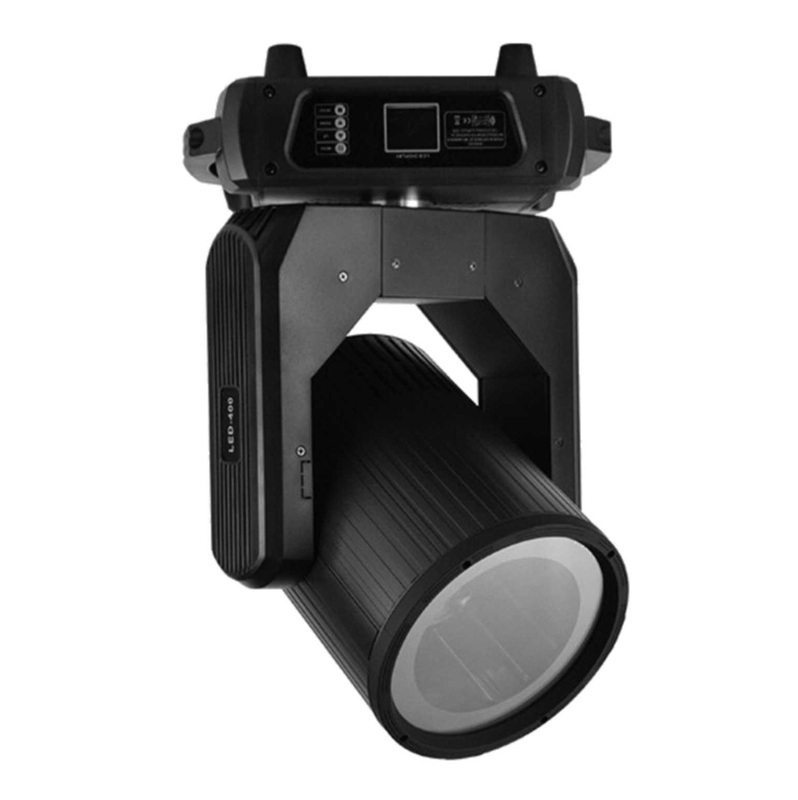
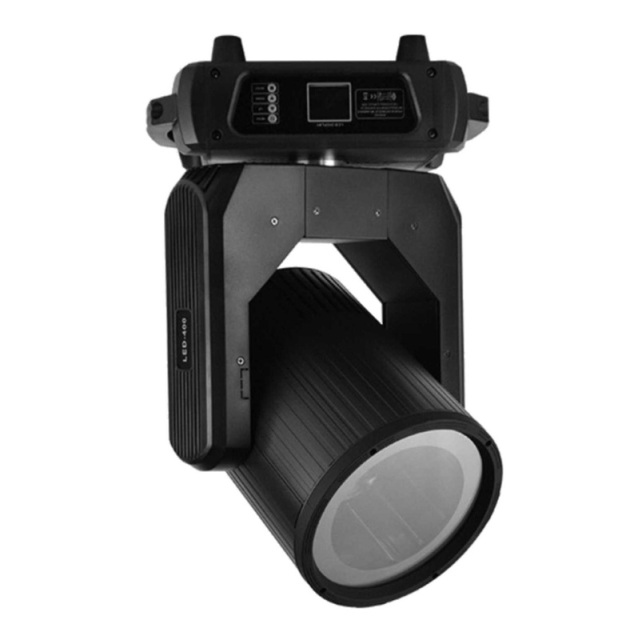
The FL-200 is a 200W COB LED moving head light that produces a soft, even field of light rather than a hard beam. A large round front lens spreads the output across a stage or a presenter, and the head pans and tilts on its yoke so a single fixture can serve several positions across an evening. It is an indoor fixture, IP20, built for rooms that want proper stage light without a full theatre rig.
That makes it a practical moving head stage light for school assembly halls, small TV or content studios, worship venues, conference rooms and bars with low ceilings. Those rooms ask for something compact, quick to aim and simple enough for staff who are not lighting programmers — three things a touring spot is rarely asked to deliver, and the brief an led moving head light supplier hears most often.
One unit covers three jobs. Flown over a stage it is the key light on a presenter; aimed across a set it fills shadows and softens contrast; opened up and coloured it washes a backdrop. Small venues often take two of these instead of three or four fixed lights, simply because the head can be re-pointed between items on the running order.
Rigging position is forgiving. Because the output is a flood rather than a spot, a fixture hung slightly off-axis or closer than ideal still covers the stage with an even field — useful in low rooms where the only sensible hang is a wall arm or a short truss.
The body combines high-temperature-resistant plastic with a moulded alloy structure, finished in matte black. That pairing gives the heat-generating head a rigid frame while keeping the base compact enough to sit inside the ceiling line of a low room instead of dominating it.
It replaces a fixed soft light on a stand or a pair of par cans. Where those have to be re-aimed by hand between scenes, this dmx moving head light changes position as a cue, and the room keeps a tidy look because nothing needs re-rigging between events.
Light Quality & Colour Control
- Colour rendering above 90. A CRI above 90 keeps skin tones, uniforms and product close-ups looking like themselves, so school streams, interviews and in-house recordings need far less colour correction afterwards.
- A soft field, not a hotspot.
- As a moving head wash light this unit spreads light across a wide area with a gradual edge, so a presenter can walk through the pool without a bright ring following them.
- 2800K for warm interiors.
- At the warm end the output reads close to tungsten — the familiar look for evening events, dining rooms and interviews where a relaxed tone suits the room.
- 6000K for daylight.
- At the cool end it sits near daylight, which is where most LED walls, window light and mixed rigs already are.
- CTO with warm and cold white.
- Instead of guessing at a colour-temperature number, the CTO control blends warm and cold white until the face in front of you looks right, on camera or in the room.
- 1–100% linear dimming.
- Fades stay smooth and the bottom of the range is still usable, so the fixture can hold a low level under a speech and then open up without a visible step.
- One white for the whole rig.
- Because the temperature is variable, an led wash light on the lectern can be set to the same white as the pars on the backdrop, so the stage reads as one picture instead of three different whites.
Zoom, Frost & Field Width
The zoom runs from 5° to 60°, a wider spread than most fixtures in this size class and the main reason the unit works at short throws. The angle is set electronically from the panel or the console, so a cue can change the size of the pool without anyone touching the fixture.
At the tight end the pool narrows onto one presenter or one prop, but the edge stays soft. This is a soft-source fixture and not a moving head spot light — there is no hard-cut beam or gobo image to project — so treat the narrow setting as a smaller pool of soft light rather than as a beam.
Opened to 60° it becomes a moving head stage light for a small hall: hung at the front of a room, even a short throw covers a wide section of wall and floor, so one fixture can hold a whole assembly rather than a single speaker.
The frost control adjusts the soft-light spot angle, rounding the edge of the pool when the zoom is tighter. It is the control to reach for when a face should blend into the background instead of sitting inside a visible circle of light.
Focus is linear and is trimmed after the zoom, from the audience side of the fixture. Each unit is assembled and aligned at our moving head light factory before packing, so the zoom and focus travel arrives ready to be trimmed on site rather than re-calibrated.
Hanging, Power & Control Setup
- Check the mounting point.
- The head is carried in a yoke bracket for ceiling, truss or wall mounting.
- Confirm the load rating of the structure and the height available at that position, and ask us for the fixture weight and dimensions so the rigging calculation uses real figures.
- Plan the power.
- Work out how many fixtures share a circuit before you order distribution, and tell us the connector standard your venue uses so the cable tails match what is already on site.
- Inspect before it goes overhead.
- Each unit leaves our moving head light factory assembled, aligned and checked.
- Unwrap it, look over the lens and the yoke, and power it up once on the ground before it is flown.
- Run the data.
- This is a standard dmx moving head light, so data goes from fixture to fixture on DMX512. Terminate the run properly and keep data cable away from mains cable wherever the route allows.
- Set the addresses.
- Give every fixture its own start address on the panel, spaced by the channel count, and write the patch down — the next technician on the show will need it.
- Or run it without a console.
- In a venue with no programmer, switch the unit to auto or master-slave on the panel: one fixture leads and the others follow the same look, with no desk and no cue stack.
- Aim and check from the seats. Use the 540° pan and 250° tilt to point at the lectern, the riser and the backdrop, then walk to the audience side — the pool that looks right from the truss is often too tight from row ten.
Venue Applications
- School and college halls.
- Assemblies, prize givings and drama productions where a teacher or technician aims the fixture before the event.
- A moving head wash light that can be set from its own panel suits a hall with no lighting desk far better than one that assumes a programmer will be present.
- Small TV and content studios.
- A soft front light for a two-camera setup, with the colour temperature matched to the rest of the rig and the pool shaped to the presenter rather than to the room.
- Worship venues.
- One or two fixtures at the front cover a lectern, a worship band and a baptismal pool without a permanent truss full of fixed lights.
- Conference and banquet rooms.
- Presenters rarely stand where the plan says they will; a moving head can be re-aimed between sessions without anyone fetching a ladder.
- Bars and restaurants with low ceilings.
- Hung close to the ceiling line, the wide end behaves as an led wash light over a floor or dining area, while the narrow end picks out a corner, a cake table or a small stage.
- Theatres, rehearsal rooms and community venues.
- Used as fill or as a soft special alongside a moving head spot light, it adds a controllable source to a small stage without adding a dimmer rack to the building.
- Distributors and rental fleets.
- Rental houses and dealers buying from an led moving head light supplier usually take this model as the soft-light step in a package, alongside the beam and spot fixtures used in the same rooms.
Specifications
| Specification | Detail |
|---|
| Fixture type | LED moving head light with soft-light output |
| Light source | 200W COB LED, rated for 50,000 hours |
| Total power | 350W |
| Input voltage | AC 100–240V, 50/60 Hz |
| Colour temperature | 2800K–6000K, CTO warm + cold white |
| Colour rendering | CRI above 90 |
| Zoom range | 5°–60° |
| Frost | Adjustable soft-light spot angle |
| Focus and dimming | Linear focus, 1–100% linear dimming |
| DMX control | 11 channels, DMX512, master-slave and auto modes |
| Pan / Tilt | 540° / 250° |
| Housing | High-temperature-resistant plastic with moulded alloy |
| IP rating | IP20 |
Model Comparison
| Feature | 200W LED wash light | FL-450 |
|---|
| Light source | 200W COB LED | 450W COB LED, 32,000 lm |
| Colour rendering | CRI above 90 | CRI Ra ≥ 95 |
| Colour temperature | 2800K–6000K | 2800K–6500K |
| Zoom range | 5°–60° | 12°–34° |
| DMX channels | 11CH | 10CH |
| Control modes | DMX512, master-slave, auto | DMX512, RDM, manual |
| Mounting | Yoke bracket | Folding integrated hanging bracket |
| Fits well | Low ceilings, short throws, small rooms | Larger studios and stages with distance to work with |
Documentation & Ordering
- Tell us the room and the job.
- Send the venue type, ceiling height, throw distance and how many positions you need to cover.
- As an LED moving head light supplier we quote against a brief rather than a catalogue line, and the accessory list comes back with the recommendation.
- Ask for the documents you need.
- We can send the specification sheet, the user manual, the DMX channel chart, photometric data and a dimension drawing, so your installer, consultant or tender review receives the paperwork in the format they work in.
- Confirm the control plan.
- Tell us which console you run and whether the fixtures will be driven from it or set to master-slave for a venue without a desk, so the units arrive matching the way the room is actually operated.
- Agree the commercial terms before production.
- Minimum order quantity, unit price, payment method, trade terms and lead time are confirmed for each order with your sales contact — these are not fixed across destinations, so ask for the current figures rather than working from an old quote.
- Settle packing and freight.
- Tell us whether the units travel by air, sea or road so the packing is specified for the route, and confirm who is handling the export documents at your end.
- Agree the after-sales route.
- Warranty scope, the process for a quality claim or return, and where spare parts come from are set out in the current warranty and repair policy — ask for a copy with your quote.
- Support is handled by the same moving head light factory that builds the fixture, which matters when you extend a rig a season later and want the new units matched to the first.
Technical Support & Model Matching
More than 30 engineers with an average of 15+ years in professional lighting stand behind every order — the same people who answer your technical questions. Tell us your venue, rigging height, throw distance and existing control setup; we help match models, check protocol and channel fit, and build a package that works as one system. If a fixture misbehaves on site, we work through the fault with you and sort out spares. Installation and commissioning guidance come with the order. Founded in 2016, exporting since 2022, LITEVISION serves buyers in more than 80 countries from offices in the USA, Taiwan, Mexico and China.
FAQ
Can this fixture run a show without a lighting console?
Yes. The unit offers auto and master-slave modes alongside standard DMX512, so a venue without a desk can set a look on the panel and let one fixture lead the others. That is the way a moving head wash light usually gets used in a school hall or a conference room, where nobody programs cues between events and the same look has to survive from one week to the next.
How much stage does the 5–60° zoom actually cover?
It depends on the hang, but the wide end is the reason this works as a moving head stage light in a low room: opened up, it covers a broad section of wall and floor from a short distance, while the tight end pulls the pool down onto one person or one prop. Set the zoom from the audience side, because a pool that looks generous from the truss is often narrow from row ten.
Can it be used outdoors or under a temporary canopy?
This led moving head light is rated IP20 and is built for indoor use. A stage that is fully under a roof and dry is fine; rain, blown dust, coastal humidity or a canopy that leaks are not, because moisture reaching the head will shorten the life of the electronics. For a permanent outdoor position, choose an IP-rated fixture from our outdoor range instead.
How do we address several units on one DMX line?
Each dmx moving head light in the chain occupies 11 channels, so give every fixture its own start address spaced by that number and record the patch before the show. Addressing is done on the fixture's own panel, which also means a unit can be re-addressed on site if a cable plan changes during rigging.
What power supply and connector does it need?
The fixture runs on AC 100–240V at 50/60 Hz and draws 350W, so it travels between territories without a voltage change. Tell us the distribution and connector standard your venue or rental stock uses and we will confirm exactly what the unit is supplied with before the order is placed.
Is this a wash light or a spot?
It is a soft-light wash fixture. Compared with a moving head spot light there is no hard-edged beam and no gobo projection; the wide zoom, the frost and the linear focus are there to shape an even pool of light on a person or a set. If a show needs crisp gobo images or a narrow aerial beam, a spot or beam fixture from the same range is the right tool for that job.
What maintenance does it need between events?
Wipe the front lens with a soft dry cloth when dust starts dulling the output, and keep the vents and fan grille clear so the head does not run hot. Check the yoke fixing and the safety bond every time the fixture goes up, and store it with the head parked rather than resting on the lens.