Product Overview
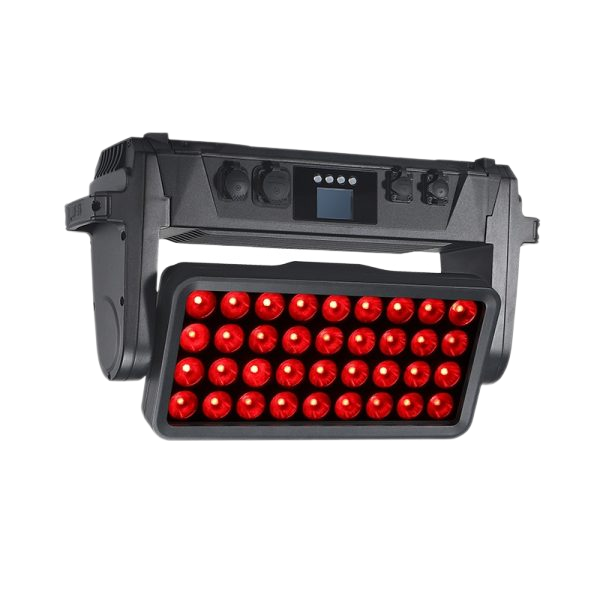
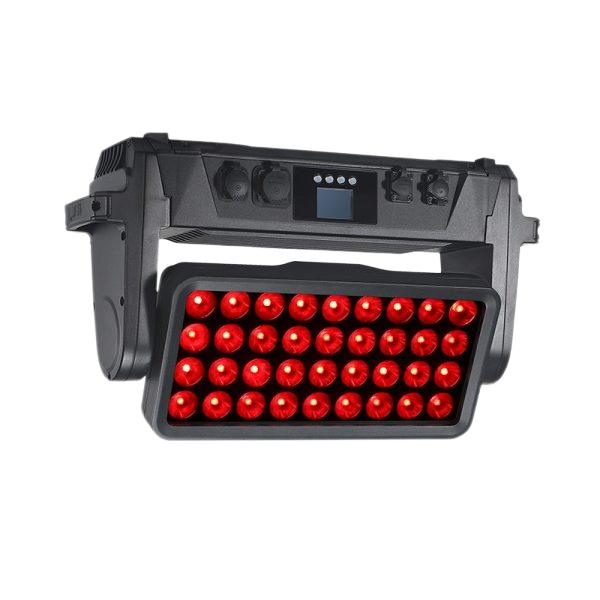
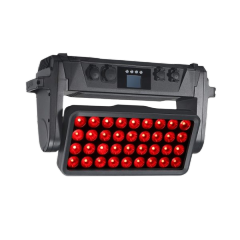
The WM3615 is a 36 × 15 W RGBW LED moving head wash light with a Tilt head. Rather than locking a flood into one position, the head swings the whole wash across a wall, a stage or a room, so one fixture covers ground that would otherwise need several static units aimed by hand.
It is designed for outdoor work first. The housing is sealed against weather and finished for exterior mounting, so an outdoor moving head light can sit on the building it lights — a facade, a rooftop terrace, a theme-park set or an open-air stage — instead of on the ground where it blocks sightlines and takes damage. Indoors it does the same job as a wide moving head stage light over a stage, a presentation or a club floor.
What it replaces is the row of fixed floods and static wall washers that have to be re-aimed whenever a layout changes. A moving head does the re-aiming from the desk, which matters in venues that turn over from a conference to a concert to a private event inside the same week.
Rental fleets, system integrators and distributors buy it for the same reason: one model covers a temporary rig and a permanent facade, so spare stock is shared and operators only have to learn one fixture. Venues that own their own lighting use it where the mounting position is awkward to reach for a manual re-aim.
Units come from an LED moving head light manufacturer that builds the housing, optics and control itself, which is why the finish, the beam and the channel layout stay the same order after order.
Light Output & Lens Angles
- One body, four lens angles. Each fixture is built with an 8°, 15°, 25° or 45° lens, chosen when the order is placed. Work out mounting height and throw distance first — the lens is not something that can be changed from a menu later.
- 8° for reach. The narrowest lens concentrates the output into a tight column, which is what tall facades, towers and distant mounting positions need.
- 15° and 25° for most walls. These are the angles for mid-height facades, backdrops and building details, giving a firm LED wall wash without a hard edge at the sides.
- 45° for close work. Where the bracket sits near the surface — low ceilings, narrow streets, wide stage floors — the widest lens spreads light evenly over a broad area, and it suits an outdoor moving head light mounted tight to the wall.
- Even from centre to edge. Intensity holds at 90% or better across the beam, so the LED wash light covers a wall as one surface rather than a bright circle with a dim rim.
- Colour that holds under scrutiny. A high rendering index and a strong red score keep skin tones, fabrics and painted finishes close to daylight, which is worth having in front of a camera and on architecture where a brand colour has to match.
- Aim without touching the rig. Tilt movement moves the wash between cues, so a moving head stage light can carry a concert, a conference and a dinner on three consecutive nights.
Mounting, Housing & Weather Protection
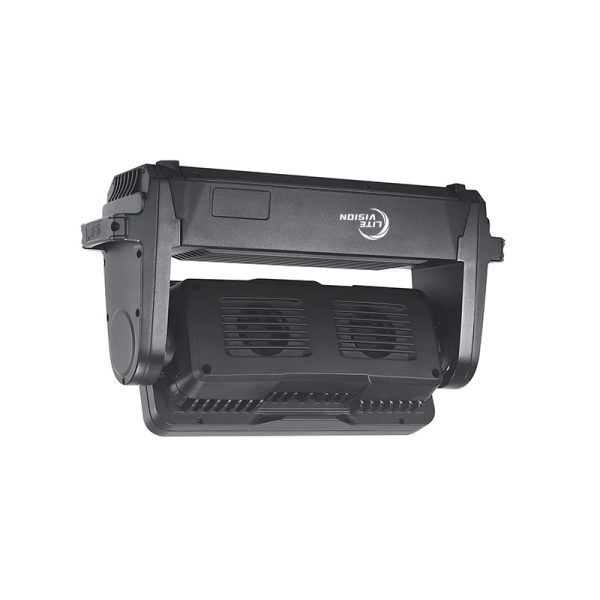
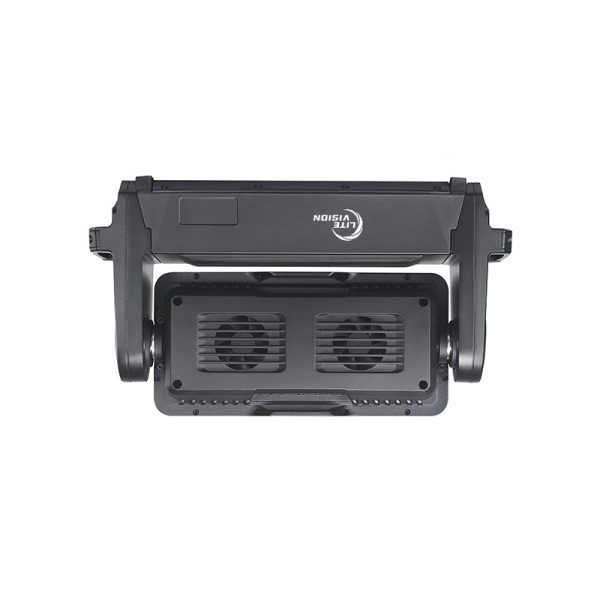
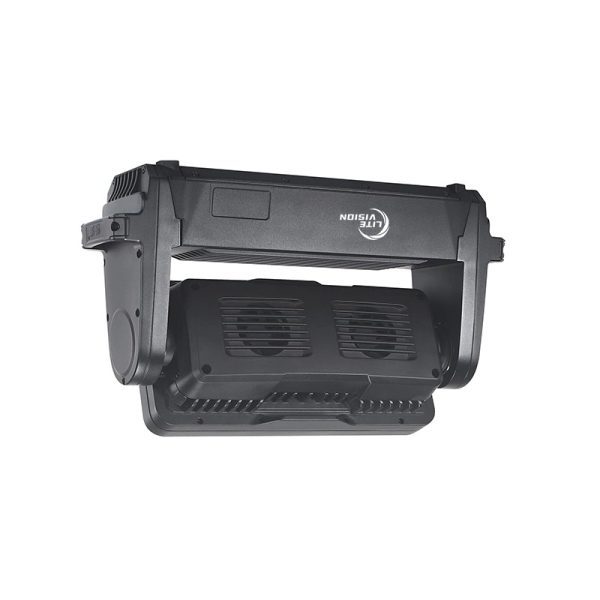
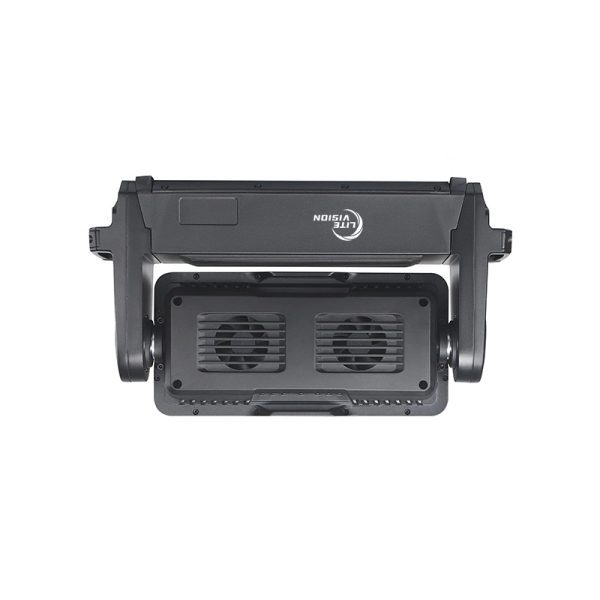
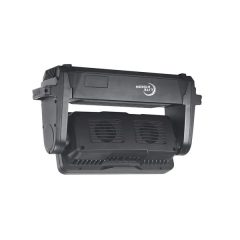
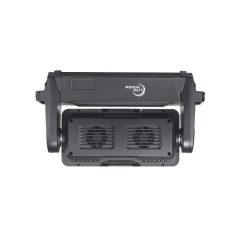
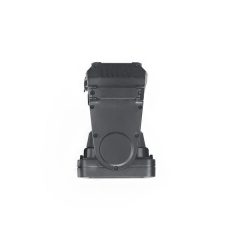
- Yoke bracket and tilt head. The bracket takes a standard clamp or a wall bracket while the head tilts independently, so the body can hang square and the light still aims where it is needed. Aluminium-magnesium housing. A cast alloy body with a hot paint finish keeps the fixture light enough for truss and wall positions, holds the optics in alignment, and is finished to survive exterior exposure rather than only the installation day. It is not submersible, and the rating only holds while every cover and cable gland is closed properly after service. Thermal protection and airflow. Overheat protection watches housing temperature and self-adjusts before the fixture becomes unsafe, and the rear vents and fan grilles need clear air — never drape a unit or box it into scenery. Service access. The rear panel and screw-fastened covers reach the control and connection side of the fixture, so routine checks do not require taking the optical side apart. Same plant, same standard. Every unit leaves the same moving head light factory in Guangzhou, where lens alignment, paint batch and control settings are fixed before packing, so two orders behave the same way. Built by the people who answer the questions. The fixture comes from an LED moving head light manufacturer that engineers and assembles its own units, so a question about a lens, a channel mode or a thermal setting reaches the team that built it. Spares matched to the fixture you own. As the LED moving head light supplier for this model we keep its build record, so a replacement lens, driver board or complete unit is matched against what is already on site.
Power & Signal Connection
- Check the supply against the label first: the fixture draws 550 W and accepts 100–240 VAC at 50/60 Hz without a changeover, so the same unit runs on 120 V and 230 V sites.
- Total the load before you specify cable. Add up 550 W per fixture across the run, leave headroom on the breaker, and plan distribution around the number of heads you intend to feed from one point.
- Settle the connector and cable specification with our team before you build looms. The connector you need depends on your distribution, and it is easier to agree before the fixtures ship than after the truss is up.
- Keep the entries sealed. This is an outdoor moving head light, so every time a cable is reconnected check the gland and its gasket — a loose gland is the most common way water reaches the electronics.
- Run the signal as one line: DMX in from the console, out to the next fixture, the last unit in the chain terminated, and signal cable kept apart from mains runs.
- Choose the channel mode before you patch, set the address on the panel or over RDM, then confirm response and RDM read-back on the first power-up, so a DMX moving head light on the rig can be checked from the desk before anyone climbs to it.
Colour, Effects & Control
Colour can be driven in two modes. RGB mixes straight from the emitters to the shade you want, while CMY lets a designer pull colour down the way they would on a conventional rig. Both are colour-mixing paths on the same LED wash light — nothing changes physically, only the way the desk talks to the fixture.
A defined colour tolerance keeps units closely matched, so six fixtures on one wall mix to one shade instead of six slightly different greens. That is the difference between a single surface and a patchwork when a facade is lit at low level for a long evening.
Low-grey transitions are handled so the last few percent of a fade steps evenly instead of snapping out — the detail you notice on a slow blackout, a sunrise cue or an architectural dim-down at closing time.
A slow breathing effect drives the dimmer on a long curve for ambient looks on a facade, a lounge ceiling or a background wall, without burning console time on a chaser that has to run all night.
If the supply drops mid-show, this moving head wash light comes back in the state it was in when it lost power, so a venue that trips a breaker does not come back to a black wall.
Four channel layouts — 7, 8, 9 and 10 channels — let a large array run the short mode and save universe space, while a few feature heads can take the fuller one. Addresses are set on the rear panel or over RDM, so a DMX moving head light can be re-addressed from the desk without sending anyone up the truss.
Specifications
| Parameter | Value |
|---|
| Light source | 36 × 15 W RGBW LED |
| Total luminous flux | 48,000 lm |
| Lens angles | 8° / 15° / 25° / 45°, specified per order |
| Colour coordinates | R 625 ± 3 nm, G 525 ± 3 nm, B 455 ± 3 nm |
| White point | 6000 / 6500 K ± 10 |
| Colour rendering | Ra ≥ 90, R9 ≥ 90 |
| Control protocol | RDM, DMX |
| Dimensions | 544 × 306 × 159 mm |
| Net weight | 12 kg |
| IP rating | IP66 |
| Housing | Aluminium-magnesium alloy, hot paint finish |
Ordering & Delivery
- Fix the lens angle first. Confirm quantity and delivery date with your sales contact. Ordering direct from the LED moving head light manufacturer puts your slot into production against the week you need the fixtures, so give them the install date rather than a rough 'as soon as possible'. Ask for the commercial terms in writing — minimum order quantity, volume steps, payment terms and the trade terms you want to ship on — and have them confirmed on the order before production starts. Agree the warranty and returns position before you buy: what the warranty covers, how long it runs, how a faulty or transport-damaged unit is handled, and who arranges the freight on a return. For a moving head wash light going onto a long installation, agree a small spares holding and record serial numbers against the site, so a future repair maps back to the right build. Ask who handles you after delivery. Your LED moving head light supplier contact owns the order, and the same team covers faults, spares and technical questions once the fixtures are on site. Request the document set your client or authority needs — the specification sheet, channel chart and the compliance documents for the destination market — and check them before the fixtures ship rather than after they land. Document | What it gives you --- | --- Specification sheet | Light source, output, lens angles, control and physical data on one page User manual | Menu structure, addressing, operating modes and routine maintenance DMX channel chart | Channel-by-channel functions for each of the four channel layouts Photometric data | Beam plots per lens angle for design work and client approval Fixture profile | Console library data matched to the desk you run Dimensional drawing | Overall size and mounting points for rigging and site drawings Compliance documents | Test reports for your destination market, checked against your requirement
Technical Support & Model Matching
More than 30 engineers with an average of 15+ years in professional lighting stand behind every order — the same people who answer your technical questions. Tell us your venue, rigging height, throw distance and existing control setup; we help match models, check protocol and channel fit, and build a package that works as one system. If a fixture misbehaves on site, we work through the fault with you and sort out spares. Installation and commissioning guidance come with the order. Founded in 2016, exporting since 2022, LITEVISION serves buyers in more than 80 countries from offices in the USA, Taiwan, Mexico and China.
FAQ
Can it stay outdoors all year round?
Yes, within its rating. The fixture is dust-tight and protected against high-pressure water jets, so a permanently mounted outdoor moving head light copes with rain, hose-down and coastal air. Keep the covers and cable glands tight after any service, mount it so water drains away rather than pooling on the housing, and put the seals on a periodic inspection list. It is not designed to be submerged.
Will it patch onto my console?
Any desk that outputs DMX512 will run it, and RDM lets you address and check the fixture from the console without climbing to it. There are four channel layouts — 7, 8, 9 and 10 channels — so a large array can use the short mode and save universe space. Send us the console model you work with and we will supply the matching profile and channel chart, so the DMX moving head light patches with named attributes instead of raw channels.
What does the moving head give me that a fixed flood does not?
A fixed flood is aimed once and left; this moving head wash light re-aims itself from the desk. That covers set changes, multi-purpose rooms and facades where different events or tenants want the light in different places. It also means one unit can serve positions that would otherwise need two or three static fixtures bolted on at different angles.
How many units does a long facade need?
Lens angle and mounting height decide more of that than the fixture does. The widest lens gives the broadest LED wash light spread from a close bracket, while the narrower lenses trade spread for reach on tall surfaces. For a long run, plan overlapping units at even spacing rather than pushing one fixture to cover the whole elevation — send us the elevation and mounting height and we will work through the spacing with you.
Will a second order match the first?
Yes. Lens angle, finish and control board are held against the model by the same team that built the original, so a follow-up order can be matched to what is already installed. Quote the original order reference or the fixture serial when you reorder, and as the LED moving head light supplier for this model we check the new units against that moving head light factory build record before they ship.
Is it suitable for touring as well as permanent installs?
It works as a moving head stage light on a temporary rig as well as a fixed one: the yoke takes a standard clamp, the Tilt head is re-aimed from the desk instead of by hand, and addresses can be reset over RDM between venues. For touring, agree the spares holding and the transport cases with us, and treat the cable glands as a check item every time the fixture is re-rigged.