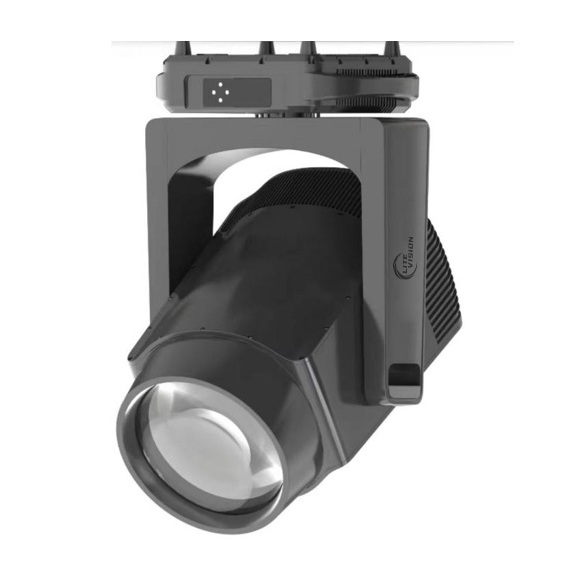
Product Overview
A 500W laser module and a 0.6–8.5° optical range give the Archi B600Laser concentrated beam effects, from precise shafts to broader beams for stage and outdoor applications. Continuous CMY mixing, a color wheel with 17 fixed colors plus white, and separate rotating and fixed gobo wheels provide color transitions, patterned textures and open beam looks. Three prism effects with bidirectional rotation, linear dimming from 0–100% and strobe operation from 1–25Hz support multiplied beam structures, fades and rhythmic accents. Pan movement of 0–540°, continuous horizontal rotation and tilt movement of 0–260° provide positioning flexibility, with 16-bit precision and automatic X-axis and Y-axis out-of-step correction.
Beam Optics
A 500W laser module powers the Archi B600Laser, with optics dedicated to concentrated beam effects. The source technology produces light for the fixture’s optical and effect systems; source wattage alone does not describe the brightness reaching a stage or scenic surface.
Across the 0.6-8.5° optical range, this beam moving head light moves from a tightly concentrated shaft toward a broader beam. The narrow end suits precise lines, while the wider end increases the illuminated area at the same working distance.
Beam width also grows with distance from the fixture. A moving head laser light can therefore create a different-looking pattern from the same optical setting when its position changes, making the actual fixture-to-surface distance important during rehearsal.
Ambient light and atmospheric conditions affect visible contrast. An outdoor moving head light used against a bright background will read differently from the same unit against a dark backdrop, even when the programmed intensity stays unchanged.
For broad scenic coverage, use a dedicated wash alongside the beam fixture. Keeping concentrated effects and general coverage on separate fixtures gives the lighting designer independent control of the aerial picture and the surrounding scene.
Color And Gobo Systems
- Continuous CMY color mixing gives this gobo moving head light a flexible palette for transitions between looks, rather than limiting every cue to a fixed wheel color.
- A color wheel carries 17 fixed colors plus white, with bidirectional rotating rainbow effects and selectable role. Use stationary wheel positions for defined color cues or rotation for a changing color sequence.
- The rotating wheel contains 9 GOBOs plus an open white circle, with replaceable patterns, gobo jitter and selectable role. Rotating patterns add movement within the projected image while the fixture itself can remain aimed at the same area.
- The fixed wheel contains 19 GOBOs plus an open white circle, with gobo jitter, forward and reverse scrolling, and selectable role. Its pattern choices support changes in texture without requiring the same motion as the rotating wheel.
- Open positions on the pattern wheels allow an unpatterned beam when a cue calls for a clean shaft of light. Moving between open and patterned looks changes the visual texture without changing to another fixture.
Electrical And Motion Specifications
| Property | Value |
|---|
| Rated fixture power | 600W |
| Rated supply voltage | AC 100–240V |
| Rated supply frequency | 50–60Hz |
| Color temperature | 6500K |
| Horizontal movement (pan) | 0–540° |
| Horizontal role precision | 16-bit |
| Continuous horizontal rotation | Supported |
| Vertical movement (tilt) | 0–260° |
| Vertical role precision | 16-bit |
| Position correction | Automatic X-axis and Y-axis out-of-step correction |
Prism And Shutter Effects
A single prism plate provides 3 prism effects, adding multiplied beam structures to the available looks. Bidirectional prism rotation changes the direction of movement, while prism role allows a stationary arrangement when the cue needs a held composition.
Linear dimming from 0-100% gives this moving head stage light intensity control for fades, accents and transitions between scenes. Program the fade against the rest of the rig during rehearsal so that changes in brightness support the intended cue timing.
Strobe operation spans 1-25Hz, with pulse, synchronous and random slow, medium and fast modes. These choices give the moving head laser light distinct timing treatments for regular beats, isolated accents or less predictable bursts.
Light frost softens the beam edge for a gentler transition into surrounding light. It is useful when a cue needs less pronounced edges while retaining the direction of the beam.
Heavy frost produces a stronger softening effect, and the light and heavy frost effects can be combined. Treat these as additional textures within the fixture’s optical system rather than as a substitute for the coverage of a dedicated wide-angle wash.
Mounting And Electrical Installation
- Plan lifting and structural support around the 61 kg net weight. For a waterproof moving head light installed overhead, a qualified rigger should assess the complete assembly, including mounting hardware and cabling, before the fixture is raised.
- Check the stated dimensions of 518 mm367 mm860 mm against the intended location. Allow additional room for the moving head, cable travel, ventilation and technician access; the stationary dimensions do not define the full moving envelope.
- Use the model-specific installation instructions from your beam moving head light manufacturer to establish the permitted mounting orientation, approved attachment points and suitable secondary restraint. Do not assume that brackets, clamps or restraint hardware are included.
- Review complete-fixture IP66 documentation and permitted ambient conditions with your beam moving head light supplier before approving an exposed location. Cable entries, mating connectors and protective caps must also suit the installation; the fixture designation alone does not establish the suitability of the entire assembled system.
- Have a qualified electrician check the actual power connector, protective-earth connection, supply protection and wiring arrangement before energizing the unit. Verify connector pinouts and connection limits rather than adapting another fixture’s wiring by appearance.
- Establish a clear movement zone before operating the moving head stage light. Secure cables away from moving parts, keep personnel outside the sweep area and carry out an initial movement check before running show cues.
Technical Downloads And Setup
- Use the exact Archi B600Laser model name when requesting the specification sheet and instruction manual from your beam moving head light supplier. Check the document revision against the actual fixture before using the files for design or commissioning.
- Obtain the model-specific control protocol and DMX channel table from your beam moving head light manufacturer before assigning console addresses. A beam moving head light needs the correct mode definition; channel counts and protocol support from a similar-looking model are not interchangeable.
- Match the console fixture library to the selected operating mode and firmware revision. For an outdoor moving head light rig containing several units, compare those versions across the fixtures, then test the mapped functions before copying programming throughout the rig.
- Request the photometric file or measured illuminance data for the intended optical settings. Use matching distances and test conditions when comparing output with another fixture, rather than treating electrical or source wattage as a brightness measurement.
- Obtain the compliance documents applicable to the destination market and the exact fixture configuration. Check that the model identification and document scope match the supplied unit before approving it for the installation.
Stage And Outdoor Applications
- Concert backlines can use the beam moving head light for coordinated rear-stage accents, leaving front-light fixtures to handle performers. Arrange the effects around the stage picture so that visual accents support the performance.
- Stadium productions can distribute an outdoor moving head light rig across separate scenic positions for large compositions. Coordinate those positions with camera sightlines and audience areas before developing the movement cues.
- Theme-park night shows can use a gobo moving head light to add changing textures to scenic elements during programmed sequences. Keep the effects aligned with show timing so that lighting changes accompany the attraction’s action.
- Outdoor event stages can combine a waterproof moving head light with separately specified architectural wash fixtures. The beam unit supplies dynamic accents while the wash fixtures carry the background color treatment, subject to each fixture’s own installation requirements.
- Theater and fixed-show rigs can pair concentrated effects with profile or framing fixtures for controlled illumination of performers and scenery. Separate cue groups help operators adjust the visual effects without disturbing the principal stage lighting.
Maintenance & Care
- Keep routine technician care of the Archi B600Laser to external cleaning, visual inspection and fault recording. Disconnect the power supply and let the fixture cool before starting; follow the model-specific service instructions for any work that requires opening the housing.
- Wipe dust from the exterior with a soft, dry cloth. Avoid abrasive pads, solvents and direct pressure washing, and keep cleaning liquid away from connectors and housing joints.
- Inspect the exposed optical surface for dust, marks or damage. Use only optical cleaning materials and methods permitted by the maintenance instructions; avoid scraping deposits or rubbing grit across the surface. Leave internal optical cleaning and alignment to qualified service personnel.
- Check accessible cables and connector bodies for cuts, crushed sections, loose fittings or corrosion. Take the fixture out of service if damage is visible, and have a qualified technician assess the affected connection before reuse.
- Inspect accessible housing joints and protective caps for visible damage or signs of moisture entry. Keep sealed covers closed during routine care. Water inside the fixture, a cracked cover or a damaged seal requires service assessment before the unit returns to operation.
- Record unusual movement, repeated role errors, unexpected noise or changes in output when they occur. Stop operation if a fault develops, and avoid forcing the head, adding lubricant or adjusting internal mechanisms without the appropriate service procedure.
- Store the fixture clean and dry, with its optical surface protected and cables arranged without sharp bends. Choose inspection and cleaning frequency around dust, weather exposure and handling rather than assuming a fixed service interval.
- Keep a maintenance record with the model identification, fault symptoms, photographs and any work performed. Contact us with these details for maintenance support; before dismantling or replacing parts, request the applicable service instructions and warranty terms, including the duration, coverage and claim procedure.
Technical Support & Model Matching
LITEVISION brings together more than 30 engineers who have worked in the industry for an average of 15+ years. Share your purchasing requirements and the models you are considering to discuss the available options with our team. We provide product maintenance and technical support, with customer service staff available to answer your questions and help address issues. Whether you are comparing options before ordering or need assistance after purchase, contact us with your technical questions and maintenance concerns.
FAQ
Does the moving head laser light draw logos or laser graphics?
For drawn logos, lettering or freeform laser artwork, choose a dedicated graphics projector. The Archi B600Laser should not be specified as a system for reproducing arbitrary images.
Uploading an artwork file is not an established function of this fixture. If a production depends on imported designs, confirm the intended projector’s file support and playback method before preparing the show content.
Animated outlines require equipment that can trace and sequence the artwork. Moving a fixture around a venue does not provide that capability.
For a stationary branded image, custom gobo projection may be another option, but compatibility, artwork requirements and custom pattern availability need confirmation before purchase.
When combining graphic content with lighting effects, give each task its own equipment and control requirements. That lets the production team specify how the artwork will be reproduced without limiting the surrounding lighting design.
How will a gobo moving head light look on textured scenery?
Raised scenery can interrupt the outline of a projected pattern: ridges catch the image while recessed areas may remain hidden. Brickwork, carved panels and draped fabric can therefore produce very different results from a smooth scenic flat.
Panel joints and fabric folds can split a recognizable shape into disconnected sections. Place important parts of the image away from these interruptions where the set design allows.
Glossy finishes may create bright highlights, while mixed finishes can make parts of the pattern appear uneven. Test a sample finished with the actual paint, coating or fabric used in the set.
An oblique projection angle can stretch the image and deepen shadows behind raised details. Assess the result from the audience’s viewing positions as well as from beside the fixture.
Fine lines may become difficult to distinguish on a strongly textured surface. Where image recognition matters, consider a simpler pattern or a smooth projection insert within the scenery.
Can a waterproof moving head light operate through a venue window?
Operation through a venue window needs an on-site optical check. Glass can reflect part of the output back into the room and create secondary images, so a clear-looking pane does not guarantee a clean result.
Tint, coatings and laminated construction may affect transmission and the appearance of the light passing through. Test the actual glazing with the window closed in its normal operating position.
Check the full programmed movement, including transitions between cues. A reflected path that misses occupied areas during a held position may cross audience or operator positions while the fixture moves.
Window frames, mullions, handles and blinds can obstruct the outgoing light. Allow for these features when choosing the fixture position and aiming through the available opening.
Dirt, condensation and water on the glass can scatter light and change the result after an initial test. Include access to both sides of the pane in the installation’s cleaning arrangements.
A waterproof fixture rating does not establish suitability for projecting through glazing. Assess the window and the fixture’s installation conditions separately before committing to this arrangement.
What routine care does the moving head stage light need?
Disconnect power and allow the unit to cool before external inspection or cleaning. Remove surface dust gently, avoid abrasive materials on optical surfaces and leave internal optical work and sealed-housing repairs to qualified technicians following the service instructions.