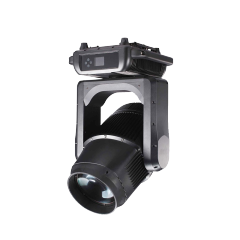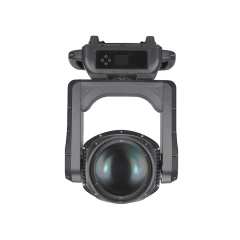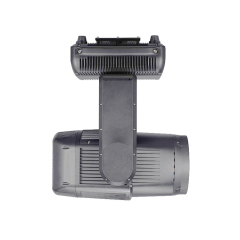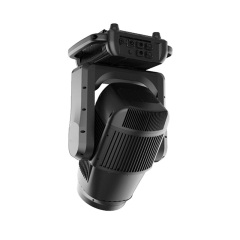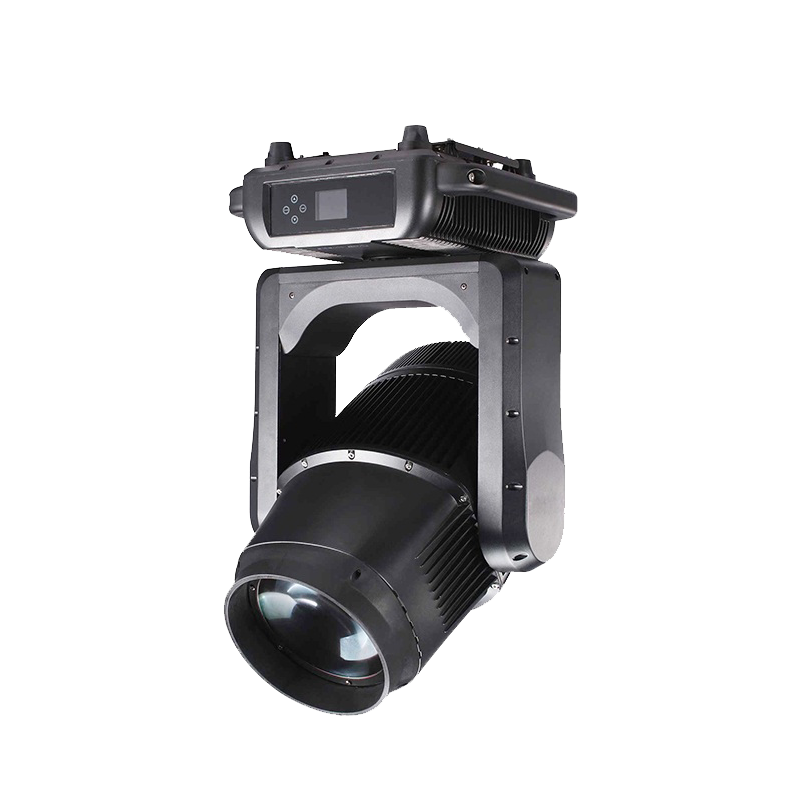
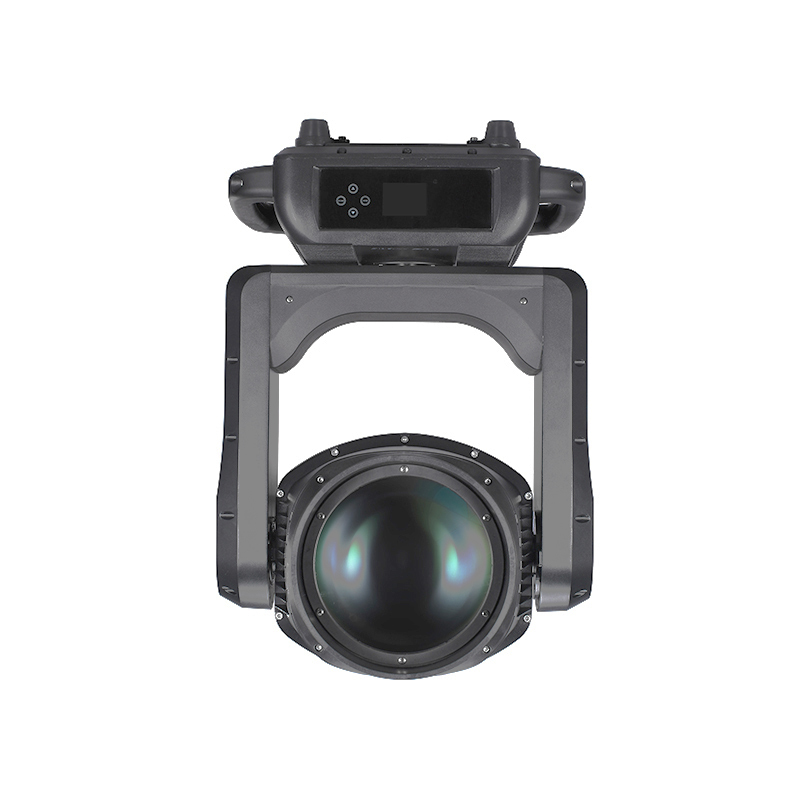
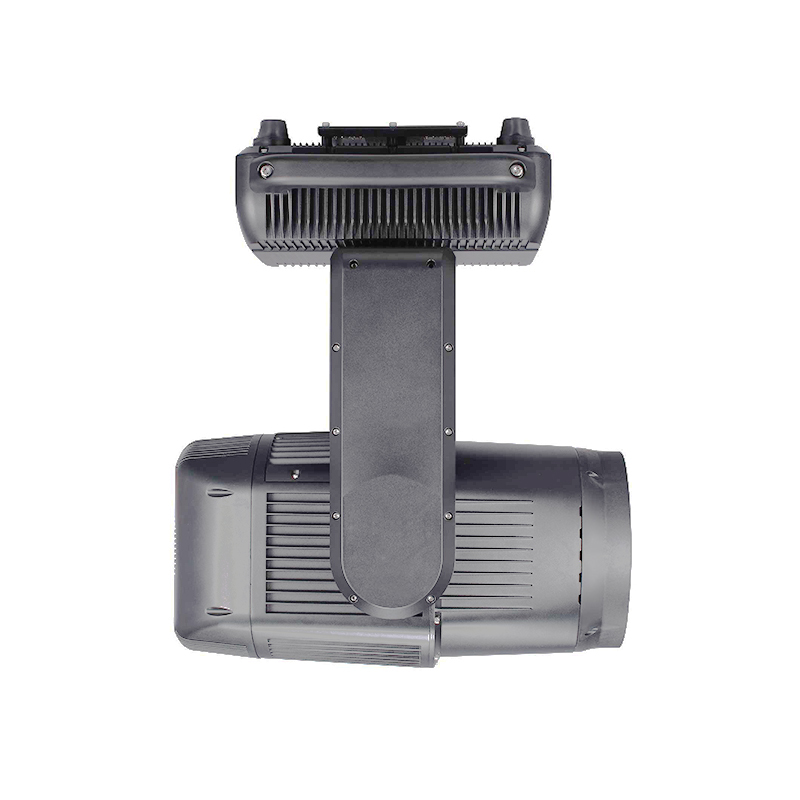
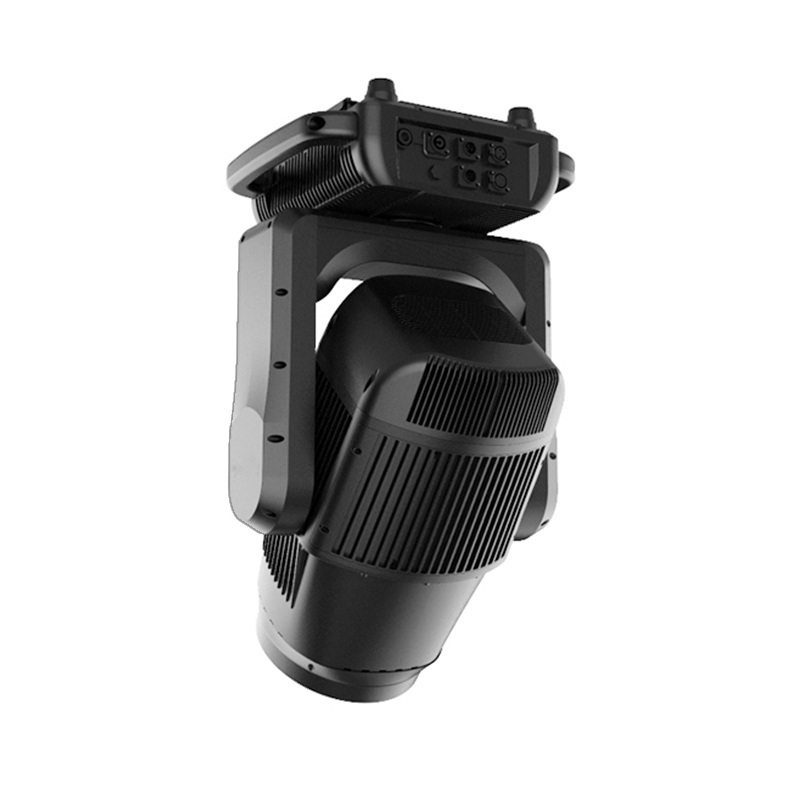
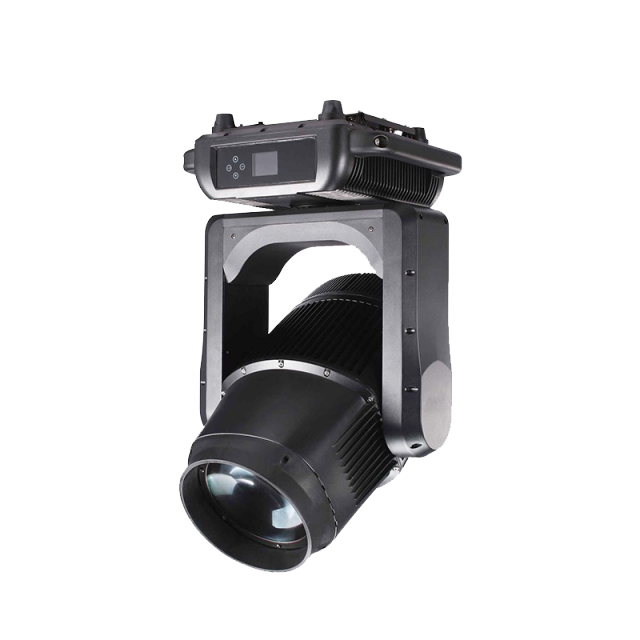
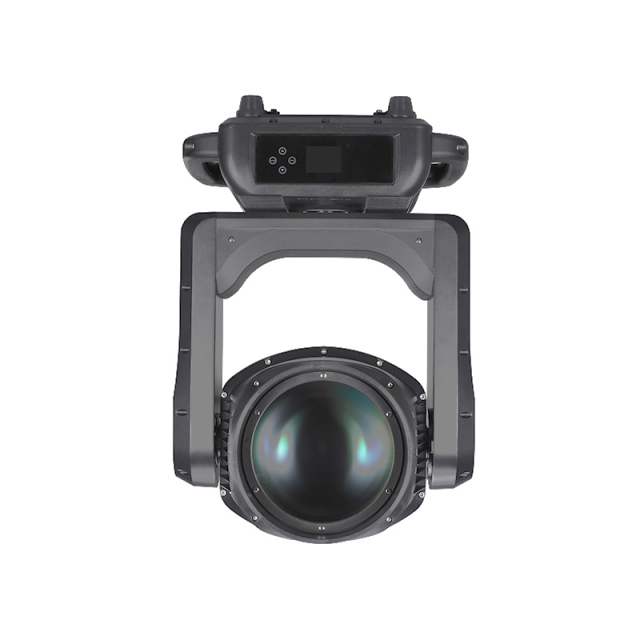
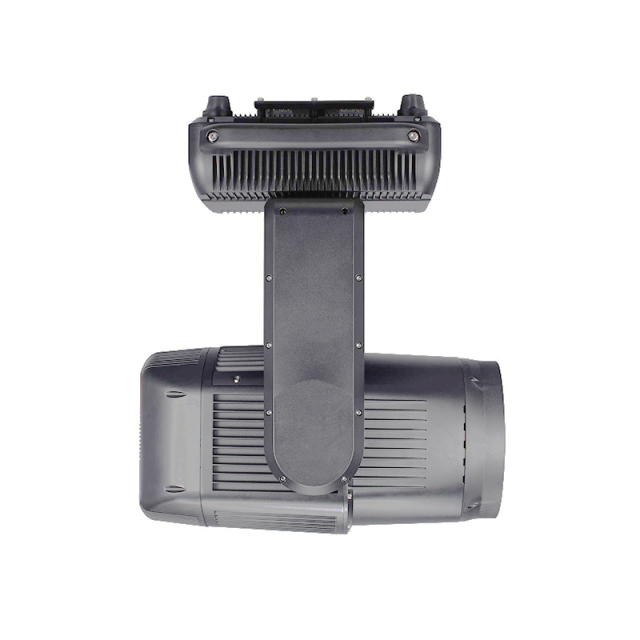
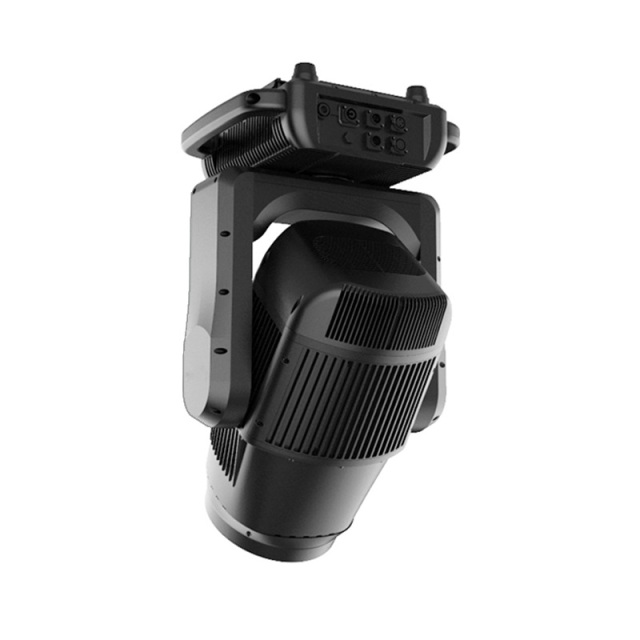
The optical train is dedicated to one extremely tight column of light, which is the whole point of the design: it is meant to be seen from the far end of a field, not to spread a soft wash across a stage. Because the beam is so narrow, it behaves like a drawing tool. Sweeps, fans and locked-off columns read as clean shapes against a dark sky, and the effect holds up even when the rest of the rig is running bright — which is what most laser stage lighting outdoor briefs are actually asking for. The weather sealing is the other half of the design. As an outdoor moving head light it is built to hang on an open-air stage, a stadium roof or a theme-park structure and stay there through a run of shows, instead of being struck and stored whenever the forecast turns. We build it as a stage laser light manufacturer for rental inventory rather than for one-off events. The people who buy it are usually rental houses extending a touring fleet, contractors fitting out a permanent outdoor rig, and dealers stocking a beam their region can genuinely deploy outside. Plan it as part of a rig rather than as a complete lighting solution. Wash fixtures, strobes and video do the coverage; this unit supplies the line, the fan and the moment. Used that way it adds a great deal to a show without needing to run flat out all night.
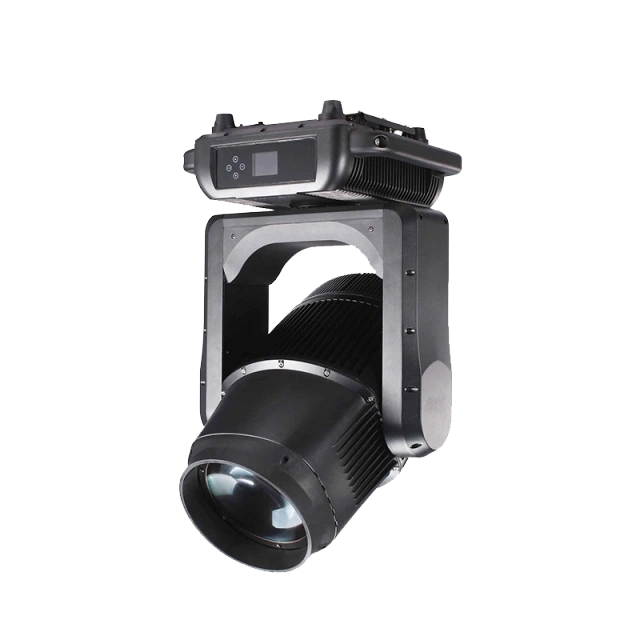
Purpose-built as a moving head laser light. This is not a hybrid splitting its time between beam and wash duty — the optics are arranged for a single tight column, which is why the output still reads at the distances outdoor shows work at. An 11-colour fixed wheel. For fast snaps, index straight to a slot and get a repeatable colour that looks the same on every night of the run. 18 fixed gobos. Break-ups, rings and abstract patterns that read most effectively when the beam is crossing haze above the audience rather than landing on a surface. 8-facet and 16-facet prisms. Both are fitted: the 8-facet reads as a tight cluster of beams, the 16-facet opens out into a wide spray for the biggest moments of a set.
Once it is patched, a moving head laser light behaves like any other unit on the desk — you address it, choose a mode and drive it from cues. Nothing about the control workflow is unusual, which matters when the fixture joins a rig that already has a show file built around it.
Three channel modes, 21, 26 and 30, let the same beam moving head light be patched lean or full. A support position on a large rig can run the short mode and share a few functions; a headline position can take the long mode and keep each wheel, prism and mixing flag on its own handle.
DMX512 is the default and Art-Net is there for installations that already distribute control over a network. Because both are supported, the same unit can sit on a touring console this week and on a permanent networked system the next.
RDM changes what maintenance feels like. The fixture can be addressed and interrogated over the data link instead of from a ladder, which is a very different job when the rig is high above the stage and the doors open in two hours.
Built-in macros and auto-run modes mean the fixture is not helpless without a console. For a permanent display position, a theme-park installation or a backup on a critical cue, it can hold a programmed sequence on its own.
| Light source | 260W laser |
| Input power | 390 W, AC 100–240 V, 50/60 Hz |
| Colour temperature | 7800 K |
| Beam angle | 0.8° |
| Source lifespan | 12,000 hours |
| Colour system | CMY colour mixing plus a fixed wheel with 11 colours |
| Gobo system | One fixed wheel with 18 gobos |
| Effects | Independent frost, 8-facet prism, 16-facet prism, 6-colour wheel |
| Pan / Tilt | 540° / 260°, 16-bit; 540° in 2.2 s, 260° in 1.2 s |
| DMX channels | 21 / 26 / 30 |
| Control | DMX512, Art-Net, RDM; wireless DMX optional |
| Dimensions | 439 × 360 × 765 mm |
| Net weight | 33 kg |
| IP rating | IP66 |
| Price and quantity | Confirm current pricing, quantity breaks and minimum order quantities with your sales contact |
| Lead time | Confirm production and transit timing against your show or install dates before you commit |
| Payment terms | Confirm the payment method, currency and schedule that apply to your order |
| Warranty | Confirm the warranty period and exactly what it covers, in writing |
| Returns and quality claims | Confirm how a claim is raised and the window that applies to it |
| Packing | Confirm export packing for a fixture of this size, and whether road-case options suit a touring fleet |
| Shipping | Confirm Incoterms, origin port and freight arrangements for your destination |
| Documentation | Request the specification sheet, DMX channel chart, fixture library file and photometric data for your console and planning software |
| Spare parts | Confirm the parts worth holding for your fleet and how they are supplied |
| Commissioning support | Confirm what installation and commissioning help is available for your site |
| Range | Outdoor and indoor moving heads, hybrid wash beam spots, LED wash and profile fixtures, effects, battery lights, follow spots, controllers, data distribution, cases and power boxes |
| Manufacturer | LITEVISION, a stage laser light manufacturer with in-house production in Huadu, Guangzhou |
| Supplier | LITEVISION — a professional stage lighting supplier whose technical team also handles the order |
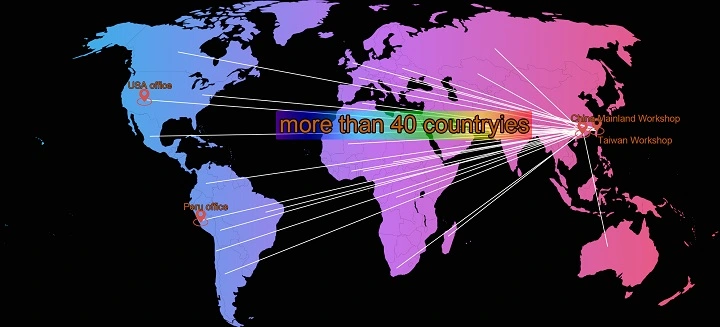
More than 30 engineers with an average of 15+ years in professional lighting stand behind every order — the same people who answer your technical questions. Tell us your venue, rigging height, throw distance and existing control setup; we help match models, check protocol and channel fit, and build a package that works as one system. If a fixture misbehaves on site, we work through the fault with you and sort out spares. Installation and commissioning guidance come with the order. Founded in 2016, exporting since 2022, LITEVISION serves buyers in more than 80 countries from offices in the USA, Taiwan, Mexico and China.
A team behind the product. More than 30 engineers with an average of 15+ years in professional lighting work on design and production, and the same team takes the technical questions that come back from the field. Thermal testing. Fixtures are run and monitored for heat behaviour. It matters most on a sealed outdoor unit, where the housing, the laser source and the cooling system have to work together in high ambient temperatures. Electrical testing. Power input, control circuitry and every connection between them are checked on each unit before it leaves the bench. Longevity testing. Extended running catches the faults that only appear after hours of use rather than in the first ten minutes of a bench test. Documented pre-shipment inspection. An independent QC team inspects every machine and issues a qualification report before the warehouse releases the order, so there is a record behind the fixture instead of a verbal assurance. Certification. Products are built to CE, RoHS, UL and ISO 9001 standards, and the compliance documents for your market are held by our QC department and issued on request. Scale and reach. Our Guangzhou plant produces more than 50,000 units a year. Many of the companies we supply are professional stage lighting suppliers, rental houses and integrators, and our regional offices support them locally. Custom and OEM work. As a stage laser light manufacturer we take on OEM, ODM and custom configurations. The process runs from an initial consultation through design, production and post-sales support, so a modified fixture is not simply handed over at the factory gate.