Product Overview
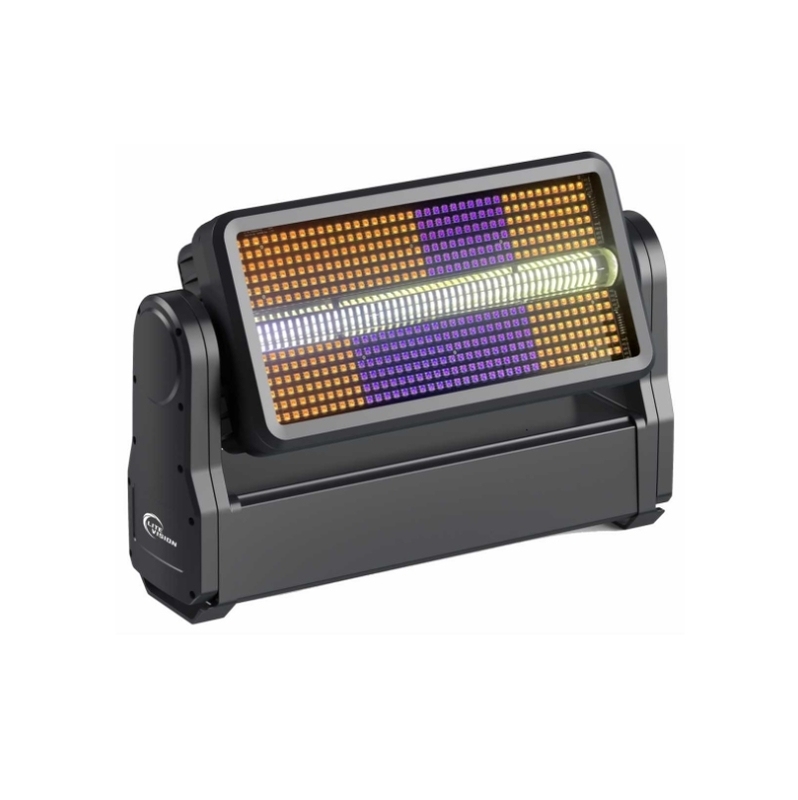
Archi MST1000-8 is a weather-rated LED strobe light that puts two different light engines into one rectangular housing. The face is a broad RGB LED panel; a bank of cool-white tubes runs down the body and fires as a blinder. Colour and hard white bursts both come from a single hanging point.
This moving head stage light suits rental operations that send fixtures out for a whole festival week, and venues that want a permanent blinder position on a front truss without building extra weather protection around it. The same unit works indoors, so stock bought for summer events still earns its keep in the winter.
On stage the two engines read as separate layers: a slow colour wash across the panel while the tubes cut in for accents, or one full white hit from both. That layering is what separates this DMX moving head light from a conventional single-tube blinder, where the only variable is how hard the flash lands.
Most buyers comparing it against a plain blinder are really weighing how much of the show needs colour. If the answer is the front line, all night, the RGB panel does work that would otherwise need a separate wash fixture — and that is the first question we ask as a moving head light supplier before quoting a rig.
Strobe Panel & Tube Engines
Colour across a wide face — the RGB panel throws a broad field rather than a narrow beam, so it fills a front line or a set wall instead of punching a single hotspot. A white hit that reads as white — the tube bank runs at daylight colour temperature, which lands as a hard strobe in the room and on camera rather than a warm amber flash. Two engines, run separately — panel and tubes are independent, so a colour look can hold while the tubes fire underneath it, and either engine can stay dark when the cue does not need it. Sealed as one system — the housing, the signal sockets and the power inlet carry the same weather rating, so the connector panel is not the weak point in a wet rig. One fixture to stock and service — panel and tubes share a housing, a clamp point and a service routine, so the spares sheet stays at one line instead of two and the service conversation with your LED strobe light supplier stays simple.
Segment Control & Patching
The RGB face is split into a 2 × 4 grid of eight addressable cells. A cue can roll colour across the face in blocks instead of treating the whole panel as a single lamp, which is what makes the fixture useful for movement rather than a static wash. The tube bank divides into eight segments down the body. That is where the chase comes from: blocks lighting in sequence from the bottom of the fixture upward, alternate sections firing, or a sectional burst that travels along the truss. Eight segments is a working choice rather than a compromise. Wide blocks read clearly past the front rows of a large crowd, where a very fine split blurs into a single line at distance. Ask your LED strobe light supplier for the channel table, then work out how many channels each unit takes before you build the patch, especially where the desk is already close to its universe limit. LED macro effects are built in for the nights when there is no time. A festival that hands over the console at six in the evening can pull a usable look straight from the fixture and refine it later.
Rigging, Power & Cabling
- Hang it from a clamp through the yoke and set the tilt bracket before the position goes up — treat it like any other moving head stage light on the truss, with the same clamp and the same safety routine.
- Add a secondary safety around the bracket and the truss. It is standard practice on flown fixtures, and it is the first thing a venue's rigging supervisor checks.
- Link power through the powerCON TRUE1 in and out sockets, then add up the draw of every fixture on the chain against the circuit before the last one goes in. Keep the run inside what your distribution can carry.
- Run signal through the sealed 3-pin in and out sockets, loop through the fixtures and terminate at the last unit. Leave the dust caps on sockets that are not in use.
- Dress every cable with a drip loop below the connector. Even a waterproof moving head light gathers water in an unmated plug, so slack under the socket and a taped join are what keep a run dry.
- Address and test every DMX moving head light at trim height before the rig goes out. A blind channel found during the show costs a cue; found at sound check it costs a minute.
Where It Works
- Festival main stages — the tube bank fires a blinder hit to the back of the crowd while the panel holds colour on the front line. An outdoor moving head light has to keep doing that when the weather turns, which is the whole point of the sealed housing.
- Touring rental stock — a moving head stage light that travels in the same cases as the rest of an outdoor rig, with sockets that survive load-in in the rain.
- Outdoor clubs and beach venues — a waterproof moving head light earns its place where salt air and spray are routine and one failed socket ends the night.
- Theme parks, plazas and city events — fixed positions that run every evening for a season, where a housing that stays sealed matters more than any single feature.
- Arena and stadium shows — the RGB face works as a wide colour accent on a set wall for the numbers that do not need a blinder.
- Distributors covering the outdoor season — order it alongside beam and wash fixtures so a client can light a whole stage from one LED strobe light supplier. Pairs and fours are the usual starting point for a front truss and a crowd position.
Specifications
| Power | 1000 W |
| Strobe panel LEDs | 640 × 5050 0.5 W RGB 3in1 |
| Panel colour | RGB |
| Strobe tube LEDs | 96 × 3535 5 W 6500 K |
| Tube colour | Cool white |
| Control protocol | DMX-512, RDM |
| Signal connection | Seetronic IP65 3-pin in / out |
| Power connection | Seetronic powerCON TRUE1 in / out |
| Effects | LED macro effects |
| IP rating | IP65 |
| Dimensions | 502 × 137 × 326 mm |
| Net weight | 11.2 kg |
Ordering & Delivery
- Send the model, quantity and destination to our sales team. As a moving head light supplier we quote against the configuration you actually need — quantity, control setup and the market the fixtures are going to.
- Confirm the minimum order quantity and any price break for larger runs, together with the production lead time and the slot reserved for your quantity. Outdoor season schedules move, so ask for a date in writing rather than assuming one.
- Confirm payment terms and trade terms for the order before production starts.
- Confirm what the warranty covers and how long it runs, and ask how a return or a quality claim is handled if a unit arrives damaged.
- Ask about sample or demo availability if your client wants to see the fixture before committing to a fleet order, and confirm what is supplied in the carton.
- Confirm packing, shipping method and the market documents your customs broker will ask for, so nothing is missing when the container lands.
| Document | What it covers |
|---|
| Specification sheet | Electrical, optical and physical data for this model |
| DMX channel table | Channel layout for the panel, the tubes and the macro effects |
| User manual | Setup, addressing, menu navigation and routine maintenance |
| Photometric data | Output and distribution figures for planning and pre-visualisation |
| Fixture profile | Console library file for patching into an existing show file |
| Compliance documents | Ask which test reports and market-specific paperwork apply to your destination |
| Spare parts list | Replaceable parts and consumables, available on request |
Technical Support & Model Matching
More than 30 engineers with an average of 15+ years in professional lighting stand behind every order — the same people who answer your technical questions. Tell us your venue, rigging height, throw distance and existing control setup; as a moving head light supplier we help match models, check protocol and channel fit, and build a package that works as one system. If a fixture misbehaves on site, we work through the fault with you and sort out spares. Installation and commissioning guidance come with the order. Founded in 2016, exporting since 2022, LITEVISION serves buyers in more than 80 countries from offices in the USA, Taiwan, Mexico and China.
FAQ
How does this model differ from the twelve-segment version?
The two share the same housing, the same panel and the same tube engines; the difference is how finely the tube bank is split. This model gives you eight segments, which read as wide blocks from the front of a large crowd, while the twelve-segment version gives you more steps for long travelling chases. Both are the same outdoor moving head light in every other respect, so the choice comes down to the cue list rather than the rigging.
Can it stay rigged outside between show days?
The housing and the connectors are built for wet work, so a fixture that stays on an outdoor stage between shows is within normal use. What fails in practice is an unmated plug: cap or mate every socket, keep drip loops in the cable, and check the seals during each service. A waterproof moving head light is only as dry as its worst connector.
Can it work as a colour fixture when the show does not need a strobe?
Yes. The RGB panel works as a broad colour source on its own with the tubes left dark, which is how clubs and corporate sets usually run it. Think of it as an LED strobe light first and a wide colour face second — the second role is why it can stay on the truss all night.
Will it patch into an existing console file?
It speaks DMX-512 with RDM, so any desk that can run a DMX moving head light will control it. Load the fixture profile from the documentation rather than building one by hand, and check the channel count against the universes you have left before the patch is finalised.
What does RDM add on site?
Addressing and status checks from the console instead of a truss climb. On a touring rig that saves time at changeover, and during a show it is the quicker way to confirm which unit has dropped off the line before anyone goes up.