Product Overview
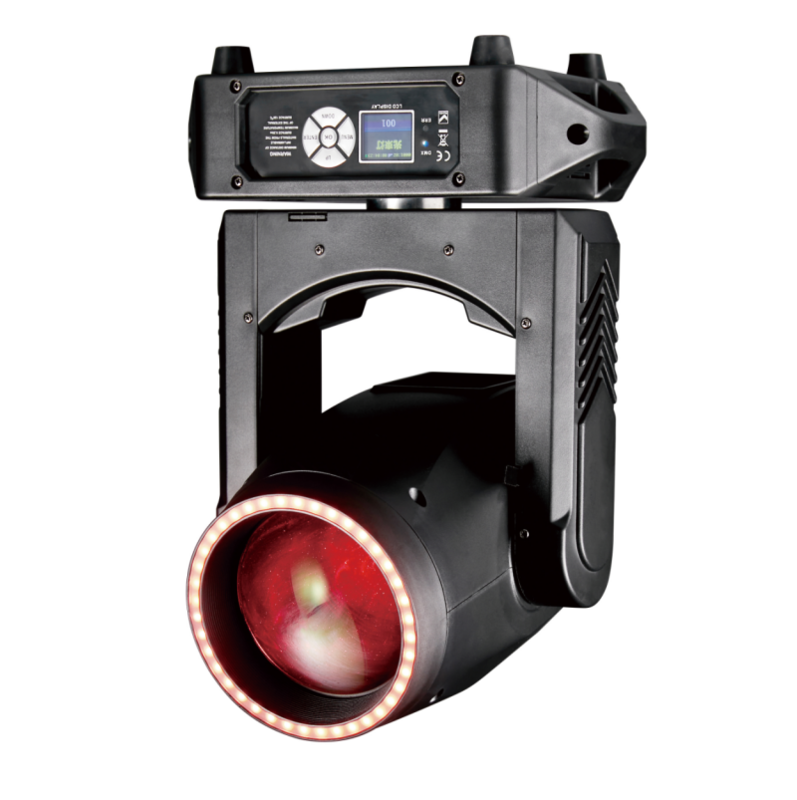
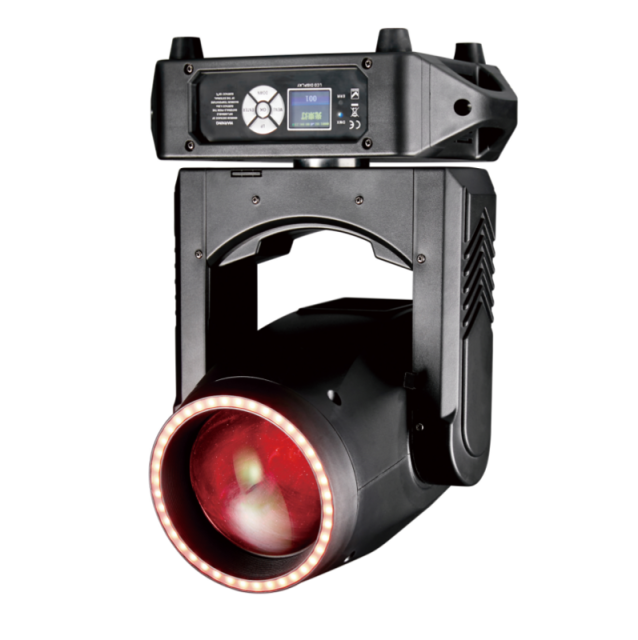
This is a beam fixture for rooms that need a hard, defined shaft of light rather than a broad wash. Clubs, theatres and touring shows use it where one strong aerial effect has to carry the look. The housing is matte black, with a red-lit front lens and textured vents along the sides, and the head sits in a heavy-duty yoke. That matters on a dark stage: the operator can see which way the lens is pointing from the floor, and the yoke gives a firm mounting point for a clamp or a floor stand. The mini moving head light in the same series handles low ceilings and one-person load-ins; this model gives noticeably more output for mid-size rooms without the size and power demands of the flagship beam at the top of the range. Companies that already own the smaller unit usually add this one when a room or a tour needs a stronger front-of-stage line. It sits in a rig next to wash and spot units and is normally fed through a DMX splitter so each truss run has its own isolated branch. Buyers come to a moving head light supplier for different reasons: a distributor building a catalogue, a rental house replacing a tired batch, a venue adding two fixtures to an existing line.
Key Features
- A beam that holds together: Every moving head beam light lives or dies on the column it throws; here the lens group keeps it tight from the front of the stage to the back wall, so haze, smoke and confetti read as solid shafts instead of a soft glow.
- Wheel colour with a clean open white: Saturated stage colours and a true open white sit on the same wheel, so a colour change is instant and nobody has to scroll through a mixing menu mid-show.
- Two gobo banks on one gobo moving head light: Glass and fixed wheels on the same fixture, so a show can move between delicate projected texture and hard, fast-rotating patterns without changing a wheel mid-set.
- Prisms that stack: Prism elements run one at a time or combined into a multi-beam fan, which turns a single head into a wide effect for builds, drops and chorus lifts.
- Frost and rainbow on tap: Frost softens the beam edge when a scene needs a gentler look, and rainbow sweeps colour through the beam for fast movement without touching the wheel.
- Dimming and strobe that behave: Dimming is mechanical across the full range so the beam fades out evenly to black, and the electronic strobe runs from a slow pulse to a hard cut, with macros fired from the console rather than built by hand.
- Straightforward to keep running: As a moving head beam light manufacturer we keep the control and power stages conventional, so a fault is traced with a DMX tester and a multimeter rather than a proprietary service laptop.
Rigging, Power & Commissioning
- Check the hanging point.
- The head hangs from its yoke bracket, so confirm the clamp, the truss rating and the secondary safety are right for a head of this size before it leaves the ground.
- A moving head beam light in this class is a two-person lift at height.
- Aim it before you tighten.
- Set the yoke roughly where the beam has to travel, then finish the aiming from the console.
- Getting the coarse position right leaves pan and tilt range for the show instead of spending it on a bad hanging angle.
- Give it a clean feed.
- This is a discharge fixture, and a moving head beam light manufacturer fits a magnetic ballast with an AC/DC switching power supply; that combination wants a stable supply on its own circuit rather than a long chain of shared sockets.
- Keep the feed away from dimmer packs.
- Address it on the fixture.
- Setup on this dmx moving head light is done from the rear panel, where an LCD works with MENU, UP, DOWN and ENTER buttons.
- Set the address there, then write it on the yoke or the case lid so the next crew does not have to power the rig up to find it.
- Focus, then store.
- Pan and tilt run on 16-bit resolution with electric correction, which keeps long sweeps smooth and brings the head back to stored positions cleanly — the reason a moving head stage light can hold a fixed special for a whole show.
- Set the key positions in the first run-through and save them.
- Keep the airflow clear.
- Textured vents on the sides feed the cooling path, and over-heat protection cuts the fixture back if the head gets too hot.
- Leave a gap around the vents on a packed truss, and blow dust out of the housing between runs.
- Dress and store it properly.
- Leave a little slack in the DMX and power leads at the head so pan and tilt never pull on a connector, label both ends, and send the fixture back to its case with the bracket folded and the lens protected.
Who It Suits
Rental and touring companies. These buyers care about load-in time and how a moving head beam light behaves on night forty, not night one. A mid-power head that shares its bracket, addressing routine and spares route with the rest of the beam range is easier to keep in rotation than a one-off model.
Distributors and dealers. They buy from a moving head light supplier who can back the range with documentation, spares and a stable build, because their own customers come back to them for all three. A defined specification, a channel chart and an English manual make the first sale and the tenth one the same conversation.
Venues with in-house technicians. Theatres, school halls and multi-purpose rooms rarely have a dedicated programmer, so a moving head stage light that is addressed from its own rear panel and behaves predictably through the console is worth more than one extra effect nobody uses.
Integrators and specifiers. When a design has to be written up before anything is ordered, the documents carry the decision: the specification sheet, the channel chart and the dimension drawing go into the submission, and the beam from the dmx moving head light is what the client sees on the night.
Applications
- Clubs and live music rooms: Hung on the front truss, a pair of these throws beams across the dance floor and over the crowd.
- Most small and mid-size rooms need two to four heads, and the beam moving head light cuts through haze even when the room is packed.
- Theatres and school halls: A moving head stage light with a hard edge earns its place on musical numbers, transitions and specials, and the frost position lets the same unit soften for a spoken scene.
- Touring and rental inventories: One case of mid-power heads covers most dates on a club-and-theatre routing, and the fixture stays manageable for a two-person load-in.
- Corporate and product-launch stages: A defined shaft over a set reads well on a wide shot, and the gobo wheels let the beam carry a brand texture or a simple break-up without extra effects units.
- DJ booths and small stages: Two mini moving head light fixtures on a booth truss give the aerial movement that smaller effect lights cannot, and the whole rig still fits in a car for a mobile setup.
- Houses of worship and multi-purpose halls: These rooms usually need one strong look for events and a softer option for quieter moments, which is exactly the range the beam and frost positions cover.
Specifications
| Model | BEAM 380 MINI MOVING HEAD 380W BEAM LIGHT |
|---|
| Power input | 100–240 V, 50/60 Hz |
| Power consumption | 420 W |
| Lamp | 380 W discharge bulb |
| Beam angle | 0–4° |
| Colour wheel | 14 colours + white |
| Gobo wheel | 5 glass gobos + 9 fixed gobos + white |
| Prism system | 8-facet, 16-facet and 6-facet linear prisms, with (8+16) stacking |
| Effects | Frost and rainbow |
| Dimming and strobe | 0–100% mechanical dimming with free dimming available; electronic strobe with macro control |
| DMX channels | 22 CH, DMX512 |
| Pan and tilt | 540° / 270°, 16-bit with electric correction |
| Ingress protection | IP20 |
| Dimensions and weight | 500 × 350 × 400 mm, 13.5 kg net |
Ordering & Delivery
- Send the brief.
- Venue type, throw distance, control platform and quantity are what we need to start; we answer as a moving head light supplier with a recommended configuration rather than a bare price.
- Confirm the configuration.
- Channel mode, colour load and gobo set are fixed by the model, so treat this gobo moving head light as a defined package; if a show depends on a particular pattern, ask before the order is released and we will tell you what can be arranged.
- Settle the commercial terms in writing.
- Minimum order quantity and any volume steps, production lead time for your slot, payment terms and the Incoterms you are working to should all appear on the quotation instead of being assumed from a catalogue.
- Sort the paperwork.
- Compliance and test documentation varies by destination; tell us the market the fixtures are going into and, as a moving head beam light manufacturer, we confirm which documents can travel with the shipment.
- Plan packing and shipping.
- Beam heads travel most safely in flight cases — ask about export packing and case options once the quantity is confirmed, and check container loading if the order is large enough to ship loose.
- Know the after-sales route.
- Warranty period and coverage, repair turnaround, spare-parts supply and the process for a quality claim are all confirmed by your sales contact when the order is placed, so there is a named route if something goes wrong on site.
- Specification sheet | Electrical, optical, channel and physical data in one document for tender packs and technical files DMX channel chart | Channel-by-channel map of the fixture's DMX mode for console patching and pre-programming User manual | Menu structure, addressing, focusing, cleaning and routine service notes Photometric data | Beam intensity and throw figures for lighting design and rigging plans Dimension drawing | Housing and mounting footprint for truss layout and case planning Fixture profile | Console and pre-visualisation profile availability, confirmed against your control platform Compliance paperwork | Market-specific documents, confirmed for your destination before the order is placed Spare parts list | The items we recommend keeping on the shelf for this model
Technical Support & Model Matching
More than 30 engineers with an average of 15+ years in professional lighting stand behind every order — the same people who answer your technical questions. If a fixture misbehaves on site, we work through the fault with you and sort out spares. Installation and commissioning guidance come with the order. Founded in 2016, exporting since 2022, LITEVISION serves buyers in more than 80 countries from offices in the USA, Taiwan, Mexico and China.
FAQ
Can this fixture be used outdoors or in a damp space?
No. It is rated IP20, which means dry indoor use. A covered stage or an enclosed room is fine, but the fixture should not be rained on, stored in a damp truck body overnight, or run in a space where condensation forms on the lens.
Can I fit my own gobos, or am I limited to the patterns supplied?
The gobo set is part of the model, so this gobo moving head light arrives with its own glass and fixed patterns. If a show depends on a specific shape — a logo, a break-up, a texture for a particular number — tell us the pattern before the order is released and we will confirm whether it can be arranged or whether the look is better built with a separate effects unit.
How do I know whether the smaller beam in the range would be enough?
If the room is small, the ceiling is low and the crew loads in alone, the mini moving head light is usually the sensible choice. Once the throw gets longer than a small club, or the design needs a beam that still has presence at the back of a theatre, this model earns the extra size. Putting one of each in the same room is the quickest way to settle it.
Will it work with my console?
Any console that outputs DMX512 will drive this dmx moving head light; there is no proprietary protocol and no dongle. Address and settings are made on the rear panel, so if your workflow depends on remote configuration over the network, say so before you order and we will confirm what is possible for your setup.
Can it do wash duty as well as beam work?
Only for moments. The frost position softens the edge enough for a solo or a speech, but this beam moving head light is built around a narrow column and will not cover a stage the way a wash unit does. Rigs that need both usually pair beam heads with dedicated wash fixtures rather than asking one unit to do everything.
How far will the beam carry in a large room, and what lamp does it use?
Throw depends on what is in the air: a tight moving head beam light stays visible across a mid-size hall or over a festival field when there is haze or smoke for it to hit, and fades much sooner in a clear, dry room. Plan from the photometric data and test one head in the space before deciding how many to buy. The fixture runs a 380 W lamp on a magnetic ballast — allow it to cool fully before a lamp change, handle a new lamp by its base rather than the glass, and recycle the old one through your usual lamp route.