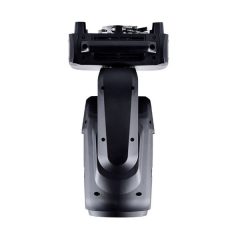
Product Overview
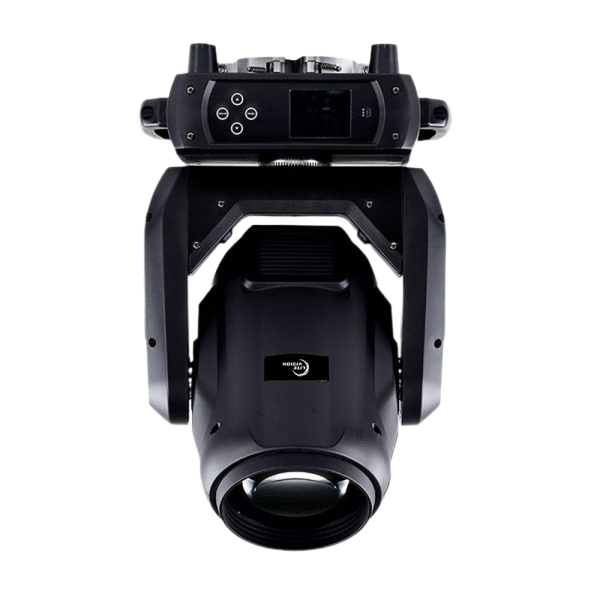
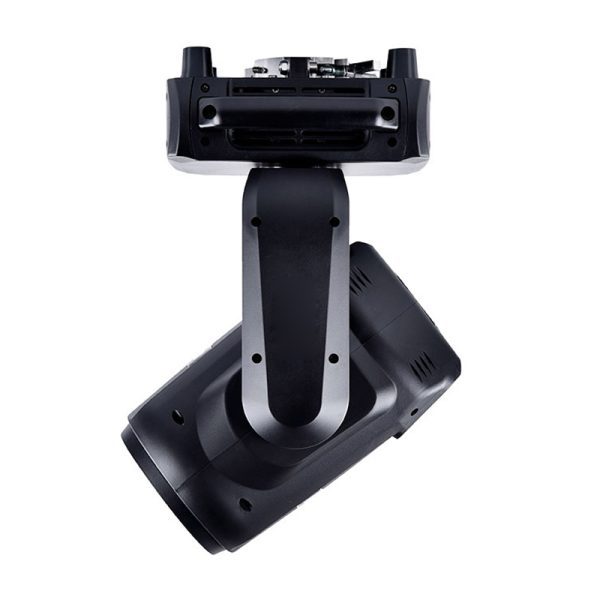
The Sword 290MINI is a compact discharge beam moving head built around a PHILIPS MSD Silver 250 W lamp. As a mini moving head light it is sized for rooms and rigs where a full-size beam would be more fixture than the space can use, and it hangs from a single truss position without extra support. The matte black housing carries a large circular front lens, with the control panel and its small display set into the top for quick access from a ladder.
Its character comes from the beam: a 1.8° fixed-focus column that cuts a hard-edged circle on a surface and leaves a clean shaft in haze. That narrow angle is what defines a beam moving head light as opposed to a wash unit — it is built to cut through a stage rather than cover it, and it performs most effectively alongside wash fixtures that light the rest of the picture.
We build and supply this model for distributors adding a compact beam to a resale range, rental houses filling the space between their large hybrids, and installers specifying a first beam for a small venue. As a beam moving head light supplier we quote and support directly from Guangzhou, and a technical question about the fixture reaches someone who works with it.
Typical positions are club dance floors, DJ booths, small and mid-size stages, school and village halls, live-band venues, and the beam layer of a bigger rig that needs more sharp lines. Used as a dj moving head light over a booth or a small floor, it still throws its narrow beam to the back of a small room from a short truss position.
Halls, theatres and multi-purpose venues use it inside a wider theatrical stage lighting rig for specials, patterns and aerial looks, while clubs place it over a dance floor where the beam has room to travel.
Optical System
- Fixed 1.8° focus — the optical train of this mini gobo moving head light is set at one narrow angle, which is what makes it a beam moving head light rather than a zoom unit. The beam stays tight across the throw, so you choose positions and angles instead of dialling beam size. High-quality optical lens in an efficient optical system — the spot keeps a defined edge with little scatter, so patterns read cleanly even at distance and the beam does not blur into a soft blob at the far end of the room. 0–100% smooth dimming — fades hold their shape on the way down instead of stepping, which matters on slow musical transitions and on cues that ride the music. Multi-speed strobe — from slow pulses to fast cuts, all driven from the console, with no separate controller needed at the fixture. Independent frost and soft-light effect — takes the hard line off the beam edge when you want a softer look on camera or a less clinical finish on a small stage. Cooling and thermal stability — output holds steady through a long set as the head manages its own temperature, and the lamp is protected through warm-up and cool-down between shows.
Colour, Gobo & Prism Effects
| Colour wheel | 12 colours + 4 colour effects + white |
| Half-colour | Split colours for two-tone beams |
| Rainbow effect | Bidirectional rotation |
| Fixed gobo wheel | 14 patterns + white |
| Gobo dithering | Pattern shake for shimmer and texture |
| Gobo role | Patterns can be placed anywhere in the beam |
| Prism 1 | 8-facet, bidirectional rotation |
| Prism 2 | 24-facet honeycomb, bidirectional rotation |
| Prism layering | Both prisms can be run together |
| Frost | Independent soft-light effect |
Pan, Tilt & role
Pan runs 540° and tilt 270°, both on 16-bit precision scanning, so this dj moving head light can sweep the full width of a floor and still land on a mark. Sixteen-bit resolution means a slow move glides rather than steps from point to point.
Because the ranges are generous, a single mini gobo moving head light on a centre truss can cover the front of a stage and reach out to both side walls without needing a second rigging position.
On power-up the fixture runs a reset with automatic error correction, so it finds its own home position and corrects any drift picked up in transit. That is the detail that keeps a touring rig — or a theatrical stage lighting plot — repeatable from venue to venue instead of being re-focused every morning.
Magnetic mounting makes initial position correction straightforward during service — a technician can restore the head to its correct alignment without stripping it down and re-homing it by hand.
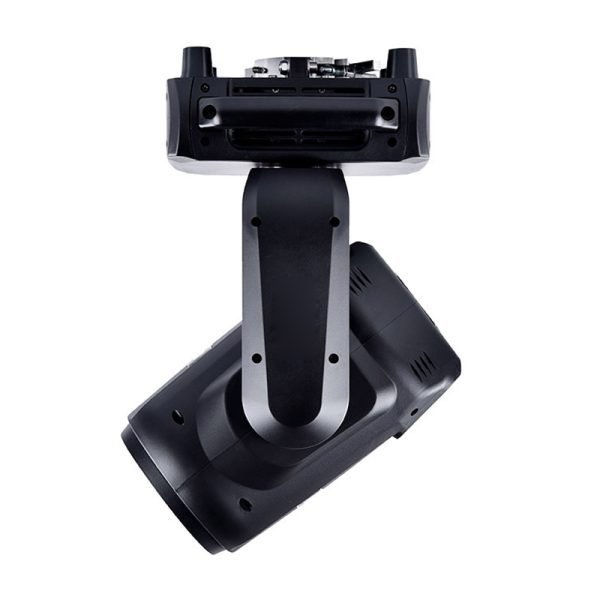
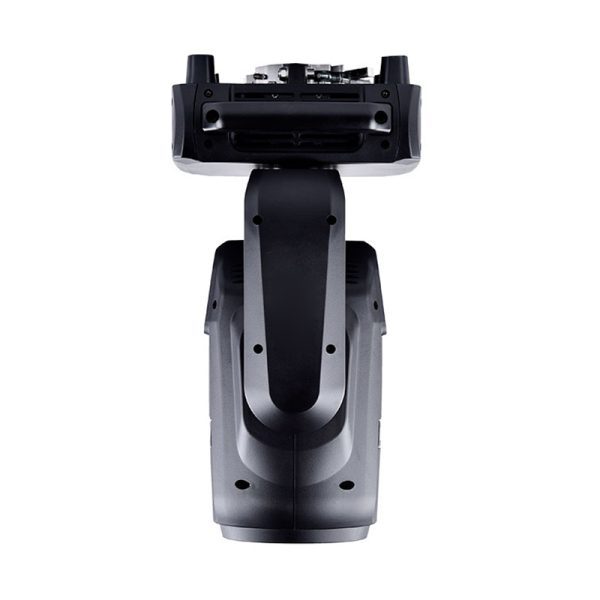
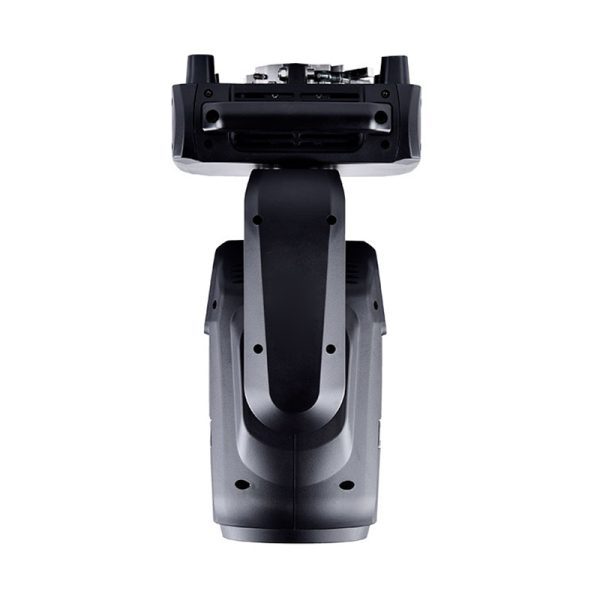
The head sits in a U-shaped yoke on a base bracket, so it can be clamped to truss or stood on a stage floor and aimed by hand before the console takes over.
Specifications
| Supply voltage | 100–240 V, 50/60 Hz |
| Power draw | 370 W (90 V) |
| Light source | PHILIPS MSD Silver 250 W |
| Lamp rated life | 1500 hours |
| Colour temperature | 8000 K |
| Beam angle | 1.8°, fixed focus |
| Control | DMX512, 3-pin XLR input and output |
| Pan | 540°, 16-bit precision |
| Tilt | 270°, 16-bit precision |
| Reset | Automatic error correction |
| Cooling | Fan |
| Dimensions | 492.5 × 313.1 × 255 mm |
| Net weight | 14 kg |
| Packing | 15.5 kg gross, carton 580 × 520 × 405 mm |
Hanging, Wiring & First Power-Up
- Mark positions on the plot first. With a fixed narrow angle this mini gobo moving head light covers a limited footprint at short throws, so the difference between two rigging points is visible on stage.
- Hang it from a rated clamp through the base bracket and fit a secondary safety bond as well — standard practice for any moving head, whatever the clamp rating.
- At 14 kg net this mini moving head light is a one-person lift onto a ladder or a low truss; use two people for anything overhead.
- Leave the cooling clear. Group fixtures so one unit's exhaust is not blowing into the next unit's intake, and keep the head free to pan without fouling cables.
- Run DMX512 on 3-pin XLR in and out, daisy-chained, with a terminator on the last fixture in the line. Address each dmx moving head light from the panel on top before the first cue rather than during soundcheck.
- Check the supply before you power up: 100–240 V, 50–60 Hz, with a plug that suits the venue. Power one unit at a time and let it finish its reset and position correction before you judge the aim.
- For a club or DJ booth position, mounting this dj moving head light at the rear of the booth throws the beam out over the floor; in a theatre, hang it downstage or mid-stage so the beam crosses the action rather than pointing at the audience.
Ordering & Delivery
- Tell us where it is going — a club floor, a hall, or part of a theatrical stage lighting rig — along with trim height, throw distance and the number of units you need. That is enough for us to advise on positions and on how many fixtures the room needs. Confirm the electrical detail for your market. Agree the commercial terms with your sales contact before the order is placed: minimum order quantity and volume pricing, payment terms and the trade term you work on. These are quoted per order and per market rather than published as a single figure. Lead time is quoted per order from our moving head light factory, so confirm the production and shipping schedule before you commit to a fixed install date, and ask how the cartons will be consolidated with the rest of the shipment. Agree the warranty period and its coverage, and the process for a unit that arrives damaged or develops a fault, in writing with your sales contact. Returns and quality claims are handled against that written agreement, so put the terms in place before dispatch. Tell us which compliance or import documents your market requires so the paperwork can be prepared with the order, and if this is your first mini moving head light purchase, ask your sales contact about sample availability and the current schedule before you plan around a date. Specification sheet — the full electrical, optical and physical data from our moving head light factory, laid out for submittals and tender packs. User manual — menu structure, DMX addressing, lamp replacement and the service points a technician needs on site. DMX channel table — attribute order and channel layout, so the patch and console profile for this dmx moving head light match on the first run. Photometric data — beam and illuminance information for planning throw, rigging positions and how many units a room actually needs. Fixture library entry — tell us the console and the software version you work with, and we match the profile to that setup. Document set — the sheet, manual, channel table and photometric file are sent together, so the package you forward to a consultant is complete. Freight and packing data — carton size and gross weight for transport planning alongside the rest of your order. Ask our team for the live revision of any document before you specify a mini moving head light on a project; working from an old sheet is the most common reason a submittal comes back.
Technical Support & Model Matching
More than 30 engineers with an average of 15+ years in professional lighting stand behind every order — the same people who answer your technical questions. Tell us your venue, rigging height, throw distance and existing control setup; we help match models, check protocol and channel fit, and build a package that works as one system. If a fixture misbehaves on site, we work through the fault with you and sort out spares. Installation and commissioning guidance come with the order. Founded in 2016, exporting since 2022, LITEVISION serves buyers in more than 80 countries from our moving head light factory and offices in the USA, Taiwan, Mexico and China.
FAQ
Does the beam show if the venue has no haze?
Haze or smoke is what makes the shaft visible in the air, and most beam looks are built on it. Without haze you still get a hard-edged circle where the beam lands — bright and sharply defined, just without the visible column. A light haze is normally enough with a beam moving head light this tight.
Can this fixture work as a wash light?
No. The focus is fixed at one narrow angle, so the head cannot widen out to cover a stage. The independent frost softens the edge and takes the clinical line off a camera shot, but it does not create wash coverage — plan wash fixtures alongside it for general light.
Will it suit a small club or a DJ booth?
That is where most of these units end up. The narrow beam travels the length of a small floor from a short truss position, so the room reads as bigger than it is. Check the mounting height first, because a low position flattens the beam's travel across the floor and shortens the look.
How is it addressed and patched?
It runs DMX512 over 3-pin XLR, in and out, daisy-chained with a terminator on the last fixture. Set the address from the panel on top of the housing before the show, and request the channel table for this dmx moving head light so the console profile matches the attribute order exactly.
How does the lamp affect service planning?
The source is a replaceable PHILIPS MSD Silver 250 W discharge lamp, so lamp changes are part of owning the fixture rather than an exception. The manual covers the replacement procedure and the handling precautions, and a hot lamp should be left to cool fully before anyone touches it.