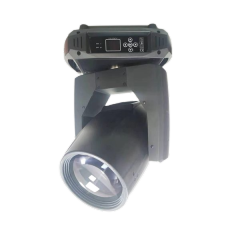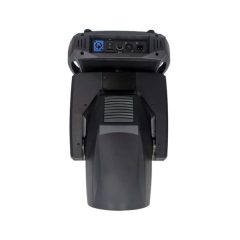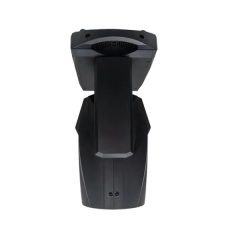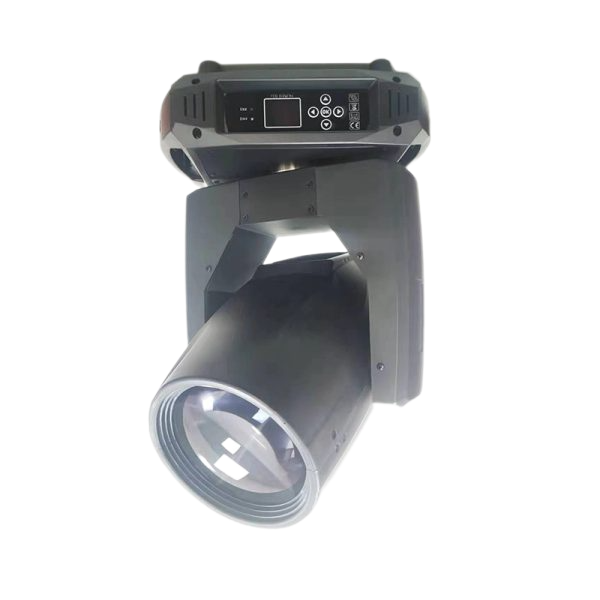
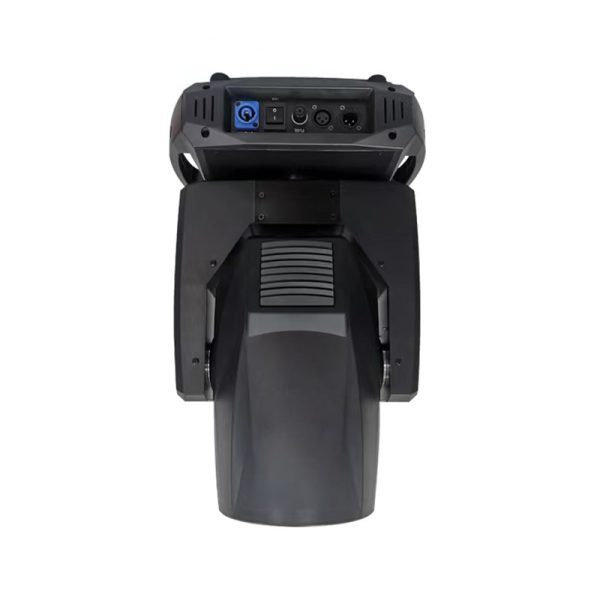
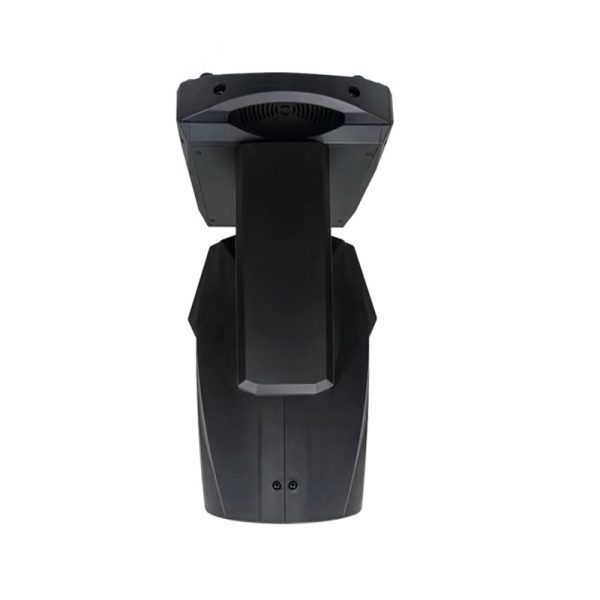
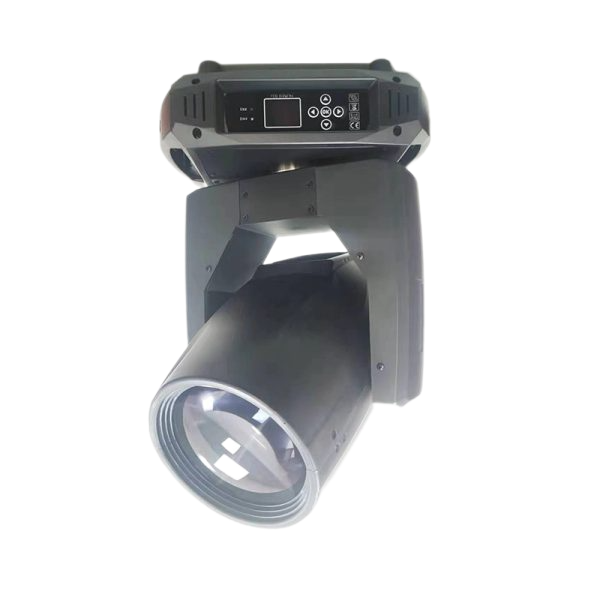
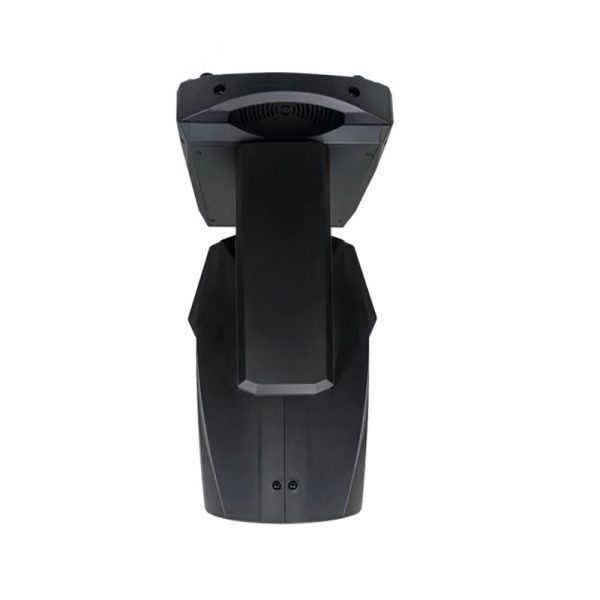
The Sword L120B is a compact beam moving head light for rooms where a full-size touring fixture will not fit. We build and test this model as an led moving head light manufacturer in Guangzhou, so the figures below describe the unit that ships rather than a hand-selected test sample. Dealers shelve it as the entry rung of the Sword family: the led moving head light you send out where a full touring fixture would be more than the job needs, and the one that stays loaded in the van for the smaller dates.
Beam angle runs from 0° to 3.8°, and the narrow end is what the fixture is for: the light leaves the lens as a near-parallel column and stays a defined shaft across the room instead of blooming into a soft cone. Open it out and the footprint widens while the edge softens slightly, which suits a unit trimmed close to the floor. A moving head beam light earns its keep on exactly this — the shape has to survive the colour wheel, the gobos and the prism without turning to mush.
Dimming is linear across the full range, so holds and slow fades track smoothly rather than stepping through visible stages. The frost filter sits in the light path and takes the hard edge off when the beam should read as a soft column over a dance floor rather than cutting a line across it. Use it sparingly in a beam rig: frost trades the crisp shaft for a gentler edge, and in most rooms the wider end of the angle does the same job with more punch.
The IP rating settles one question before any other: whether this fixture is eligible for the room at all. The Sword L120B is rated IP20, which means the housing stops fingers and solid objects from reaching the live parts and gives no protection against water whatsoever. A beam moving head light carrying that rating belongs under a solid roof — bars, clubs, theatres, school halls, studios and function rooms where nothing sprays, drips or condenses onto the rig.
That rules out more venues than most buyers expect. An open-air stage, a canopy that takes wind-driven rain, a pool deck, a beach bar, a working kitchen or a site still being plastered all sit outside the rating, not because the housing is flimsy but because water and heavy dust reach the optics and the electronics through the vents. Haze and fog in a closed room are fine; a mister or a water effect aimed at the rig is not. If the room runs unusually hot, cold or humid, ask us for the operating range before you commit the fixture to it.
Ventilation belongs to the same decision. The housing is vented for cooling, so the unit needs clear air around it — not boxed in between cases, not pressed against a drape, and not run under a cover between shows. In a dusty room, put the lens and the fan path on the room's cleaning routine instead of waiting for output to drop.
Where the job is outdoors or in a wet room, this is the wrong model and no amount of sheltering turns it into an outdoor unit. The Archi 461B (IP55) and Archi 461BSW (IP65) in our range take that work, and the Ommatea P1940M is rated IP65 for fixed outdoor installation — send us the venue and we will point you to the right moving head stage light rather than sell you one that fails its first rainy night.
Bars, clubs and mobile rigs are where most of these end up. Two units on a bar truss over the floor, a pair either side of a small stage, or four in a line behind the booth gives crossing beams and a prism fan without an operator glued to the desk all night — this is the sort of dj moving head light that gets programmed once and then runs on a handful of cues.
Small theatres, school halls and multi-purpose rooms get a different benefit: a real beam on a stage that cannot take a heavy touring unit, plus gobos for projection between scenes. There, a moving head stage light also has to be practical for whoever runs the room — noise under open microphones matters, so test a unit in the space before you commit a full rig, and keep the cue list short enough for a duty technician to recall.
Sizing is the practical question. Two units cover a bar floor and a small stage, four give you crossing shafts and a prism fan, and eight start to look like a proper rig that wants a desk and an operator. If you are lighting a room for the first time, send us the plan and the trim height and we will tell you what the geometry supports.
- 120 W LED module. A single 120 W LED engine rated 6500–8000 K — cool white, so the colour wheel reads crisply and the beam stays visible in light haze instead of washing out. - 20,000-hour rating. Quoted LED life is 20,000 hours, with no discharge lamp to replace mid-season and no lamp hours to log between shows. - 200 W at the wall. The fixture draws 200 W from AC110–240 V at 50/60 Hz, so rig power is easy to total and the number does not drift as the source ages.
No lamp stock to carry. Because it is an led moving head light rather than a discharge fixture, there is no spare lamp on the shelf and no colour shift from a lamp approaching end of life.
Stable modules between batches. We build to a fixed module specification at our moving head light factory, so a replacement light engine matches the one already in your rig instead of being a near-equivalent.
No warm-up wait. Output is there from the first cue, which matters on a menu of short sets where the rig is blacked out between songs.
| Parameter | Value |
|---|---|
| Input voltage | AC110–240 V, 50/60 Hz |
| Power consumption | 200 W |
| Light source | 120 W LED module, 6500–8000 K, 20,000-hour life |
| Beam angle | 0°–3.8° |
| Dimming | Linear, 0–100% |
| Colour wheel | 12 colours + open, half-colour and flow effect |
| Six-colour wheel | Six colour combinations |
| Gobo wheel | 15 fixed gobos + open, jitter and flowing-water effect |
| Prism | 8-facet and honeycomb, bidirectional rotation |
| Frost | Yes |
| DMX channels | 16 |
| IP rating | IP20 |
| Dimensions | 32 × 24 × 50 cm |
| Net weight | 12 kg |
More than 30 engineers with an average of 15+ years in professional lighting stand behind every order — the same people who answer your technical questions. Tell us your venue, rigging height, throw distance and existing control setup; we help match models, check protocol and channel fit, and build a package that works as one system. If a fixture misbehaves on site, we work through the fault with you and sort out spares. Installation and commissioning guidance come with the order. Founded in 2016, exporting since 2022, LITEVISION serves buyers in more than 80 countries from offices in the USA, Taiwan, Mexico and China.
- Components checked into the line. LED modules, drivers, pan and tilt motors, prisms and the colour and gobo wheels are inspected as they arrive, so a production run is never built around a weak component.
Every fixture run on the bench. Each unit is powered and cycled through its functions before packing — pan and tilt calibration, colour and gobo wheel indexing, prism rotation, frost in and out, linear dimming, and addressing from the top-panel menu. A dmx moving head light that will not hold an address does not ship.
Channel map held steady. The 16-channel map is fixed for this model and the firmware version is kept consistent between runs, so a second order patches exactly like the first. Ask which chart matches your production batch.
Serial numbers trace the build. The serial on the fixture and on the carton ties the unit to its inspection record — quote it in any claim and there is no argument about which fixture came from where.
Transit damage and dead on arrival. Open the carton and check the fixture before it goes on a truss. Photograph the carton and the unit if anything has taken a knock and report it straight away; the handling route for damaged and faulty units is set out in the warranty and returns policy.
Warranty terms before you confirm. Period, covered parts and exclusions are issued with the order — request the current version and read it against the promise you make to your own customers, because impact damage, water ingress and third-party repair normally sit outside cover.
Spares worth keeping on the shelf. The LED module, prism assemblies, colour and gobo wheels and fans are the parts that wear; tell us how many fixtures you run and we will quote a spares list alongside the order.
One build across the season. As an led moving head light manufacturer we keep the module specification and menu structure identical between runs, so a fleet bought across two orders still behaves as one rig.